Stagnant Physical Activity Levels and Public Health Impacts
Source:The Hindu ↗
Why It Matters
The article highlights the crucial intersection of public health and climate action. For UPSC aspirants, it demonstrates how shifting from motorized to active transport (NMT) serves as a multi-sectoral solution, linking GS2 health challenges (lifestyle diseases) with GS3 environmental concerns (emissions) and GS1/GS3 urban infrastructure policies.
Summary
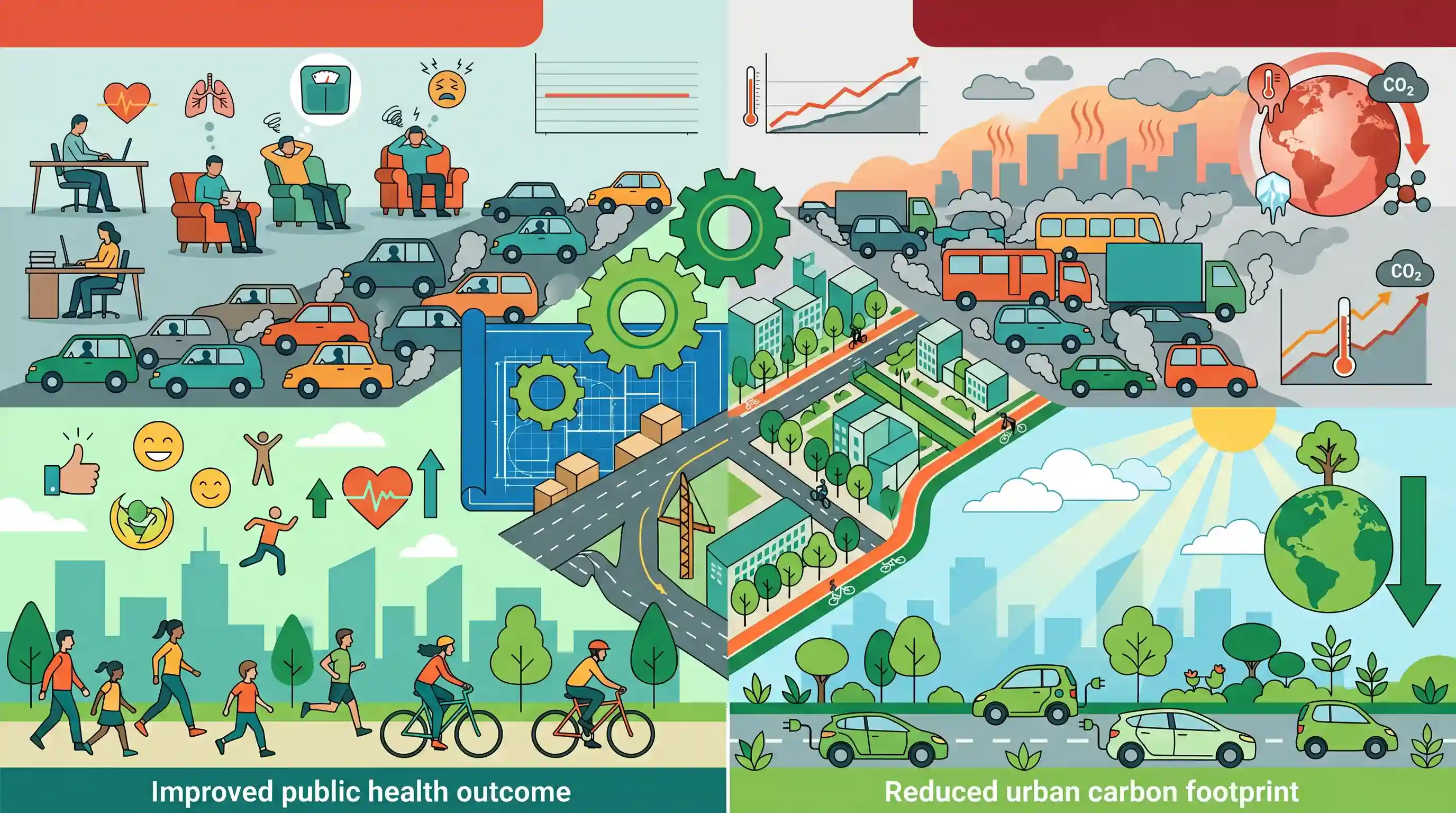
Global physical activity levels have stagnated over the past two decades, exacerbating the burden of non-communicable diseases (NCDs) and hindering climate change mitigation efforts. The reliance on motorized transport instead of active mobility (walking and cycling) contributes significantly to both sedentary lifestyles and rising greenhouse gas emissions. Integrated urban planning that prioritizes non-motorized transport infrastructure is essential for generating the dual co-benefits of improving public health and reducing urban carbon footprints.
Key Points
- Global physical activity levels have stagnated over the last 20 years, leading to a rise in non-communicable diseases (NCDs) and straining public health systems.
- Heavy reliance on private motorized vehicles contributes heavily to both sedentary lifestyles and greenhouse gas (GHG) emissions.
- Active transport (walking and cycling) offers dual co-benefits: improving population health through exercise and mitigating climate change by lowering transport emissions.
- Addressing this crisis requires urban planning that shifts away from car-centric development toward non-motorized transport (NMT) infrastructure and accessible public transit.
- Achieving global health targets demands integrated policymaking across the public health, urban development, and environmental sectors.
Important Terms
National Urban Transport Policy (NUTP)

An Indian policy framework (2006/2014) prioritizing "moving people" over "moving vehicles," emphasizing public transport and non-motorized infrastructure for sustainable urban mobility.
UPSC context
GS Paper 3 (Infrastructure/Urbanization); tests strategies for sustainable city planning and reducing urban carbon footprints.
Non-communicable Diseases (NCDs)
Chronic, non-contagious medical conditions like heart disease and diabetes, often caused by lifestyle factors such as physical inactivity, tobacco use, and unhealthy diets.
UPSC context
GS Paper 2 (Social Justice/Health); tests knowledge of India's health burden and preventive healthcare policies.
Non-Motorized Transport (NMT)
Transport modes powered by human activity, primarily walking and cycling. These are zero-emission, cost-effective, and provide significant health "co-benefits" by promoting exercise.
UPSC context
GS Paper 3 (Environment/Infrastructure); highlights low-carbon mobility solutions and active lifestyles in urban planning.
Smart Cities Mission
A Government of India initiative (2015) to develop 100 citizen-friendly cities using smart solutions like ICT, efficient mobility, and sustainable infrastructure.
UPSC context
GS Paper 2/3 (Governance/Urbanization); relevant for discussing urban renewal and achieving Sustainable Development Goals.
World Health Organization (WHO)
A specialized UN agency for international public health that sets global standards, coordinates disease responses, and monitors health trends like physical activity levels.
UPSC context
GS Paper 2 (International Institutions); critical for analyzing global health governance and international NCD strategies.
Active Mobility
Human-powered transportation, such as walking and cycling, providing dual benefits of improving personal health and reducing carbon footprints simultaneously.
UPSC context
GS Paper 3 (Environment/Health); relates to climate mitigation through behavioral shifts and "co-benefit" strategies.
Prelims Trap
The National Urban Transport Policy primarily mandates the transition to Electric Vehicles to reduce urban emissions.
NUTP’s core philosophy is "moving people, not vehicles." It focuses on equitable road space allocation, public transit, and non-motorized transport (NMT), rather than just swapping combustion engines for EVs.
Static Concepts Connected
What are the core principles of India's National Urban Transport Policy (NUTP)?
- Moving People: Prioritizes the efficient movement of people rather than the movement of vehicles, aiming for equitable allocation of road space.
- NMT Priority: Mandates dedicated, safe infrastructure for Non-Motorized Transport (NMT) like walking and cycling to promote active mobility.
- Transit-Oriented Development: Integrates land use and transport planning (Transit-Oriented Development) to make public transit accessible, efficient, and financially viable.
What defines India's Non-Communicable Disease (NCD) burden?
- High Mortality: NCDs, predominantly cardiovascular diseases, respiratory illnesses, and diabetes, account for over 60% of all deaths in India.
- Primary Risk Factors: Physical inactivity, unhealthy diets, tobacco, and harmful alcohol use are the four major behavioral risk factors driving the epidemic.
- NP-NCD: The National Programme for Prevention & Control of Non-Communicable Diseases (NP-NCD) targets early diagnosis, screening, and decentralized management.
Cross-Topic Patterns
Health-Climate Co-benefits
Active mobility creates dual co-benefits by intersecting SDG 3 (Health) with SDG 13 (Climate). Reducing vehicular reliance directly lowers both GHG footprints and the NCD burden stemming from sedentary lifestyles.
Complete Streets in Smart Cities
The Smart Cities Mission emphasizes "Complete Streets," shifting urban design away from car-centric infrastructure toward democratized road spaces featuring pedestrian walkways, cycling tracks, and accessible public transit.

Urban transport, climate co-benefits, and NCDs will likely combine in a GS-3 Mains question on sustainable urban infrastructure by 2026.
Linked PYQs · 4
Linked PYQs · 4
- 2014MainsGS3
National Urban Transport Policy emphasises on 'moving people' instead of 'moving vehicles'. Discuss critically the success of the various strategies of the Government in this regard.
- 2019MainsGS1
How is efficient and affordable urban mass transport key to the rapid economic development of India?
- 2022PrelimsGS1
In the context of WHO Air Quality Guidelines, consider the following statements: 1. The 24-hour mean of PM2.5 should not exceed 15 µg/m³ and annual mean of PM2.5 should not exceed 5 µg/m³. 2. In a year, the highest levels of ozone pollution occur during the periods of inclement weather. 3. PM10 can penetrate the lung barrier and enter the bloodstream. 4. Excessive ozone in the air can trigger asthma. Which of the statements given above are correct?
- 2020MainsGS2
In order to enhance the prospects of social development, sound and adequate health care policies are needed particularly in the fields of geriatric and maternal health care. Discuss.
