Integrating Physical Activity and Climate Action for Public Health
Source:The Hindu ↗
Why It Matters
The intersection of urban planning, public health, and climate action is critical for sustainable development. Understanding the dual benefits of active transport can help policymakers design integrated interventions that lower greenhouse gas emissions, combat non-communicable diseases, and address social inequalities in health outcomes.
Summary
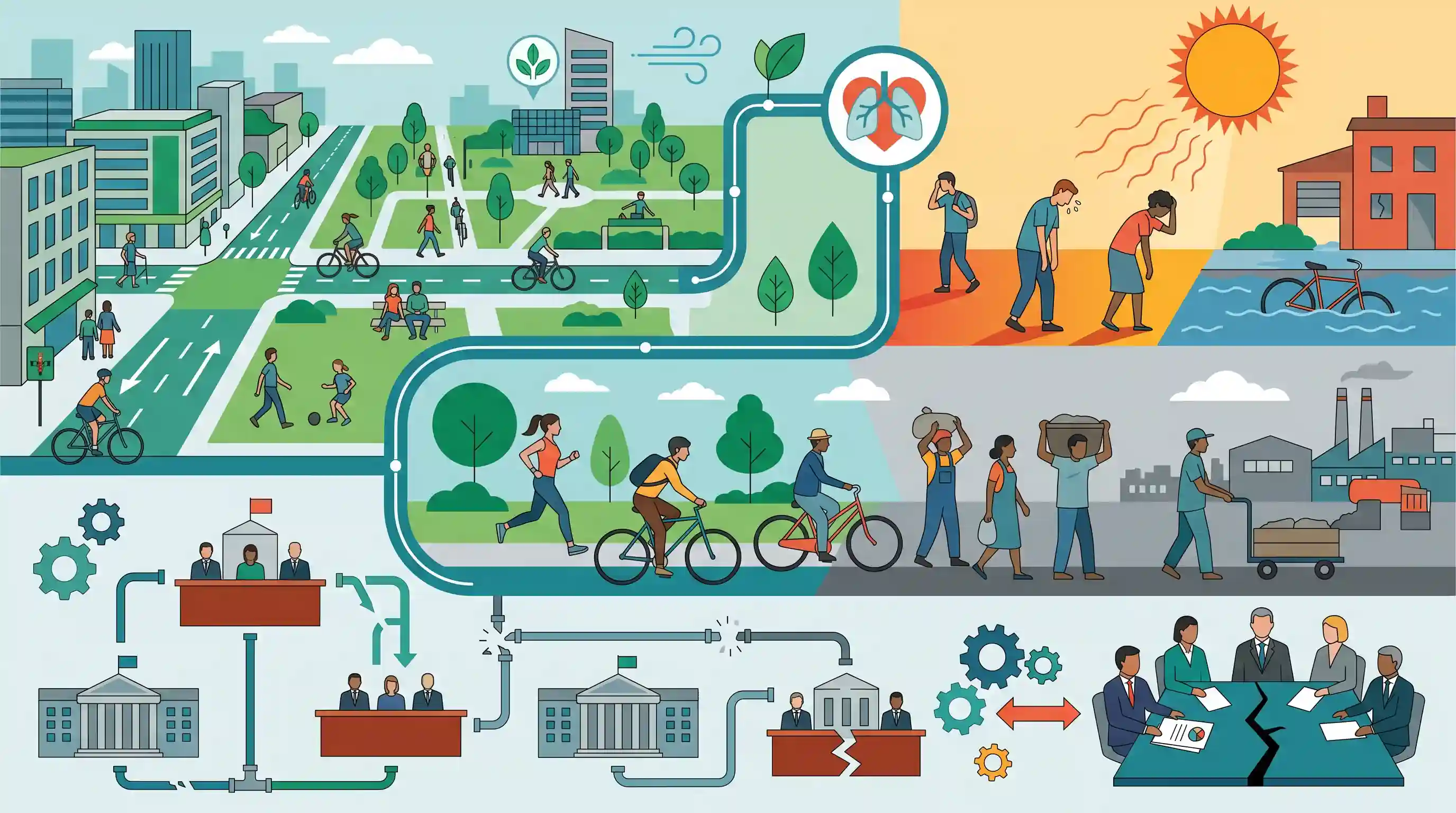
Recent studies published in Nature Health and Nature Medicine highlight that aligning physical activity initiatives with climate action yields synergistic benefits for both public health and environmental sustainability. While active transport—such as walking and cycling—and better urban design help mitigate climate change by reducing motor transport emissions, extreme weather events like heatwaves and floods increasingly threaten outdoor physical activity. The research further reveals stark global inequalities: socially advantaged groups engage in active leisure by choice, while disadvantaged groups rely on active labor out of economic necessity. Additionally, the studies underscore a significant policy implementation gap, citing low political priority and a lack of cross-sectoral collaboration among government departments as key barriers to achieving integrated public health and climate goals.
Key Points
- Integrating physical activity with climate action initiatives promotes both public health and environmental sustainability through active transport and low-emissions urban design.
- Climate change directly undermines physical activity by making outdoor environments unsafe due to extreme weather events such as heatwaves and urban flooding.
- Significant global socio-economic inequalities exist in physical activity; affluent individuals predominantly engage in active leisure by choice, whereas disadvantaged populations engage in active labor out of economic necessity.
- Despite widespread formulation of physical activity policies globally, implementation is severely limited by low political priority and a lack of cross-sectoral collaboration across health, education, and transport departments.
Important Terms
Active Transport

Human-powered modes of transportation, such as walking and cycling, used for commuting and daily errands.
UPSC context
GS-3 (Infrastructure/Environment); essential for sustainable urban planning, reducing carbon footprints, and improving public health.
Climate Change Mitigation
Efforts to reduce or prevent the emission of greenhouse gases to limit the extent of global warming.
UPSC context
GS-3 (Environment); core to India’s Net Zero 2070 goals and international environmental agreements.
Cross-sectoral Collaboration
A governance approach where different government departments or sectors work together to address complex, overlapping challenges.
UPSC context
GS-2 (Governance); critical for overcoming administrative silos and implementing integrated public health and environmental policies.
Social Inequality
Disparities in access to resources and exposure to risks, often reflected in 'choice-based' versus 'necessity-based' behaviors.
UPSC context
GS-1 (Society) & GS-2 (Social Justice); concerns the equitable distribution of health and climate benefits among vulnerable sections.
Nature Health
A peer-reviewed journal (launching 2026) within the Nature Portfolio focusing on public, global, and environmental health.
UPSC context
GS-2 (Health/Policy); provides high-level scientific evidence for population health and climate resilience strategies.
Nature Medicine
A premier peer-reviewed journal that publishes high-impact translational and clinical research in medicine.
UPSC context
GS-2 (Health); influential in setting global medical standards and driving evidence-based public health interventions.
Prelims Trap
High physical activity uniformly indicates positive health outcomes across all socio-economic strata.
UPSC may frame high physical activity as universally positive. However, for disadvantaged groups, it is often hazardous 'active labor' out of necessity, unlike affluent 'active leisure'.
Static Concepts Connected
What are the core principles of India's National Urban Transport Policy (NUTP)?
- People over vehicles: Focuses on moving people rather than moving vehicles by prioritizing public transit.
- NMT Prioritization: Promotes Non-Motorized Transport (NMT) like walking and cycling through dedicated, safe infrastructure.
- Land Use Integration: Integrates land use with transport planning (Transit-Oriented Development) to minimize travel distances.
How do Urban Heat Islands (UHI) exacerbate climate-health risks?
- Albedo reduction: Concrete and asphalt absorb and retain solar radiation, drastically reducing urban albedo compared to rural areas.
- Anthropogenic heat: Vehicular emissions, industrial activity, and AC units release trapped heat directly into city microclimates.
- Health vulnerability: Increases thermal stress and heatstroke vulnerability, specifically threatening outdoor active labor and active transport.
Cross-Topic Patterns
Climate change as public health crisis
Links GS2 (Health) and GS3 (Environment). Rising temperatures restrict Non-Motorized Transport (NMT) and exacerbate NCDs, highlighting the need for climate-resilient urban planning.
Socio-economic divide in climate vulnerability
Connects GS1 (Society) with climate impacts. Disadvantaged sections endure forced 'active labor' under extreme heat, contrasting sharply with affluent indoor 'active leisure' choices.

Expect a GS3 Mains question on integrating the National Urban Transport Policy with climate adaptation to mitigate urban heat risks.
Linked PYQs · 5
Linked PYQs · 5
- 2024MainsGS3
Flooding in urban areas is an emerging climate-induced disaster. Discuss the causes of this disaster. Mention the features of two such major floods in the last two decades in India. Describe the policies and frameworks in India that aim at tackling such floods.
- 2022MainsGS3
Discuss global warming and mention its effects on the global climate. Explain the control measures to bring down the level of greenhouse gases which cause global warming, in the light of the Kyoto Protocol, 1997.
- 2017MainsGS3
'Climate change' is a global problem. How India will be affected by climate change? How Himalayan and coastal states of India will be affected by climate change?
- 2020MainsGS2
In order to enhance the prospects of social development, sound and adequate health care policies are needed particularly in the fields of geriatric and maternal health care. Discuss.
- 2024MainsGS1
Despite comprehensive policies for equity and social justice, underprivileged sections are not yet getting the full benefits of affirmative action envisaged by the Constitution. Comment.
