Madhya Pradesh Police Portal for Court Cases and Contempt Tracking
Source:freepressjournal ↗
Why It Matters
It highlights a key e-governance initiative in Madhya Pradesh aimed at improving police administration and legal compliance. Understanding such tech-driven administrative reforms (like CMTS and MPSEDC's role) is crucial for MPPSC aspirants studying state governance.
Summary
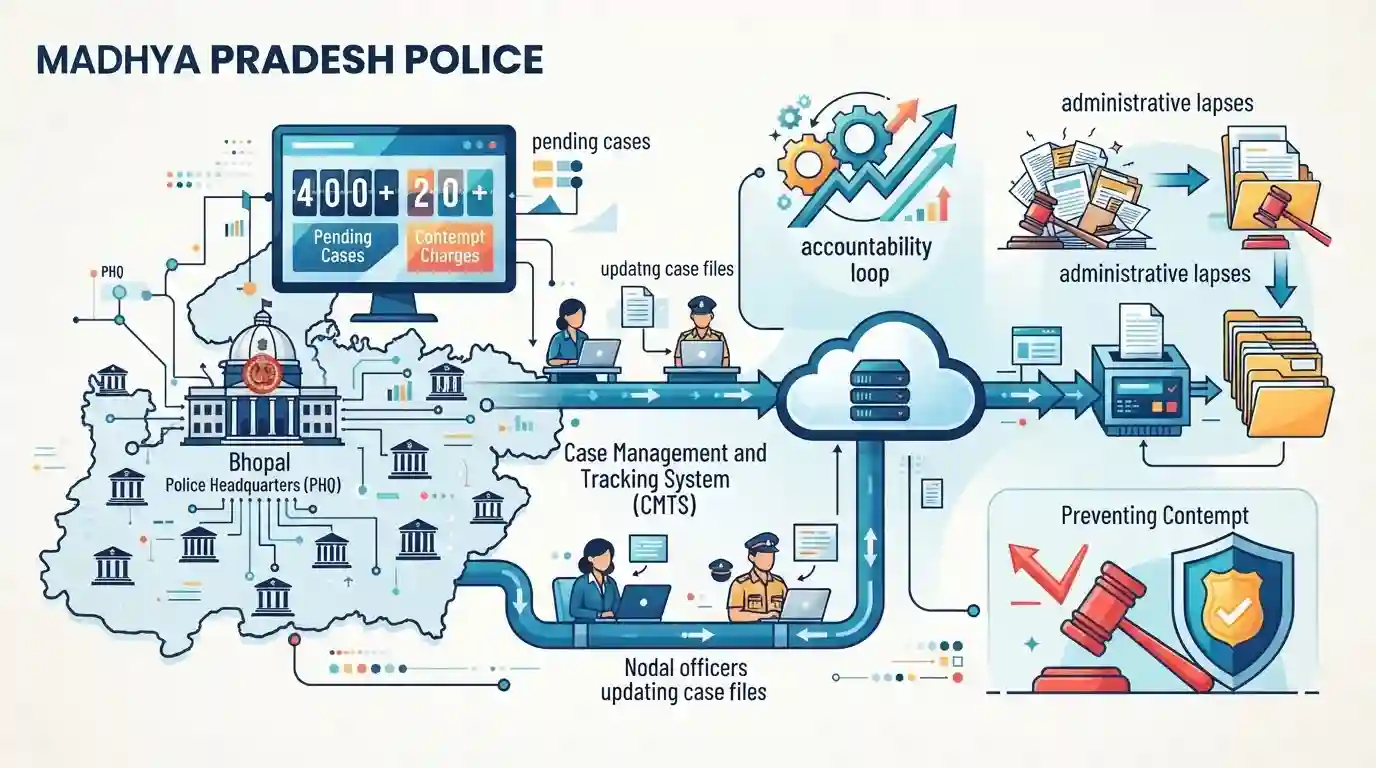
The Madhya Pradesh Police Headquarters (PHQ) in Bhopal is launching an online portal to track approximately 4,000 pending court cases, including 200 contempt of court charges. Developed by the MP State Electronics Development Corporation (MPSEDC) using the Case Management and Tracking System (CMTS), the portal will require nodal officers to provide regular updates on legal proceedings. This e-governance initiative aims to improve accountability, streamline the handling of writ petitions, and prevent further administrative lapses and contempt charges against police officials.
Key Points
- The Madhya Pradesh Police Headquarters (PHQ) is developing a dedicated web portal to monitor and track court cases involving the police department.
- The portal aims to address the backlog of approximately 4,000 writ petitions and prevent lapses that have led to around 200 pending contempt of court cases.
- The Madhya Pradesh State Electronics Development Corporation (MPSEDC) is preparing the portal based on the Case Management and Tracking System (CMTS).
- Officers in charge (OICs) and appointed nodal officers will be required to regularly update case statuses and documents to ensure timely compliance with court orders.
Important Terms
Case Management and Tracking System (CMTS)

An e-governance software solution used by the state to digitize, securely track, and manage workflows for legal proceedings and pending court cases to prevent administrative delays.
UPSC context
Relevant for MPPSC GS Paper 2 (E-Governance) as an example of leveraging technology to enhance administrative accountability.
Madhya Pradesh State Electronics Development Corporation (MPSEDC)
A state government nodal agency responsible for implementing IT policies, building e-governance infrastructure, and driving digital transformation initiatives across Madhya Pradesh.
UPSC context
Crucial for MPPSC GS Paper 2 & 3 (E-Governance, Science & Tech) to understand the institutions executing digital governance.
Madhya Pradesh Police Headquarters (PHQ)
The central administrative and command hub of the Madhya Pradesh Police, located in Bhopal, tasked with statewide law enforcement strategy, operations, and inter-departmental legal compliance.
UPSC context
Important for MPPSC GS Paper 2 (Public Administration), illustrating state-level law enforcement administration and institutional accountability.
Contempt of Court
The offense of being disobedient to or disrespecting a court of law. In this context, it refers to police officials failing to comply with binding judicial directives or deadlines.
UPSC context
A key concept in MPPSC GS Paper 2 (Judicial System), testing knowledge of judicial powers over administrative lapses.
Writ Petition
A formal legal order issued by a higher court directing a government authority or official to act (or cease acting) in a specific way, often to enforce fundamental rights.
UPSC context
Core topic in MPPSC GS Paper 2 (Polity), specifically Articles 32 and 226 concerning constitutional remedies and judicial review.
Prelims Trap
"Contempt of Court is a purely statutory provision governed by the Contempt of Courts Act, 1971, with no constitutional backing."
While the Contempt of Courts Act, 1971 is statutory, the actual power to punish for contempt is constitutional, vested in the Supreme Court (Article 129) and High Courts (Article 215).
Static Concepts Connected
What are the constitutional and statutory bases for Contempt of Court in India?
- Constitutional power: Article 129 (Supreme Court) and Article 215 (High Courts) explicitly grant these courts the power to punish for contempt of themselves.
- Statutory framework: The Contempt of Courts Act, 1971 regulates the procedure and defines the limits of this power.
- Types of Contempt: Categorized into Civil (willful disobedience of judgments/orders) and Criminal (scandalizing or lowering the authority of the court).
What is the role of MPSEDC in Madhya Pradesh's administration?
- Nodal IT Agency: Incorporated in 1983, it serves as the nodal agency for promoting Information Technology and implementing e-Governance in Madhya Pradesh.
- Key Projects: It implements major state digital infrastructure, including the State Data Centre (SDC), State Wide Area Network (SWAN), and CM Helpline.
Cross-Topic Patterns
e-Governance as an administrative reform
The CMTS portal aligns with the broader national push for police modernization (like CCTNS), utilizing digital tracking to minimize bureaucratic lethargy and enhance accountability in public administration.
Executive lapses driving judicial pendency
The accumulation of 4,000 police-related writ petitions highlights the chronic delay in executive compliance, which frequently forces the judiciary to invoke contempt powers to ensure enforcement.

MPPSC often tests state IT bodies; expect a direct question identifying MPSEDC as the nodal agency for Madhya Pradesh e-governance portals.
Linked PYQs · 2
Linked PYQs · 2
- 2023MPPSC_PRELIMSGS1
Which of the following is not an E–procurement portal?
- 2025MPPSC_PRELIMSGS1
The compendium of Mission Mode Projects under National e-Governance Plan (NeGP) is known as:
