Digital Forensics Help Security Forces Identify Pahalgam Terrorists
Source:The Hindu ↗
Why It Matters
Demonstrates the evolving technological tactics of cross-border terrorists (like utilizing LoRa radios and deep forest topography) and the concurrent adaptation by Indian security agencies through indigenous technological countermeasures and digital forensics. Highly relevant for GS-3 Internal Security and counter-terrorism case studies.
Summary
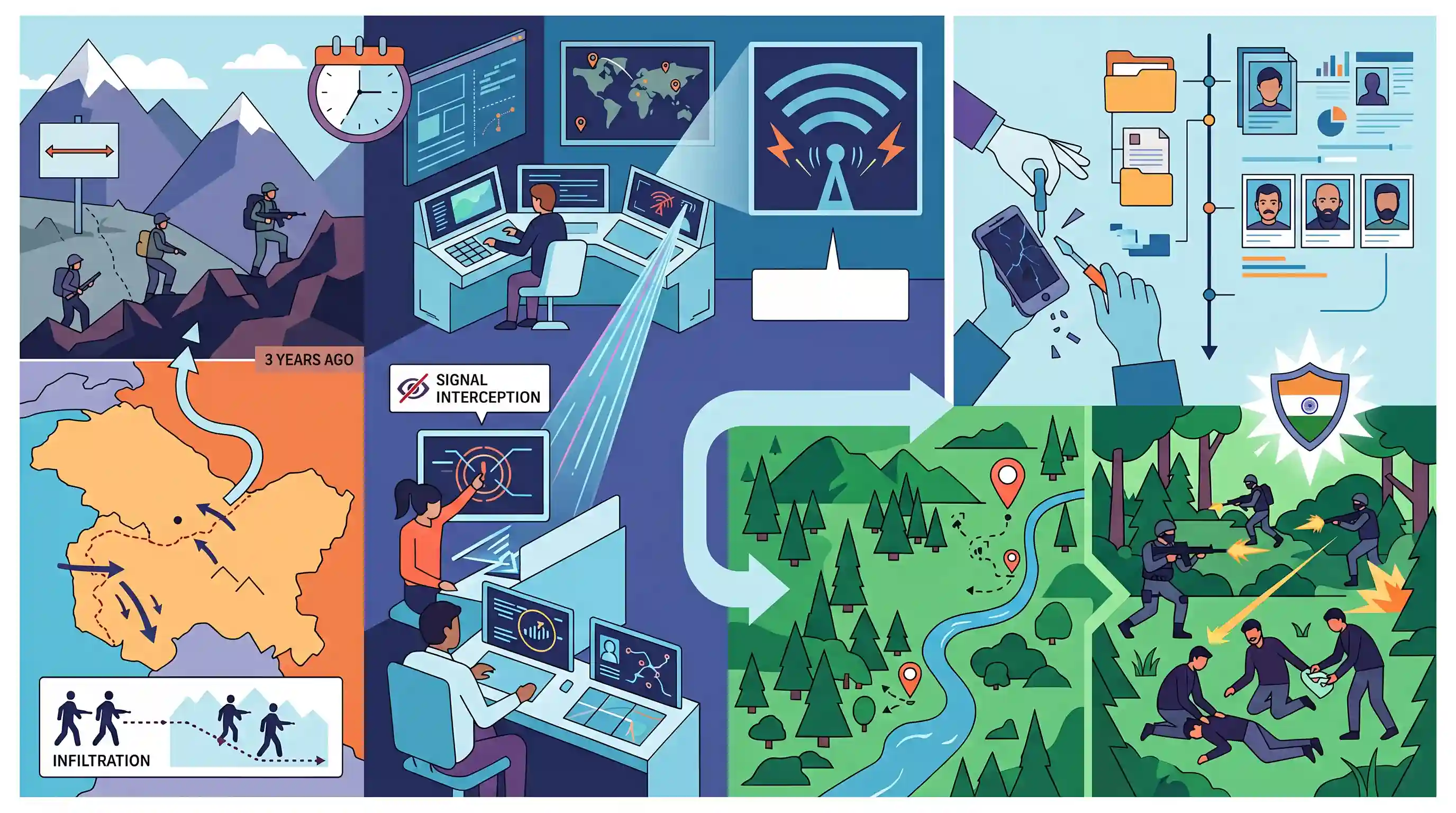
Security forces successfully eliminated three Lashkar-e-Taiba (LeT) terrorists involved in the Pahalgam attack by utilizing digital forensics and indigenous signal-tracking technology. The terrorists, part of a larger heavily-armed group that infiltrated across the Pir Panjal three years ago, were tracked to the Dachigam forest after intelligence agencies intercepted their LoRa (long-range) wireless communications. Photos recovered from a mobile phone in a 2024 encounter were key to identifying the perpetrators.
Key Points
- Three Pahalgam terrorists belonging to Lashkar-e-Taiba (LeT) were eliminated during Operation Mahadev in the Dachigam forest.
- Identification was facilitated by matching photos recovered from a slain terrorist's phone in a 2024 encounter with eyewitness accounts from the Baisaran meadow attack.
- The terrorists utilized LoRa (long-range) wireless modules for communication to evade traditional cellular tracking.
- Indian intelligence and armed forces deployed indigenous ultra-signal capturing technology to intercept the LoRa communications and pinpoint their forest hideout.
- The eliminated terrorists were part of a hardened group of 20-25 Pakistani infiltrators operating across the Pir Panjal and south Kashmir forests, responsible for roughly 135 security personnel casualties since 2021.
Important Terms
Operation Mahadev

A specific counter-terrorism operation (2025) by Indian security forces that identified and eliminated three Lashkar-e-Taiba (LeT) terrorists responsible for the deadly Pahalgam attack.
UPSC context
GS Paper III: Internal Security; tests knowledge of specific CT operations and the evolution of intelligence-led warfare in J&K.
Lashkar-e-Taiba (LeT)
A Pakistan-based UN-designated terrorist organization primarily active in Jammu and Kashmir, responsible for major attacks including the 2008 Mumbai attacks and the Pahalgam incident.
UPSC context
GS Paper III: Internal Security — Terrorism; tests understanding of major terror outfits and cross-border security threats.
LoRa (Long Range) Technology
A low-power, wide-area network (LPWAN) protocol used for wireless communication; recently adapted by terror modules for covert, long-range signaling to bypass conventional surveillance.
UPSC context
GS Paper III: Science & Technology and Internal Security; tests awareness of emerging technologies used by non-state actors.
Digital Forensics
The branch of forensic science focused on recovering and investigating data from digital devices (mobiles, laptops) to establish links between terror modules and their handlers.
UPSC context
GS Paper III: Role of Technology in Security; tests understanding of modern evidence collection in counter-terrorism investigations.
Pir Panjal Range
A major mountain range in the Lesser Himalayas, crucial for J&K's security as it is frequently used by militants for cross-border infiltration into the Valley.
UPSC context
GS Paper I (Geography) and III (Security); tests knowledge of strategic terrain and its impact on border management.
Dachigam National Park
A wildlife sanctuary near Srinagar characterized by dense forests and steep terrain, often exploited as a hideout by terrorists to evade aerial and ground surveillance.
UPSC context
GS Paper I (Geography) and III (Security); relevant for environmental conservation and the "forest-based" shift in insurgency tactics.
Prelims Trap
LoRa (Long-Range) wireless technology requires active cellular networks (4G/5G) or Wi-Fi to establish communication.
LoRa operates on unlicensed sub-gigahertz radio frequencies, entirely independent of conventional cellular networks. This off-grid capability is precisely why it evades traditional cell-tower triangulation.
Static Concepts Connected
What is the habitat and conservation status of the Hangul (Kashmir Stag)?
- Primary Habitat: It is primarily restricted to Dachigam National Park in the Zabarwan Range of Jammu and Kashmir.
- Conservation Status: It is listed as Critically Endangered on the IUCN Red List and protected under Schedule I of India's Wildlife Protection Act, 1972.
- Species Profile: It is the State animal of J&K and the only surviving sub-species of the Elk/Red Deer family in India.
What is the geographical significance of the Pir Panjal Range?
- Geographic Divide: It is the largest mountain system of the Lesser Himalayas, acting as a crucial geographic divide separating the Jammu Hills from the Kashmir Valley.
- Major Passes: Key passes include Banihal, Sinthan, and Rohtang, which serve as vital transit and historic infiltration routes.
- River Systems: It dictates regional drainage patterns, with the Jhelum and Chenab rivers cutting through its rugged terrain.
Cross-Topic Patterns
Off-grid Tech + Border Security
The shift from standard cellular to off-grid communication networks like LoRa links the 'S&T in everyday life' syllabus directly to 'challenges of border area security'.
Protected Areas + Insurgency Hideouts
Dense habitats like Dachigam (Hangul) and Manas (Rhino) historically offer geographical cover for insurgents, blending biodiversity conservation challenges with internal security operations.

LoRa technology's radio frequency mechanics paired with border security implications is a high-probability multi-statement Prelims target.
Linked PYQs · 2
Linked PYQs · 2
- 2025MainsGS3
Terrorism is a global scourge. How has it manifested in India? Elaborate with contemporary examples. What are the counter measures adopted by the State? Explain.
- 2023MainsGS3
Winning of 'Hearts and Minds' in terrorism-affected areas is an essential step in restoring the trust of the population. Discuss the measures adopted by the Government in this respect as part of the conflict resolution in Jammu and Kashmir.
