AIGenerated Wildlife Images and Misinformation Risks
Source:Indian Express ↗
Why It Matters
The incident serves as a practical case study for GS3 (Science & Technology and Internal Security) regarding the real-world implications of AI misuse, deepfakes, and the role of legal frameworks like the IT Act and BNS in curbing digital misinformation.
Summary
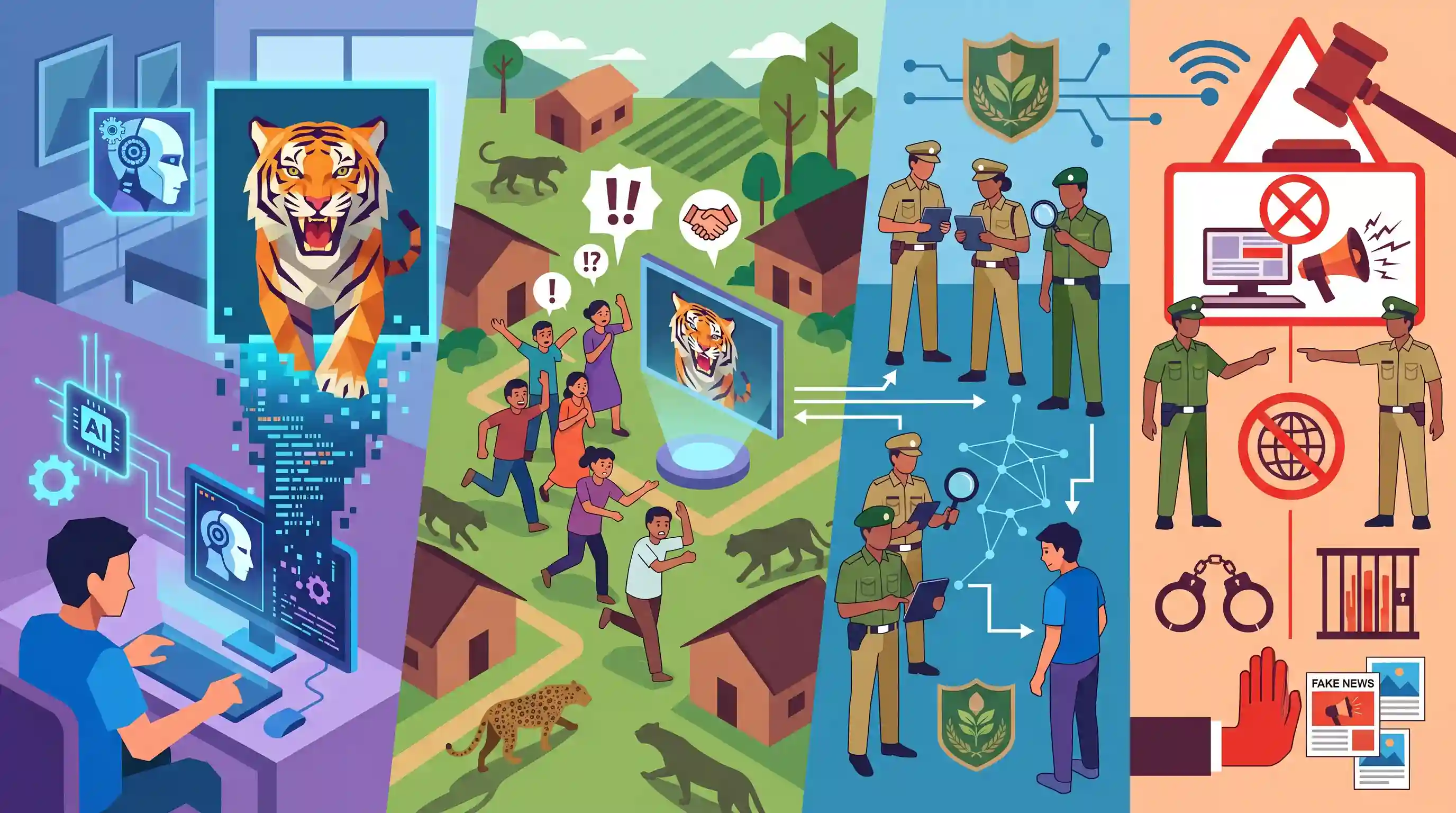
A fake, AI-generated image of a tiger in Pune's Junnar taluka triggered panic among villagers, an area already prone to human-leopard conflicts. The Forest Department investigated the matter and traced the image to a local youth who admitted to creating it with an AI tool. Authorities issued a stern warning against the dissemination of misinformation, stating that such acts would attract stringent penalties under the Bharatiya Nyaya Sanhita (BNS) and the Information Technology (IT) Act. The case underscores the growing misuse of artificial intelligence to create synthetic media that can cause real-world law and order issues.
Key Points
- An AI-generated image of a tiger circulated in Junnar, causing panic among locals who already suffer from frequent human-leopard conflicts.
- The Forest Department conducted a probe and identified a local youth who confessed to creating the fake image using an AI tool.
- Forest officials issued a warning that spreading fake information will invite strict legal action under the Bharatiya Nyaya Sanhita (BNS) and the Information Technology (IT) Act.
- The incident illustrates the tangible risks of AI misuse and synthetic media in instigating public fear and disrupting normal life in sensitive regions.
Important Terms
Bharatiya Nyaya Sanhita (BNS)

India's primary criminal code that replaced the Indian Penal Code (IPC) in 2024. It modernizes the legal framework to address contemporary crimes including terrorism and organized crime.
UPSC context
GS Paper II (Polity & Governance). Tests understanding of criminal justice reforms and new legal provisions for maintaining law and order.
Information Technology (IT) Act, 2000
The foundational law in India for cybercrime and e-commerce. It provides legal recognition for electronic records and prescribes penalties for digital offenses like data theft and identity fraud.
UPSC context
GS Paper III (Cyber Security). Relevant for discussing regulatory frameworks for the digital economy and internal security challenges.
Human-Wildlife Conflict (HWC)
Negative interactions between humans and wild animals causing loss of life, property, or livelihoods. Common in forest-adjacent areas due to habitat fragmentation and human encroachment.
UPSC context
GS Paper III (Environment & Biodiversity). Tests knowledge of conservation challenges, mitigation strategies, and the role of the Forest Department.
Deepfakes
AI-generated synthetic media (images, audio, or video) that convincingly mimic real people or objects to portray events that never occurred.
UPSC context
GS Paper III (Science & Tech / Internal Security). Tests awareness of emerging AI threats, misinformation, and ethical implications of technology.
Synthetic Media
Digital content—including text, images, and video—produced or significantly altered by artificial intelligence and machine learning algorithms.
UPSC context
GS Paper III (Science & Tech). Relevant for questions on generative AI and the impact of technological advancements on information integrity.
Prelims Trap
Digital platforms enjoy absolute immunity under the IT Act for AI-generated fake news posted by users.
Platform immunity is conditional (Safe Harbour under Section 79). It is revoked if platforms fail to remove flagged unlawful synthetic media within mandated timelines.
Static Concepts Connected
What is the 'Safe Harbour' provision for digital intermediaries?
- Section 79: Under the IT Act, it grants conditional immunity to platforms (like social media) from legal liability for third-party data or information hosted by them.
- Due Diligence: Platforms must follow IT Rules 2021; failing to remove flagged deepfakes or fake news within expedited timelines (e.g., 3 hours) strips them of this legal immunity.
Why are leopards thriving in agricultural zones like Junnar?
- Sugarcane Cover: Dense, tall cash crops like sugarcane act as surrogate forests, providing ideal breeding grounds and prolonged camouflage for the species.
- Easy Prey Base: Proximity to human settlements offers an abundance of livestock and feral dogs, sustaining high predator densities outside traditional protected areas.
Cross-Topic Patterns
Deepfakes as a public order threat
AI misuse is evolving from political misinformation to triggering localized panic, bridging cyber technology with internal security and testing the applicability of the new Bharatiya Nyaya Sanhita (BNS).
Cash crops altering wildlife behavior
Sugarcane expansion in Maharashtra inadvertently shifts leopard habitats from forests to farmlands, demonstrating how agricultural cropping patterns directly escalate human-wildlife conflict outside protected areas.

A 2026 GS3 question will likely link AI-generated synthetic media to public order challenges, testing the IT Rules' takedown efficacy.
Linked PYQs · 4
Linked PYQs · 4
- 2023MainsGS3
Introduce the concept of Artificial Intelligence (AI). How does Al help clinical diagnosis? Do you perceive any threat to privacy of the individual in the use of Al in healthcare?
- 2020MainsGS3
Discuss different types of cyber crimes and measures required to be taken to fight the menace.
- 2025PrelimsGS1
Consider the following statements: I. It is expected that Majorana 1 chip will enable quantum computing. II. Majorana 1 chip has been introduced by Amazon Web Services (AWS). III. Deep learning is a subset of machine learning. Which of the statements given above are correct?
- 2024PrelimsGS1
Consider the following statements: I. It is expected that Majorana 1 chip will enable quantum computing. II. Majorana 1 chip has been introduced by Amazon Web Services (AWS). III. Deep learning is a subset of machine learning. Which of the statements given above are correct?
