Severe earthquake impact and infrastructure vulnerability
Source:The Hindu ↗
Why It Matters
Provides a critical contemporary case study on earthquake vulnerability and the importance of disaster-resilient critical infrastructure (hospitals/bridges), directly relevant to GS1 (Physical Geography) and GS3 (Disaster Management).
Summary
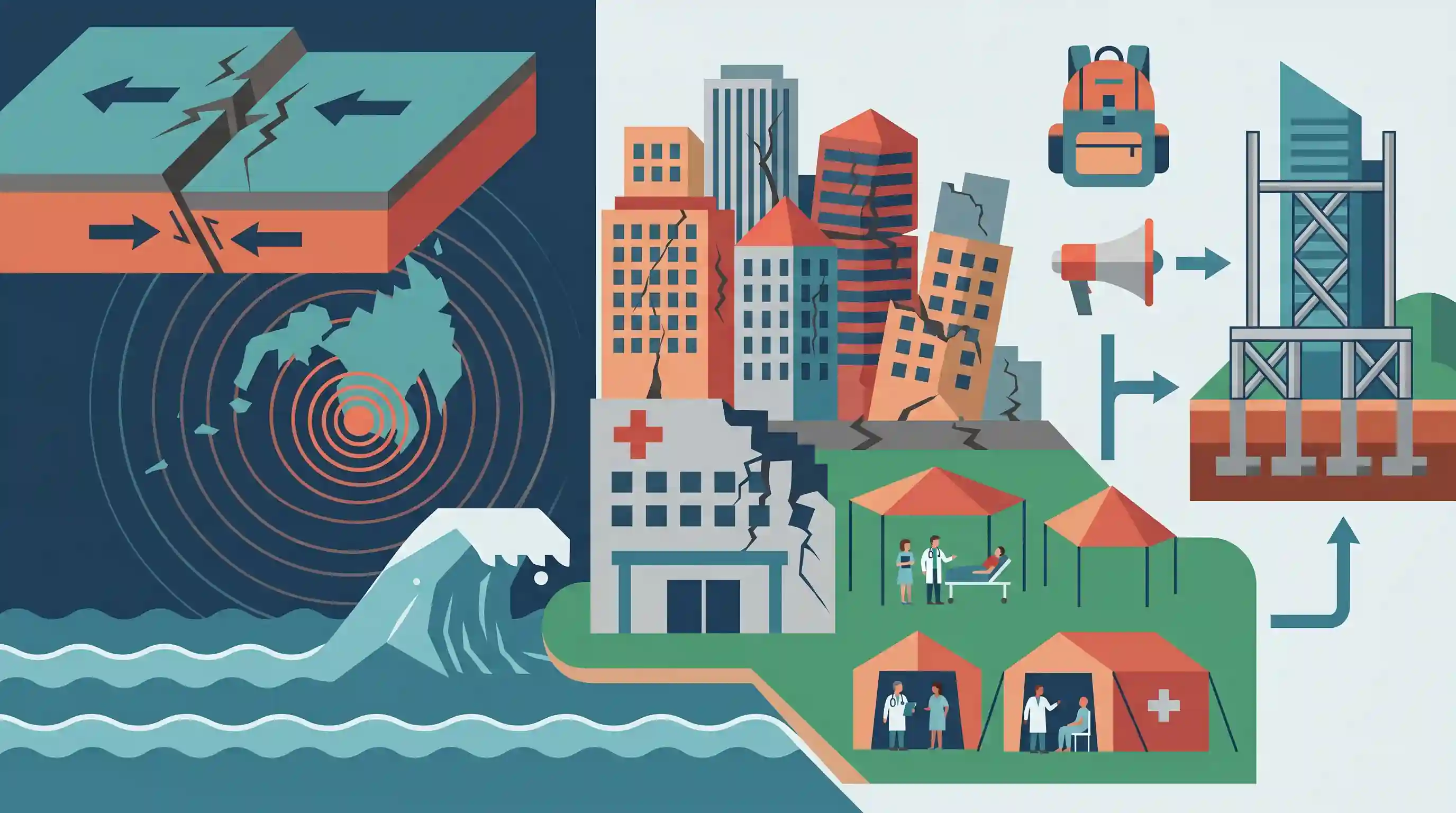
A powerful magnitude-7.8 earthquake struck the southern Philippines (Mindanao island), causing at least 41 deaths, severe infrastructure damage, and prompting temporary tsunami warnings. The severe structural damage to medical facilities in Sarangani province and General Santos city forced hospitals to operate outdoors, highlighting acute vulnerabilities in critical infrastructure. The disaster underscores the pressing need for earthquake-resilient infrastructure and robust disaster preparedness for regions situated along the seismically active Pacific Ring of Fire.
Key Points
- A devastating magnitude-7.8 earthquake struck the southern Philippines, causing over 40 fatalities and extensive destruction across Mindanao island.
- Critical infrastructure vulnerabilities were exposed as hospitals in Sarangani province and General Santos city suffered severe structural damage, forcing medical personnel to treat patients in makeshift outdoor facilities.
- The seismic event triggered landslides, power outages, and temporary tsunami warnings, highlighting the cascading hazards associated with major earthquakes.
- The disaster reiterates the extreme geographic vulnerability of the Philippines due to its position on the Pacific 'Ring of Fire' and underscores the urgent need for earthquake-resilient infrastructure.
Important Terms
Sendai Framework for Disaster Risk Reduction (SFDRR)

A 15-year UN-led international agreement (2015-2030) aimed at reducing disaster risk and losses. It emphasizes proactive risk management, "Building Back Better," and shared responsibility among stakeholders.
UPSC context
GS Paper III: Disaster Management. Tests knowledge of global frameworks, India's National Disaster Management Plan alignment, and targets for 2030.
Pacific Ring of Fire
A 40,000 km horseshoe-shaped tectonic belt encircling the Pacific Ocean, characterized by frequent earthquakes and volcanic activity due to colliding tectonic plates.
UPSC context
GS Paper I: Physical Geography. Tests understanding of plate tectonics, seismic belts, and the distribution of natural hazards globally.
Coalition for Disaster Resilient Infrastructure (CDRI)
A global partnership launched by India in 2019 to promote infrastructure systems that can withstand and recover quickly from climate and disaster risks.
UPSC context
GS Paper II/III: International Relations & Infrastructure. Tests India’s leadership in global climate action and disaster preparedness initiatives.
Tsunami Early Warning System (TEWS)
A network of sensors and communication tools (like DART buoys) designed to detect undersea earthquakes and sea-level changes to provide advance notice of incoming waves.
UPSC context
GS Paper III: Science & Tech / Disaster Management. Tests knowledge of INCOIS (Hyderabad) and India's maritime safety technology.
Subduction Zone
A geological region where one tectonic plate sinks beneath another, often creating deep ocean trenches and causing some of the world's most powerful earthquakes.
UPSC context
GS Paper I: Physical Geography. Tests technical knowledge of plate movements and the mechanical causes of tsunamigenic earthquakes.
Prelims Trap
"CDRI is a specialized UN agency established to legally enforce the Sendai Framework for Disaster Risk Reduction."
CDRI is an India-led global partnership, not a UN agency. Furthermore, the Sendai Framework is a voluntary, non-binding agreement, not a legally enforceable treaty.
Static Concepts Connected
What geological processes form the Pacific Ring of Fire?
- Convergent boundaries: Formed predominantly by subduction zones where denser oceanic tectonic plates are forced under lighter continental or other oceanic plates.
- Magma generation: The subducting plate melts at depth, creating buoyant magma that rises to form extensive volcanic island arcs like the Philippines.
- High seismicity: Friction along these subduction faults accumulates massive tectonic stress, releasing suddenly to trigger the world's most powerful earthquakes and tsunamis.
What is Sendai Target D and how does India contribute to it?
- Target D objective: Aims to substantially reduce disaster damage to critical infrastructure and disruption of basic services, notably health and educational facilities, by 2030.
- India's CDRI: Launched by India in 2019, the Coalition for Disaster Resilient Infrastructure (CDRI) operationalizes this target by promoting disaster-proof infrastructure planning globally.
Cross-Topic Patterns
Mindanao: Tectonics meets geopolitics
Mindanao's extreme seismic vulnerability overlays its geopolitical significance near the contested South China Sea and local insurgency, making it a high-probability multidimensional map location for Prelims.
Cascading hazards in GS3
The shift from single-hazard to multi-hazard 'cascading' events (an earthquake triggering landslides, tsunamis, and grid failures) is the new focal point for NDMA guidelines and GS3 disaster preparedness.

Expect 2026 Prelims to test CDRI's structure, or a GS3 Mains question linking Sendai Target D to resilient health infrastructure.
Linked PYQs · 5
Linked PYQs · 5
- 2021MainsGS3
Discuss about the vulnerability of India to earthquake related hazards. Give examples including the salient features of major disasters caused by earthquakes in different parts of India during the last three decades.
- 2019MainsGS3
Vulnerability is an essential element for defining disaster impacts and its threat to people. How and in what ways can vulnerability to disasters be characterized? Discuss different types of vulnerability with reference to disasters.
- 2024MainsGS3
What is disaster resilience? How is it determined? Describe various elements of a resilience framework. Also mention the global targets of Sendai Framework for Disaster Risk Reduction (2015–2030).
- 2013MainsGS3
How important are vulnerability and risk assessment for pre-disaster management ? As an administrator, what are key areas that you would focus on in a Disaster Management System.
- 2025MainsGS1
What are Tsunamis? How and where are they formed? What are their consequences? Explain with examples.
