Philippine agency flags suspected China election interference
Source:The Hindu ↗
Why It Matters
It highlights the growing intersection of geopolitics, cyber security, and democratic integrity. State-sponsored disinformation and election interference are emerging threats to national security, making this a highly relevant case study for internal security (GS3) and international relations (GS2) modules, especially concerning Chinese influence operations and the South China Sea dispute.
Summary
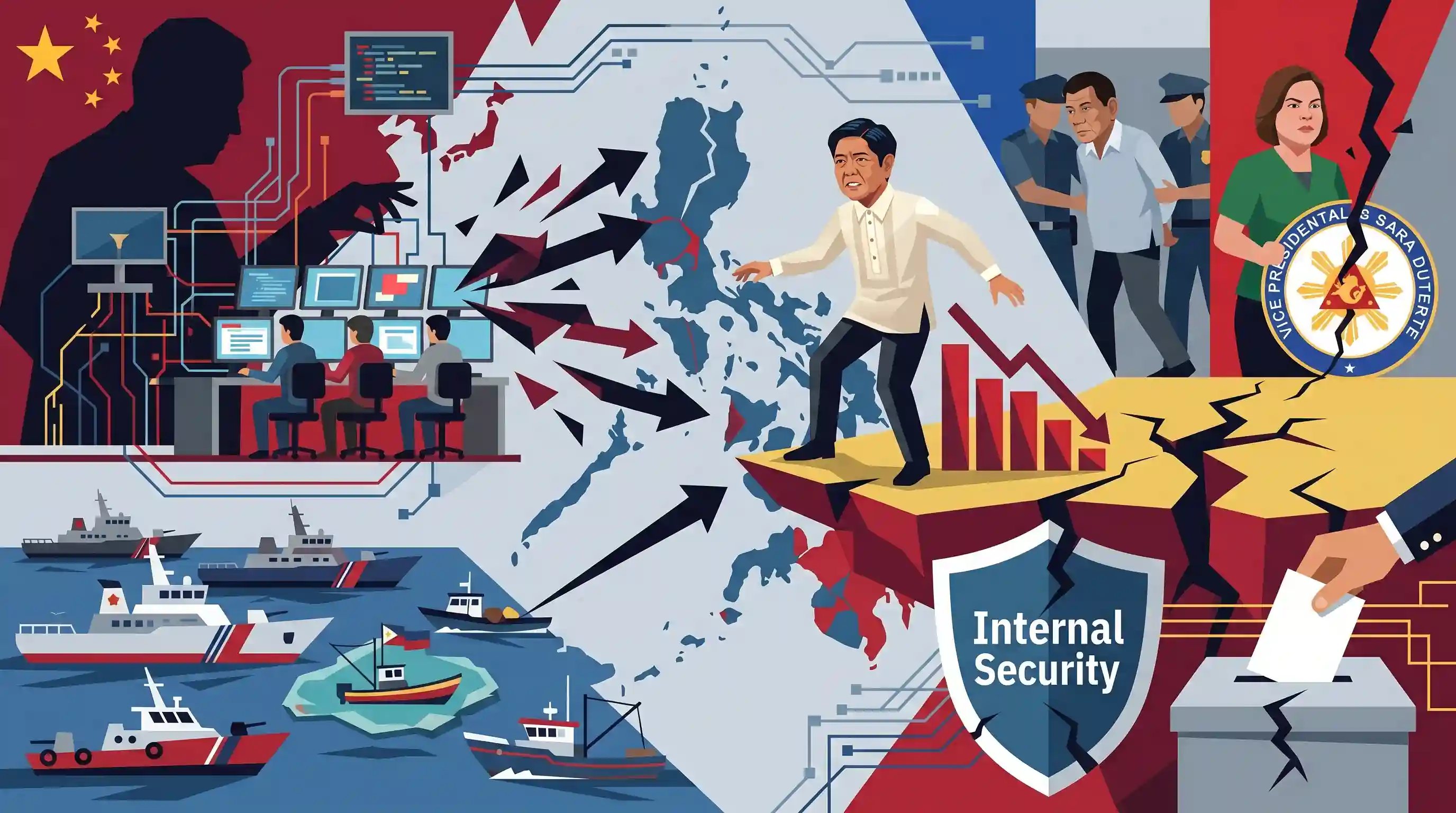
The Philippine National Security Council has warned of a suspected state-sponsored campaign by China to interfere in the upcoming Philippine mid-term elections. Authorities allege that the Chinese embassy in Manila is financing local troll farms to spread disinformation and undermine the administration of President Ferdinand Marcos Jr. This development is seen as part of a broader strategy by Beijing, complementing its ongoing aggression in the disputed South China Sea. The situation is further complicated by severe domestic political instability following the recent arrest of former President Rodrigo Duterte and the impeachment of Vice President Sara Duterte, which has led to a significant drop in President Marcos Jr.'s approval ratings. This case highlights the increasing use of cyber warfare and social media manipulation as tools for foreign policy and geopolitical coercion.
Key Points
- The Philippine National Security Council (NSC) has cited signs of a state-sponsored campaign by China to interfere in its upcoming mid-term elections.
- Allegations suggest that the Chinese embassy in Manila is paying Filipinos to operate troll farms aimed at undermining President Ferdinand Marcos Jr.'s administration.
- This suspected election interference is viewed as an extension of China's broader aggression and territorial ambitions in the South China Sea.
- The interference occurs amid domestic political turmoil in the Philippines, exacerbated by the arrest of former President Rodrigo Duterte over an International Criminal Court probe into his drug war.
- The incident underscores the growing global security threat of state-backed disinformation campaigns weaponising social media to destabilise target nations.
Important Terms
National Security Council (NSC)

An apex executive body that coordinates a country's domestic, foreign, and military policies. In India, it has a three-tier structure (SPG, NSAB, NSCS) chaired by the Prime Minister.
UPSC context
GS Paper II/III: Essential for security management and executive decision-making.
International Criminal Court (ICC)
The first permanent international tribunal, headquartered in The Hague, established to prosecute individuals for the gravest international crimes like genocide, war crimes, and crimes against humanity.
UPSC context
GS Paper II: Important International Institutions. Tests knowledge of global justice frameworks and sovereignty.
Rome Statute
The 1998 treaty that founded the ICC. It establishes the court's jurisdiction over four core crimes. India is notably not a signatory to this statute.
UPSC context
GS Paper II: International Treaties. Relevant for legal accountability and India’s stance on global courts.
UNCLOS
An international treaty, often called the 'Constitution of the Oceans,' defining the rights and responsibilities of nations regarding use of the world's oceans and maritime resources.
UPSC context
GS Paper II: International Relations. Crucial for South China Sea disputes and maritime security.
Information Operations (IO)
The strategic use of technology and communication (e.g., troll farms) to influence an adversary's public sentiment or disrupt decision-making without resorting to open military conflict.
UPSC context
GS Paper III: Cyber Security/Internal Security. Tests understanding of non-traditional threats to democracy.
Grey-zone Warfare
Competitive statecraft occurring between the duality of peace and war, involving cyberattacks, economic coercion, and disinformation to achieve strategic goals while avoiding military escalation.
UPSC context
GS Paper III: Security Challenges. Relevant for studying contemporary conflict strategies and Indo-Pacific geopolitics.
Foreign Electoral Intervention (FEI)
Efforts by one government to influence another nation's elections through covert funding, cyber-manipulation, or disinformation to alter results or undermine democratic stability.
UPSC context
GS Paper II: Governance/Polity. Highlights threats to electoral integrity and national sovereignty.
Prelims Trap
The ICC loses all jurisdiction over crimes committed in a state the moment it formally withdraws from the Rome Statute.
The ICC retains jurisdiction over alleged crimes committed while the nation was still a member, even if the nation subsequently withdraws.
Static Concepts Connected
What is the ICC's Principle of Complementarity?
- Last resort: The ICC is a court of last resort; it steps in only when national judicial systems are unwilling or genuinely unable to prosecute grave international crimes.
- Core jurisdiction: It prosecutes individuals (not states) for genocide, crimes against humanity, war crimes, and the crime of aggression.
- India's status: India has not signed the Rome Statute, objecting to the UN Security Council's outsized power to refer or delay ICC investigations.
How does 'Sharp Power' differ from 'Soft Power'?
- Soft Power: Relies on attraction and persuasion through a country's culture, political values, and diplomacy (e.g., cultural exports, diaspora influence).
- Sharp Power: Involves authoritarian regimes using manipulative, covert tools like disinformation and troll farms to pierce and subvert democratic processes in target nations.
- Cognitive Warfare: A subset of sharp power that aims to alter public perception and polarize societies to destabilize a nation without traditional kinetic military action.
Cross-Topic Patterns
Hybrid Warfare + Maritime Aggression
China's dual strategy of funding troll farms in Manila while bullying vessels in the South China Sea demonstrates 'gray-zone' tactics spanning both cyber and physical domains.
Social Media + Internal Security (GS3)
The weaponization of digital platforms for election interference directly ties to UPSC's GS3 focus on the role of state and non-state actors creating internal security challenges via cyberspace.

ICC jurisdiction rules over withdrawn states (like the Philippines) are highly probable as a tricky multi-statement Prelims question.
Linked PYQs · 2
Linked PYQs · 2
- 2014MainsGS2
With respect to the South China sea, maritime territorial disputes and rising tension affirm the need for safeguarding maritime security to ensure freedom of navigation and over flight throughout the region. In this context, discuss the bilateral issues between India and China.
- 2016MainsGS3
Use of Internet and social media by non-state actors for subversive activities is a major security concern. How have these been misused in the recent past? Suggest effective guidelines to curb the above threat.
