Higher Education Research Ecosystem and Dropout Crisis in India
Source:Indian Express ↗
Why It Matters
A robust research ecosystem is crucial for India's transition to a knowledge economy and achieving self-reliance in science and technology. The systemic failures in PhD programs highlight significant gaps in higher education quality and human capital utilization, making it highly relevant for questions on education policy, human resources (GS2), and R&D innovation (GS3).
Summary
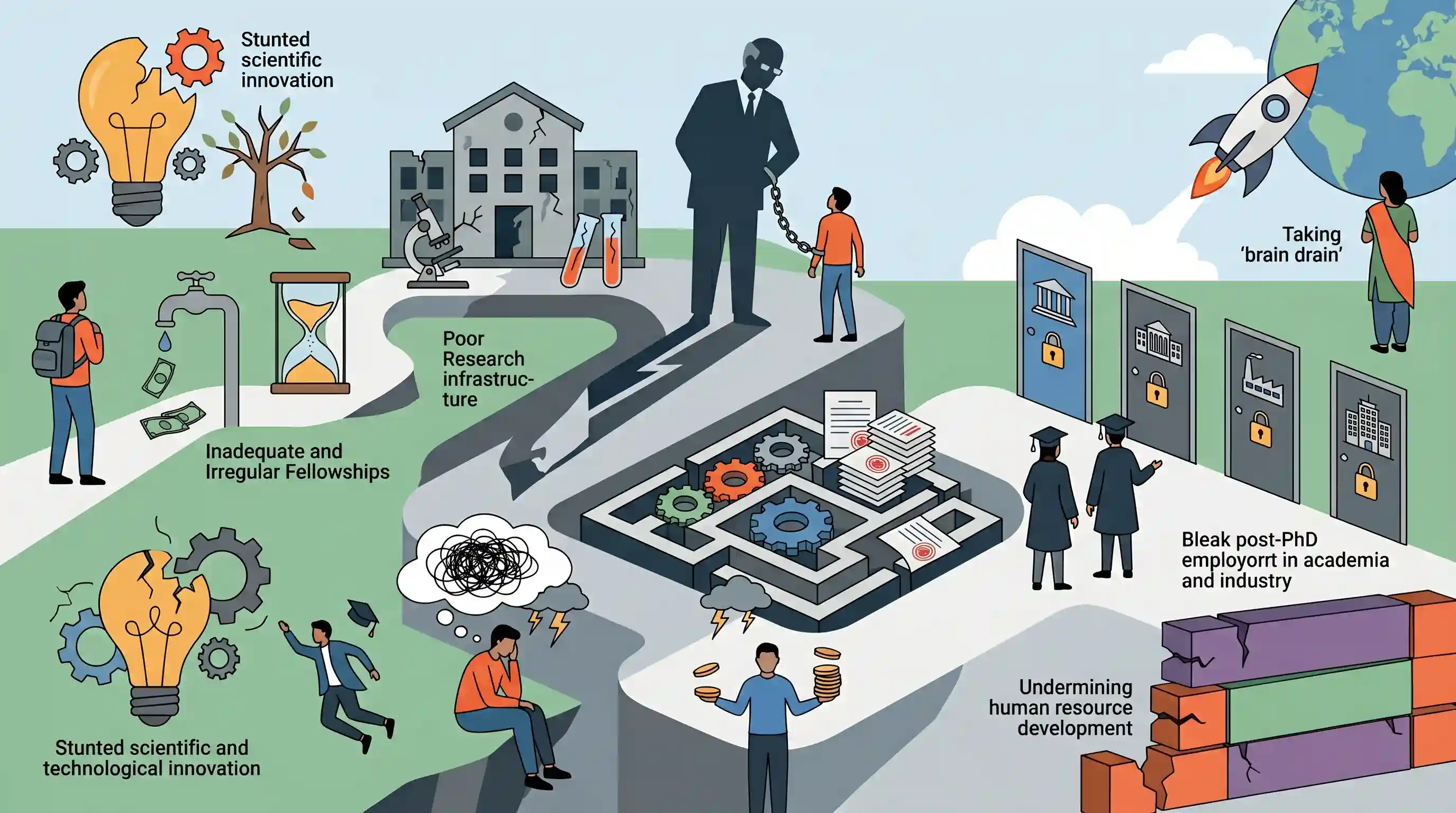
The article explores the systemic and structural challenges driving high dropout rates among PhD scholars in India. Key issues include inadequate and irregularly disbursed fellowships, poor research infrastructure, and a toxic academic environment marked by hierarchical student-supervisor dynamics. Compounded by bureaucratic hurdles and bleak post-PhD employment prospects in both academia and industry, these factors lead to severe mental stress and financial instability. Consequently, many researchers abandon their PhDs, which threatens to stunt India’s long-term scientific and technological innovation, exacerbating the 'brain drain' and undermining human resource development.
Key Points
- Financial Instability: Inadequate stipends and chronic delays in the disbursement of fellowships (like JRF and SRF) push research scholars into severe financial distress.
- Toxic Academic Culture: Hierarchical and often exploitative dynamics between supervisors and scholars lead to an unhealthy work environment and rampant mental health issues.
- Bleak Employment Prospects: A lack of adequate academic positions and weak linkages between academia and industry mean that a PhD degree does not guarantee secure or remunerative employment.
- Bureaucratic Hurdles: Red tape in procuring lab equipment, securing funding for conferences, and administrative bottlenecks significantly delay research output and demoralize scholars.
- Impact on National R&D: High dropout rates and the subsequent 'brain drain' undermine India's goal of building a robust knowledge economy and its overall human capital development.
Important Terms
University Grants Commission (UGC)

A statutory body established in 1956 responsible for coordinating, determining, and maintaining standards of university education in India and disbursing research grants.
UPSC context
GS Paper 2: Statutory/regulatory bodies; issues relating to the development and management of Social Sector/Services relating to Education.
Council of Scientific and Industrial Research (CSIR)
India's largest autonomous R&D organization under the Ministry of Science and Technology; it conducts industrial research and provides fellowships for STEM doctoral scholars.
UPSC context
GS Paper 3: Achievements of Indians in science & technology; indigenization of technology and developing new technology.
Junior Research Fellowship (JRF)
An entry-level financial grant awarded to PhD scholars for the first two years of research, typically based on qualifying national competitive exams.
UPSC context
GS Paper 2: Issues relating to Human Resource Development and the efficiency of higher education funding.
Senior Research Fellowship (SRF)
An upgraded fellowship granted to research scholars after two years of satisfactory work as a JRF, offering increased financial support for the remaining PhD duration.
UPSC context
GS Paper 2: Evaluates the structural progression and career stability within India's research and development (R&D) ecosystem.
National Eligibility Test (NET)
A national-level examination conducted to determine eligibility for Assistant Professorship and the award of Junior Research Fellowships in Indian universities.
UPSC context
GS Paper 2: Governance and Education; tests knowledge of regulatory mechanisms in higher education.
Brain Drain
The large-scale emigration of highly skilled and educated individuals from their home country, often caused by poor local infrastructure or lack of opportunity.
UPSC context
GS Paper 3: Impact of human capital flight on India's transition to a knowledge-based economy and technological innovation.
Prelims Trap
"The private sector contributes the majority of Gross Expenditure on Research and Development (GERD) in India."
Aspirants often assume private dominance like in the US or China. In India, the public sector drives R&D, with private investment lagging at ~36%.
Static Concepts Connected
What are the key features of the Anusandhan National Research Foundation (ANRF)?
- Core Objective: Established to seed, grow, and promote R&D and foster a research culture across universities, replacing the Science and Engineering Research Board (SERB).
- Funding Mechanism: Aims for a ₹50,000 crore outlay over 5 years, with ~70% (₹36,000 crore) expected to be mobilized from non-government/private sources.
- Industry Linkage: Seeks to bridge the gap between academic research and industry, directly addressing the systemic issues in higher educational institutions.
How is India's Gross Expenditure on R&D (GERD) structurally constrained?
- Low Overall Funding: GERD remains stagnant at roughly 0.64% of GDP, far below the global average of ~1.8% and the 2% target set by various national policies.
- Public Sector Dominance: Unlike developed economies where private enterprise funds 70%+ of R&D, India relies heavily on public funds, with private share at only ~36%.
- Institutional Skew: The bulk of public R&D funding goes to specialized autonomous institutes (e.g., CSIR, DRDO, ISRO), leaving public universities severely under-resourced.
Cross-Topic Patterns
Demographic Dividend vs. Employability
The 'employability paradox' directly links higher education structural issues to India's demographic dividend. Without industry-linked PhDs, a highly educated but unemployable workforce risks becoming a demographic disaster.
NEP 2020 and structural reform gaps
NEP 2020 envisions Multidisciplinary Education and Research Universities (MERUs) and autonomous research bodies. Current toxic supervisor dynamics and UGC funding bottlenecks highlight the gap between policy and reality.

ANRF's funding structure and India's GERD composition (public vs. private share) are prime targets for a 2026 Prelims statement question.
Linked PYQs · 3
Linked PYQs · 3
- 2015MainsGS2
The quality of higher education in India requires major improvements to make it internationally competitive. Do you think that the entry of foreign educational institutions would help improve the quality of higher and technical education in the country? Discuss.
- 2023MainsGS2
The crucial aspect of development process has been the inadequate attention paid to Human Resource Development in India. Suggest measures that can address this inadequacy.
- 2023MainsGS2
Skill development programmes have succeeded in increasing human resources supply to various sectors. In the context of the statement analyse the linkages between education, skill and employment.
