Union protests discrimination against disabled staff at PGIMER
Source:Indian Express ↗
Why It Matters
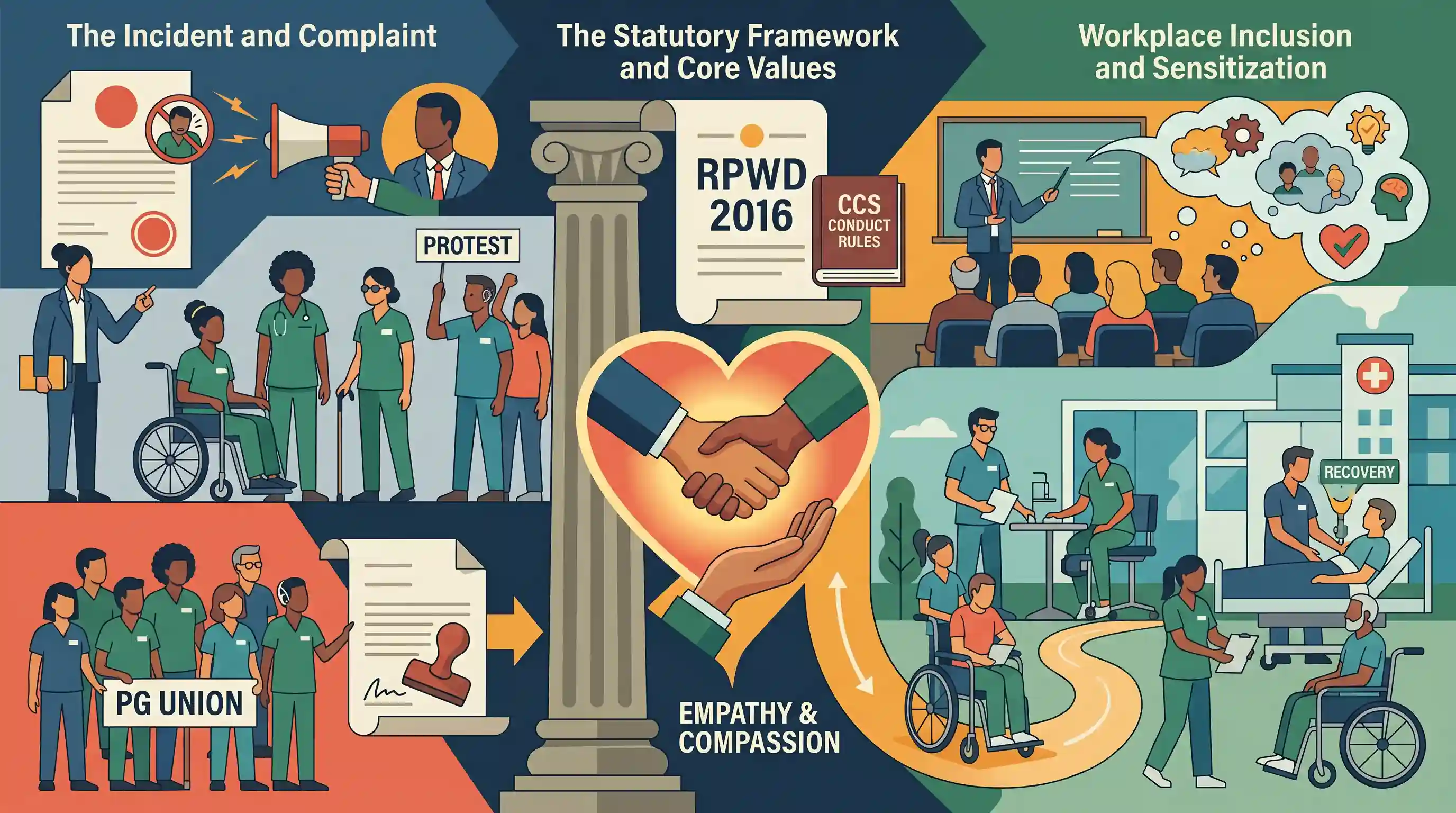
It emphasizes the practical challenges of ensuring workplace inclusion in public institutions despite progressive legal frameworks like the RPWD Act, 2016. It underscores the critical need for behavioral change and sensitization among administrators to foster empathy toward differently abled employees.
Summary
A complaint has been lodged by the PGI Differently Abled Employees Union against a Deputy Nursing Superintendent at PGIMER, Chandigarh, alleging discriminatory remarks against disabled staff. An internal note suggested that differently abled nursing staff were unsuitable for managing potentially violent patients at the Drug De-Addiction Centre. The union highlighted that such generalizations reflect entrenched biases and violate the Rights of Persons with Disabilities (RPWD) Act, 2016, alongside CCS Conduct Rules. The incident brings forward the practical challenges of disability inclusion in the workplace and emphasizes the need for empathy and mandatory sensitization programs for public administrators.
Key Points
- The PGI Differently Abled Employees Union filed a complaint alleging discriminatory and humiliating remarks against disabled nursing officials by an administrative officer at PGIMER.
- The controversy centered on an internal note suggesting that posting differently abled staff in the Drug De-Addiction Centre was unsafe due to the unpredictability of patients.
- The union argues that this generalization violates the Rights of Persons with Disabilities (RPWD) Act, 2016, and the CCS Conduct Rules.
- Demands include mandatory sensitization programs for administrative staff and implementation of the Grievance Committee for Persons with Disabilities' recommendations to ensure workplace inclusion.
Important Terms
Rights of Persons with Disabilities (RPWD) Act, 2016

A 2016 legislation replacing the 1995 Act, expanding recognized disabilities from 7 to 21. It mandates non-discrimination, reasonable accommodation, and 4% reservation in government jobs for persons with benchmark disabilities.
UPSC context
GS Paper 2: Social Justice; vulnerable sections. Tests knowledge of statutory rights and welfare provisions for Persons with Disabilities (PwDs).
Central Civil Services (CCS) Conduct Rules, 1964
A set of rules governing the conduct of Central Government employees. Rule 3 mandates 'absolute integrity' and prohibits acts 'unbecoming of a government servant,' including discrimination against underprivileged sections of society.
UPSC context
GS Paper 4: Ethics; foundational values for civil services. Tests understanding of the code of conduct and administrative ethics in public service.
Chief Commissioner for Persons with Disabilities (CCPD)
A statutory authority under the RPWD Act, 2016, vested with quasi-judicial powers to safeguard the rights of PwDs, inquire into complaints of discrimination, and monitor the implementation of disability laws.
UPSC context
GS Paper 2: Governance; statutory and regulatory bodies. Tests knowledge of institutional mechanisms for protecting the rights of vulnerable groups.
Institute of National Importance (INI)
A status granted by an Act of Parliament to premier institutions (like PGIMER, AIIMS) to develop high standards of medical education, research, and tertiary healthcare in India.
UPSC context
GS Paper 2: Issues relating to Health and Education. Tests awareness of the specialized status and autonomy of premier public institutions.
Grievance Redressal Officer (GRO)
A mandatory authority that every government establishment must appoint under Section 23 of the RPWD Act, 2016, to address complaints regarding discrimination and denial of rights in the workplace.
UPSC context
GS Paper 2: Governance; Grievance Redressal Mechanisms. Tests knowledge of internal administrative tools for enforcing statutory rights.
Prelims Trap
"Under the RPWD Act 2016, PwDs are statutorily exempted from hazardous or unsafe workplace deployments."
There is no blanket exemption. The Act mandates "reasonable accommodation." Administrators cannot use "safety" as a unilateral excuse to exclude PwDs without providing support systems.
Static Concepts Connected
What is "Reasonable Accommodation" under the RPWD Act, 2016?
- Definition: Necessary modifications to ensure PwDs enjoy rights equally with others, without imposing a disproportionate or undue burden on the establishment.
- Legal mandate: Section 20 of the RPWD Act legally mandates government establishments to provide reasonable accommodation and a barrier-free environment.
- Judicial backing: The Supreme Court (Vikash Kumar v. UPSC) ruled that providing reasonable accommodation is a positive obligation of the State under Articles 14 and 21.
What is the grievance redressal mechanism under the RPWD Act, 2016?
- Officer appointment: Section 23 requires every government establishment to appoint a Grievance Redressal Officer to handle workplace discrimination issues.
- Resolution timeline: The officer is mandated to maintain a register of complaints and resolve them within a strict timeline of two weeks.
- Escalation: If unresolved, complaints can be escalated to the State Commissioner or Chief Commissioner for Persons with Disabilities.
Cross-Topic Patterns
RPWD Act + GS4 Case Studies
Incidents of workplace discrimination against PwDs serve as practical case studies for GS4, highlighting the gap between legal mandates and attitudinal barriers among administrators.
Rights + Social Model of Disability
UPSC often contrasts the outdated medical model (focusing on impairment) with the modern social model (focusing on removing systemic and attitudinal barriers).

Expect a GS2 or GS4 question evaluating 'reasonable accommodation' as a tool to bridge the gap between statutory rights and attitudinal barriers.
Linked PYQs · 2
Linked PYQs · 2
- 2017MainsGS2
Does the Rights of Persons with Disabilities Act, 2016 ensure effective mechanism for empowerment and inclusion of the intended beneficiaries in the society? Discuss.
- 2022MainsGS4
Apart from intellectual competency and moral qualities, empathy and compassion are some of the other vital attributes that facilitate the civil servants to be more competent in tackling the crucial issues or taking critical decisions. Explain with suitable illustrations.
