Expansion of postgraduate medical seats in Himachal Pradesh colleges
Source:tribuneindia ↗
Why It Matters
The drastic increase in PG medical seats and senior clinical faculty posts is a major policy step to address the chronic shortage of specialist doctors in Himachal Pradesh's public healthcare system. This is a crucial topic for state-specific administrative exams focusing on social development indicators and public health infrastructure.
Summary
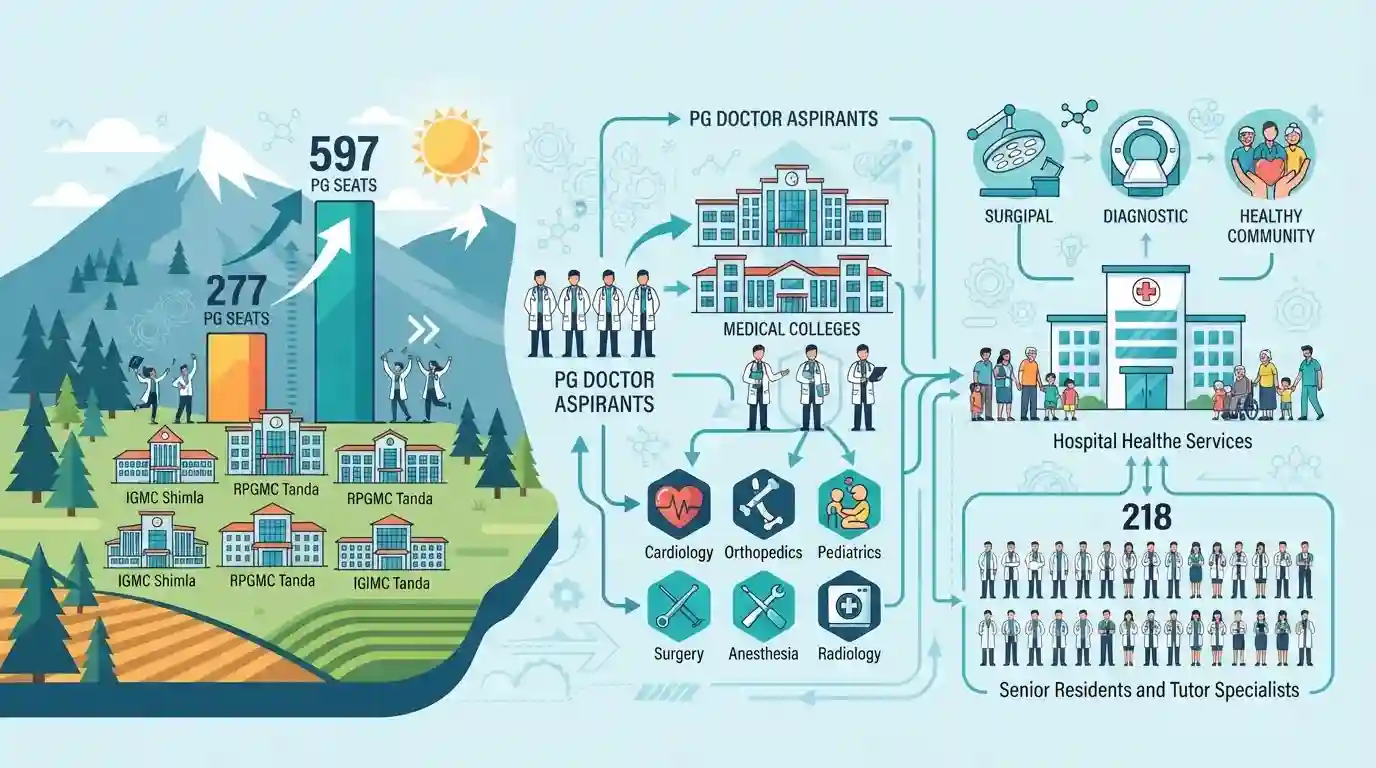
Chief Minister Sukhvinder Singh Sukhu announced a significant expansion in medical education for Himachal Pradesh, with postgraduate (PG) medical seats in six state government medical colleges slated to increase from 277 to 597. The initiative is aimed at overcoming the acute shortage of specialist doctors in the state, offering larger opportunities for medical aspirants, and providing high-quality healthcare services. To facilitate this upgrade in infrastructure and human resources, the state government has also created 218 posts of Senior Residents and Tutor Specialists over the last three years.
Key Points
- The Himachal Pradesh government is increasing the number of postgraduate (PG) medical seats in its six government medical colleges from 277 to 597.
- The move aims to address the shortage of specialist doctors, create better career prospects for local medical aspirants, and improve the state's healthcare delivery system.
- The expansion of PG seats across the six colleges is as follows: IGMC Shimla (139 to 230), RPGMCH Tanda (99 to 156), LBSGMC Mandi (24 to 79), YSPGMC Nahan (3 to 35), PJNGMC Chamba (4 to 32), and RGMC Hamirpur (8 to 65).
- To support the academic and clinical demands of this expansion, the state government has created 218 new posts for Senior Residents and Tutor Specialists in government medical colleges over the past three years.
Important Terms
Indira Gandhi Medical College (IGMC), Shimla

Established in 1966, this premier state-run medical institution in Shimla, Himachal Pradesh, is undergoing significant postgraduate seat expansion to alleviate specialist doctor shortages and strengthen regional patient care.
UPSC context
Tests GS-2 (Health) & State GK, highlighting state-led healthcare infrastructure and human resource development capacity.
Dr. Rajendra Prasad Government Medical College (RPGMCH), Tanda
A major public medical college and hospital in Kangra district, Himachal Pradesh, established in 1996. It serves as a vital clinical training center whose PG seats are currently being increased to combat the specialist doctor deficit.
UPSC context
Important for GS-2 (Health) and State GK, illustrating the spatial distribution of tertiary healthcare and capacity-building in hilly regions.
Lal Bahadur Shastri Government Medical College (LBSGMC), Mandi
A public medical college in Ner Chowk, Mandi. Originally an ESIC project, it was transferred to the Himachal Pradesh government in 2017 and is now expanding PG medical seats to improve healthcare access.
UPSC context
Highlights GS-2 issues of center-state infrastructure coordination and strategies to improve rural healthcare access via increased PG training.
Dr. Yashwant Singh Parmar Government Medical College (YSPGMC), Nahan
Established in 2016 in Sirmaur district by upgrading a regional hospital, this state medical college is augmenting its postgraduate training capacity to address the growing demand for skilled healthcare professionals.
UPSC context
Pertinent for GS-2 (Public Health), showing the phased upgradation of district/regional hospitals to tertiary care and educational hubs.
Pandit Jawaharlal Nehru Government Medical College (PJNGMC), Chamba
A government medical college located in Chamba, Himachal Pradesh. Established in 2017, it is part of the state's decentralization of medical education and is undergoing a significant expansion of its postgraduate medical seats.
UPSC context
Relevant for GS-2 (Health), reflecting interventions to boost specialist healthcare availability in remote or geographically challenging districts.
Dr. Radhakrishnan Government Medical College (RGMC), Hamirpur
A government tertiary medical college established in Hamirpur in 2018. It focuses on medical training and is slated for increased PG seats to build a skilled local medical workforce in Himachal Pradesh.
UPSC context
Relevant for GS-2 (Social Sector - Health), demonstrating recent infrastructure creation to address human resource deficits in hilly regions.
Prelims Trap
State governments have the autonomous authority to increase postgraduate medical seats in state-run colleges.
While state governments upgrade infrastructure and propose increases, the statutory power to approve and grant new medical seats rests exclusively with the National Medical Commission.
Static Concepts Connected
Who regulates the expansion of medical seats in India?
- NMC's MARB: The Medical Assessment and Rating Board (MARB) under the NMC is the statutory body that evaluates and approves the increase of UG and PG medical seats.
- Faculty-Student Ratios: PG seat allocations are strictly regulated by the NMC based on the hospital's clinical material (patient load) and the unit's faculty-to-student ratio.
What measures exist to address the specialist doctor shortage in India?
- DNB Equivalency: The government equated Diplomate of National Board (DNB) qualifications with MD/MS degrees to rapidly expand the pool of available specialists and teaching faculty.
- District Hospital Upgradation: A Centrally Sponsored Scheme (CSS) aims to establish new medical colleges by upgrading existing district or referral hospitals to expand PG training capacity.
Cross-Topic Patterns
Infrastructure vs. Human Resource bottlenecks
Building new medical colleges is frequently hampered by an acute shortage of teaching faculty. Upgrading infrastructure without parallel human capital expansion (PG seats) leads to 'ghost hospitals'.
State schemes bridging the PMJAY gap
State health schemes like HP's HIMCARE or Rajasthan's former Chiranjeevi Yojana act as crucial supplements to PMJAY, covering the 'missing middle' families excluded from SECC-2011 criteria.

Mains 2026 may ask to evaluate the 'upgrading district hospitals to medical colleges' scheme in solving the specialist doctor shortage.
