Internal Security Threats from Radicalized Non-State Actors
Source:Indian Express ↗
Why It Matters
It provides a concrete example of how radicalized non-state actors pose a grave threat to national security, which is directly relevant to GS Paper 3 topics concerning internal security, the mandate of the NIA, and the application of anti-terror laws like UAPA.
Summary
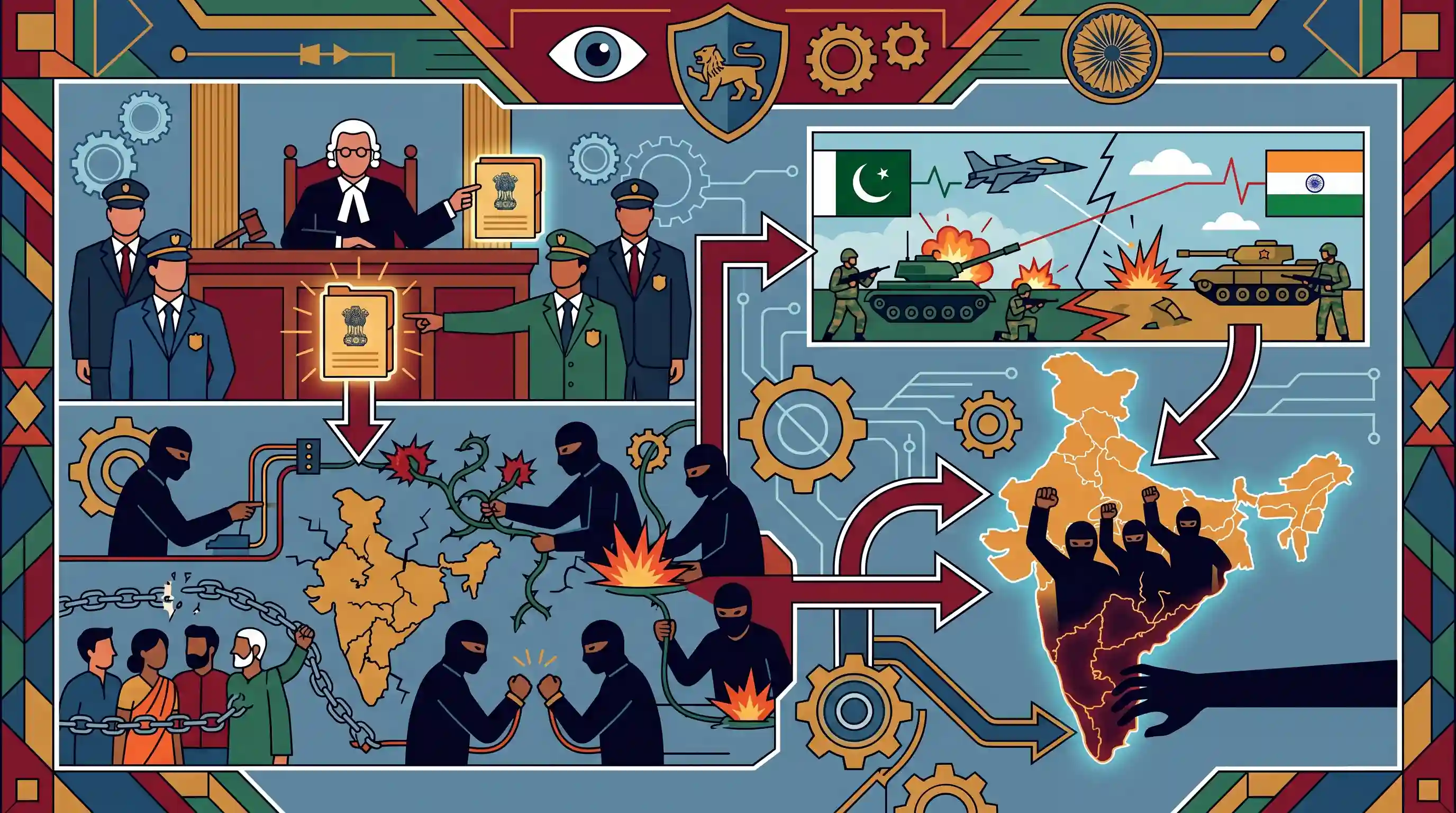
The National Investigation Agency (NIA) has informed a court that the banned Popular Front of India (PFI) poses the "greatest threat to unity" and had allegedly formulated plans to capture South India in the event of a war with Pakistan. This submission underscores the grave internal security challenges posed by radicalized non-state actors operating within the country and their potential to exploit external conflicts to compromise India's sovereignty.
Key Points
- The NIA presented findings to a court describing the banned Popular Front of India (PFI) as the greatest threat to India's unity.
- According to the NIA, the PFI had devised a contingency plan to capture power in South India by exploiting the chaos in the event of an India-Pakistan war.
- The development highlights the severe multidimensional threat posed by domestic non-state actors and their potential ideological or strategic alignment with hostile external state actors.
- Underscores the critical role of central investigative agencies like the NIA in preempting terror modules and neutralizing radicalized organizations under the UAPA framework.
Important Terms
Unlawful Activities (Prevention) Act (UAPA)

India's primary anti-terror law, enacted in 1967 to prevent activities threatening the nation's sovereignty and integrity. It empowers the government to designate individuals and organizations as terrorists.
UPSC context
GS Paper 3 (Internal Security); critical for understanding legal mechanisms against terrorism and its impact on fundamental rights.
National Investigation Agency (NIA)
India’s premier federal counter-terrorism agency established under the Ministry of Home Affairs to investigate and prosecute offenses affecting national security, sovereignty, and integrity.
UPSC context
GS Paper 3 (Various Security Forces); essential for studying the institutional framework and mandate of central investigative agencies.
Popular Front of India (PFI)
An Islamist socio-political organization founded in 2006 and banned in 2022. It is accused by central agencies of radicalization, money laundering, and maintaining terror links.
UPSC context
GS Paper 3 (Internal Security/Role of Non-State Actors); serves as a case study for extremism and radicalization challenges.
NIA Act
The 2008 legislation that created the NIA post-26/11, granting the agency pan-India jurisdiction to investigate 'Scheduled Offences' without requiring state government consent.
UPSC context
GS Paper 2 & 3 (Security/Governance); tests knowledge of statutory powers and federal dynamics in counter-terrorism operations.
Prelims Trap
"The NIA requires prior approval of the State DGP to seize or attach properties connected to terrorism."
The 2019 NIA (Amendment) Act empowered the Director General of the NIA to directly approve property seizures during investigations, removing the state-level veto.
Static Concepts Connected
How does the UAPA regulate 'unlawful associations'?
- Central Notification: The Central Government can declare an organization 'unlawful' via official gazette notification under Section 3 of the Act.
- Tribunal Confirmation: The ban must be adjudicated and confirmed by a UAPA Tribunal (headed by a High Court judge) within six months of the notification.
- Individual Designation: The 2019 UAPA amendment allows the Centre to designate specific individuals as terrorists, stopping banned group leaders from simply forming new outfits.
What is the statutory mandate of the NIA?
- Counter-Terrorism Mandate: Established post-26/11 via the NIA Act 2008, it operates as India's Central Counter-Terrorism Law Enforcement Agency.
- Suo Motu Jurisdiction: It has pan-India jurisdiction and can take over scheduled terror offenses without requiring prior consent from state governments.
- Expanded Schedule: The 2019 amendment expanded its investigative scope to include cyber terrorism, human trafficking, offenses under the Explosive Substances Act, and counterfeit currency.
Cross-Topic Patterns
Federal friction over NIA jurisdiction
NIA's pan-India overriding investigative powers often clash with 'Public Order' and 'Police' being State subjects under Schedule VII, triggering center-state federal friction.
Proxy warfare and Fifth Columnists
Hostile external actors weaponize domestic radical groups as "fifth columnists" to exploit wartime chaos, illustrating the lethal nexus between external state threats and internal non-state actors.

Expect a 2026 prelims question testing the exact procedures of UAPA Tribunal confirmations or the 2019 NIA property attachment powers.
Linked PYQs · 3
Linked PYQs · 3
- 2021MainsGS3
Analyse the multidimensional challenges posed by external state and non-state actors, to the internal security of India. Also discuss measures required to be taken to combat these threats.
- 2023MainsGS3
What are the internal security challenges being faced by India? Give out the role of Central Intelligence and Investigative Agencies tasked to counter such threats.
- 2019MainsGS3
Indian Government has recently strengthened the anti-terrorism laws by amending the Unlawful Activities (Prevention) Act (UAPA), 1967 and the NIA Act. Analyze the changes in the context of prevailing security environment while discussing the scope and reasons for opposing the UAPA by human rights organizations.
