Domestic Fuel Prices Hiked for Fourth Time Amid Global Crude Pressures
Source:The Hindu ↗
Why It Matters
Understanding the mechanics of domestic fuel pricing and OMC under-recoveries is crucial for GS3 Economy. It also illustrates how international geopolitical events directly influence India's macroeconomic stability and energy security, which frequently appear in both GS2 (IR) and GS3 (Economy) questions.
Summary
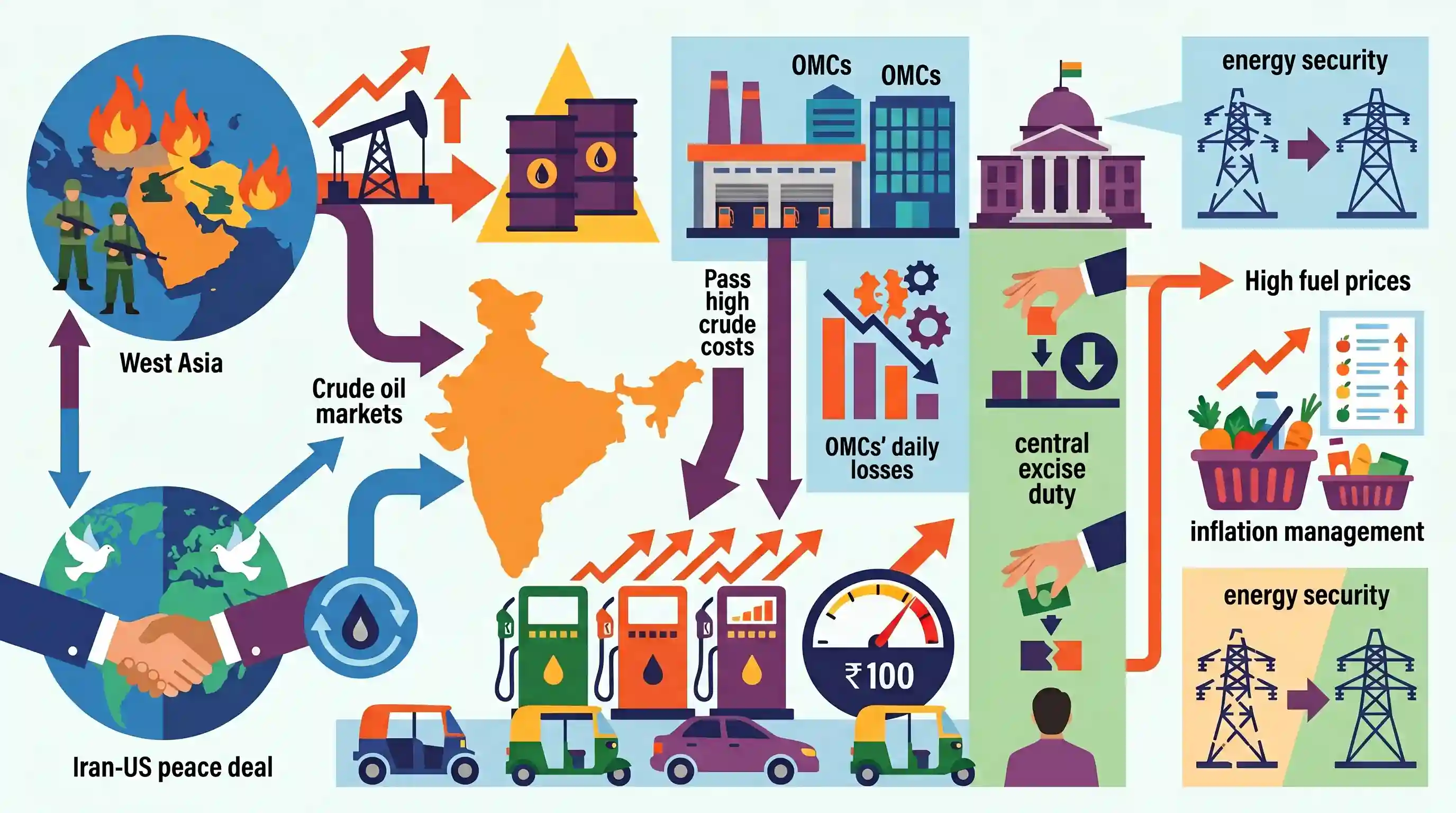
The article discusses the recent surge in domestic fuel prices in India, with petrol and diesel seeing their fourth price hike in 10 days, pushing petrol past ₹100 per litre in Delhi. This upward revision stems from oil-marketing companies (OMCs) passing on the burden of high global crude oil prices, which have been elevated due to ongoing conflicts in West Asia. Although the government previously reduced central excise duty to ease consumer burden, OMCs continue to face significant daily losses. However, global benchmark crude futures have recently shown signs of easing amid prospects of an Iran-US peace deal, underscoring the direct impact of international geopolitical developments on India's energy security and inflation dynamics.
Key Points
- Petrol and diesel prices were hiked by 80 paise per litre, marking the fourth increase in 10 days and bringing the total hike to ₹2.8 per litre.
- Petrol prices crossed the ₹100 per litre mark in Delhi for the first time since May 2022.
- Oil marketing companies (OMCs) are facing daily under-recoveries of nearly ₹600 crore on fuel sales, a decrease from a previous high of ₹750 crore per day.
- OMCs had absorbed the impact of high international crude oil prices triggered by the West Asia conflict for about three months.
- A ₹10 per litre reduction in central excise duty in late-March resulted in an estimated revenue loss of over ₹1 lakh crore for the government.
- India's crude oil basket averaged $107.84 per barrel, while benchmark Brent crude futures eased to $97.23 per barrel amid hopes of an Iran-US peace deal.
Important Terms
Oil Marketing Companies (OMCs)

Downstream entities (mostly state-owned like IOCL, BPCL, HPCL) responsible for refining, distributing, and retailing petroleum products. They act as the primary interface between global oil markets and domestic consumers.
UPSC context
GS Paper 3: Infrastructure and Energy; tests understanding of the energy supply chain and public sector role.
Energy Security
The uninterrupted availability of energy sources at an affordable price. For India, it involves balancing high import dependence with strategic reserves, domestic production, and transition to renewable sources.
UPSC context
GS Paper 3: Energy; critical for questions on strategic autonomy and sustainable development.
Central Excise Duty
A fixed-rate indirect tax levied by the Union Government on the production of petroleum products. It remains outside the GST regime and is a major non-shareable revenue source for the Centre.
UPSC context
GS Paper 3: Mobilization of Resources; tests knowledge of fiscal policy and federal taxation disputes.
Brent Crude
The global benchmark for crude oil extracted from the North Sea. It prices roughly two-thirds of internationally traded oil, significantly influencing India's import bill and domestic fuel rates.
UPSC context
GS Paper 3: Indian Economy; relevant for understanding external sector vulnerabilities and trade balance.
Dynamic Fuel Pricing
A pricing system where petrol and diesel rates are revised daily by OMCs at 6 AM, reflecting international market fluctuations and USD-INR exchange rate movements.
UPSC context
GS Paper 3: Economic Development; relates to market deregulation and price transmission mechanisms.
Cost-Push Inflation
Inflation caused by a rise in the cost of production inputs like fuel and wages. Higher fuel prices increase transportation costs, leading to a cascading effect on essential goods.
UPSC context
GS Paper 3: Inflation; crucial for analyzing the impact of energy prices on CPI and WPI.
Under-recoveries
The revenue loss incurred by OMCs when the retail selling price of fuel is lower than the international market-linked cost, often due to government-directed price freezes.
UPSC context
GS Paper 3: Fiscal Policy; explains the financial health of OMCs and government subsidy burdens.
Prelims Trap
The Union Government directly regulates the retail prices of petrol and diesel under the Administered Pricing Mechanism.
Petrol and diesel were deregulated in 2010 and 2014. OMCs determine prices based on global crude rates. The government influences retail prices via taxes, not direct price-setting.
Static Concepts Connected
How are petrol and diesel prices determined in India?
- Deregulated pricing: Petrol and diesel were deregulated in 2010 and 2014, moving away from the Administered Pricing Mechanism (APM).
- Dynamic adjustment: Oil Marketing Companies (OMCs) currently adjust retail prices based on a 15-day rolling average of international benchmark crude prices and the rupee-dollar exchange rate.
- Taxation structure: Fuel remains outside the GST framework. The Centre levies excise duty while states levy Value Added Tax (VAT), creating diverse regional retail prices.
What differentiates Brent Crude from West Texas Intermediate (WTI)?
- Geographical origin: Brent is extracted from the North Sea (Europe), whereas West Texas Intermediate is sourced from US oil fields.
- Physical properties: Both are 'sweet' (low sulfur) and 'light' (low density), but WTI is slightly lighter and sweeter than Brent, making it ideal for gasoline.
- Global benchmark: Brent serves as the primary pricing benchmark for about two-thirds of the world's internationally traded crude oil, heavily influencing India's import basket.
Cross-Topic Patterns
Imported inflation via crude oil dependency
High global crude directly spikes India's WPI and CPI, forcing the RBI to tighten monetary policy. This perfectly illustrates the 'imported inflation' phenomenon driven by external supply shocks.
Excise duty cuts vs fiscal deficit targets
Reducing central excise duty to shield consumers from high fuel prices causes massive revenue losses, complicating the government's fiscal consolidation glide path under the FRBM Act.
West Asian geopolitics & Energy Security
The linkage between the Iran-US peace deal and falling Brent prices highlights why India prioritizes the Strategic Petroleum Reserve (SPR) and diverse supply chains to mitigate geopolitical vulnerabilities.

Fuel pricing deregulation, GST exclusion, and the mechanics of imported inflation are likely to form a combined multi-statement Q in 2026.
Linked PYQs · 2
Linked PYQs · 2
- 2020PrelimsGS1
The term 'West Texas Intermediate', sometimes found in news, refers to a grade of
- 2025MainsGS2
"Energy security constitutes the dominant kingpin of India's foreign policy, and is linked with India's overarching influence in Middle Eastern countries.” How would you integrate energy security with India's foreign policy trajectories in the coming years?
