Imported inflation and domestic fuel pricing pressures from oil shocks
Source:The Hindu ↗
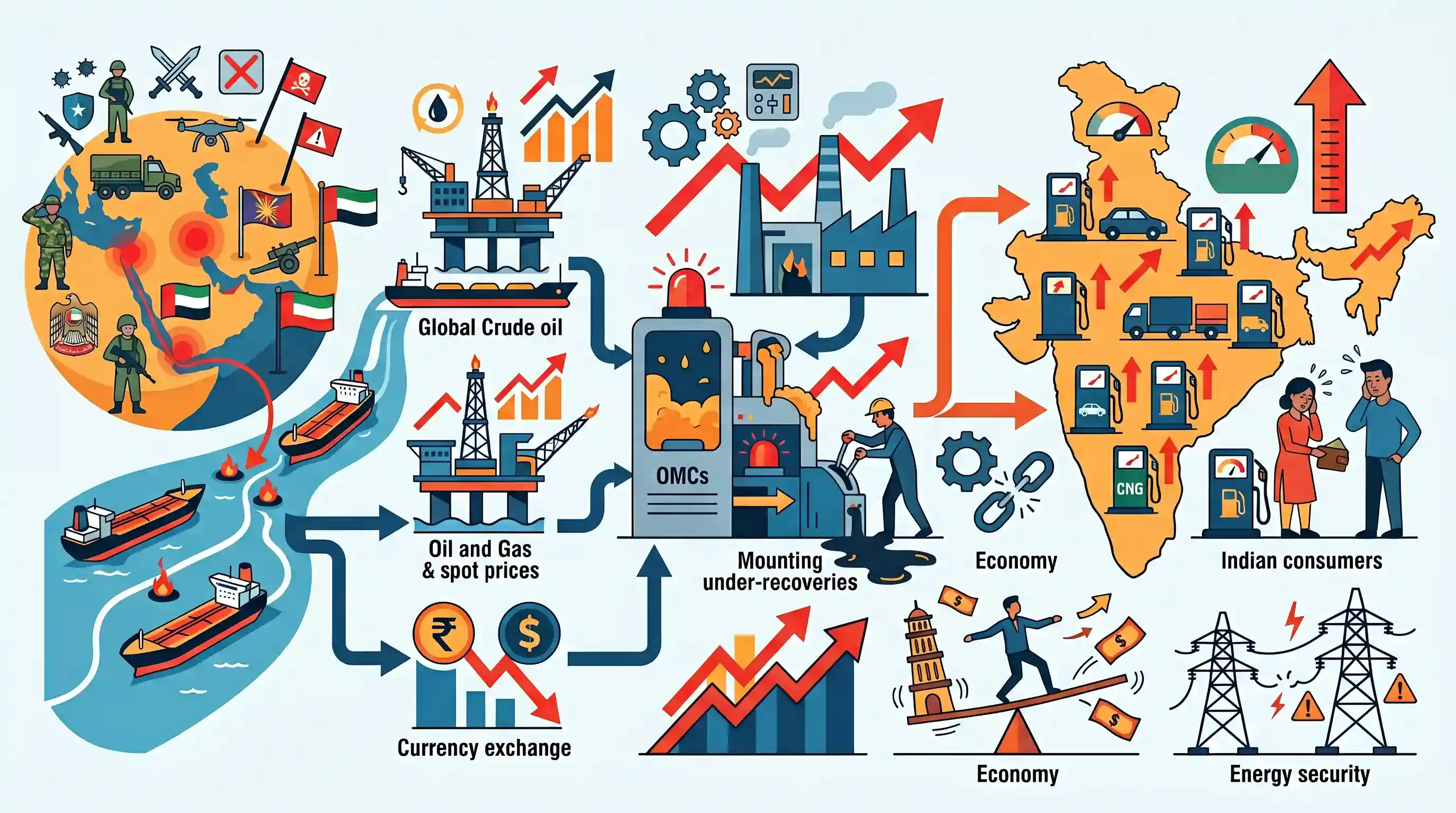
Why It Matters
India imports over 80% of its crude oil requirements. Fluctuations in global oil prices, combined with currency depreciation and geopolitical chokepoint risks, directly influence domestic inflation, the import bill, and the fiscal health of OMCs. This intersection of geopolitics (GS2) and macroeconomics (GS3) is a core focus area for UPSC.
Summary
Petrol, diesel, and CNG prices in India have been hiked for the third time in eight days as state-owned Oil Marketing Companies (OMCs) attempt to offset mounting under-recoveries. The upward revision is driven by a combination of high global crude oil prices, rising spot LNG prices, and a depreciating Indian Rupee against the US Dollar, which has increased the cost of imports. Furthermore, ongoing geopolitical tensions in West Asia, particularly concerns over the Strait of Hormuz, are adding risk premiums to global energy supply chains, posing continued challenges to India's macroeconomic stability and energy security.
Key Points
- Petrol, diesel, and CNG prices witnessed their third hike in eight days due to mounting under-recoveries faced by Oil Marketing Companies (OMCs).
- The hikes are primarily driven by elevated global crude oil prices ($85-$90 per barrel) and a surge in Liquefied Natural Gas (LNG) spot prices.
- A depreciating Indian Rupee against the US Dollar has amplified the impact, leading to higher import bills and imported inflation for petroleum products.
- Geopolitical tensions in West Asia, notably the threat to supply chains via the Strait of Hormuz chokepoint, continue to inject volatility into global energy markets and threaten India's energy security.
Important Terms
Oil Marketing Companies (OMCs)

Public sector enterprises (like IOCL, BPCL, and HPCL) responsible for refining, distributing, and retailing petroleum products. They manage the domestic fuel supply chain and implement pricing policies.
UPSC context
GS Paper III: Indian Economy. Relevant for infrastructure, energy pricing, and the role of Public Sector Undertakings (PSUs).
Under-recoveries
The revenue shortfall incurred by OMCs when the domestic retail price of fuel is kept lower than the international market-linked cost of production and import.
UPSC context
GS Paper III: Economy. Tests understanding of subsidies, fiscal deficits, and the financial health of energy PSUs.
Strait of Hormuz
A strategic maritime chokepoint between the Persian Gulf and the Gulf of Oman. It is the world's most vital energy transit route for crude oil and LNG.
UPSC context
GS Paper II: International Relations. Critical for West Asia geopolitics, maritime security, and India's energy supply chain vulnerabilities.
Energy Security
The uninterrupted availability of energy sources at an affordable price. It includes availability, accessibility, and reliability of supply to sustain economic growth.
UPSC context
GS Paper III: Energy. A major theme involving diversification, strategic reserves, and reducing import dependency.
Imported Inflation
A general rise in domestic prices caused by the increased cost of imported essential goods, such as crude oil, or a depreciating local currency.
UPSC context
GS Paper III: Economy. Tests the link between external shocks, exchange rate volatility, and domestic monetary stability.
Fuel Pricing Mechanism
The system used by OMCs to fix retail fuel rates, currently based on a daily pricing model linked to a 15-day rolling average of international prices.
UPSC context
GS Paper III: Economy. Concerns deregulation, Trade Parity Pricing (TPP), and the impact of administrative control on markets.
Prelims Trap
Petrol and diesel prices in India are governed by an administered pricing mechanism set by the central government.
Petrol and diesel were officially deregulated in 2010 and 2014. Periodic retail price freezes by OMCs are informal interventions, not statutory administered pricing.
Static Concepts Connected
How does fuel pricing work in India and what are under-recoveries?
- Deregulation: Petrol (2010) and diesel (2014) are officially market-determined, supposed to move daily based on global trade parity pricing.
- Under-recoveries: The financial loss OMCs incur when they informally hold retail prices below international market rates to absorb consumer shocks.
- Oil Bonds: Historically issued by the government to compensate OMCs for these under-recoveries, acting as a deferred fiscal burden.
How do crude oil spikes impact India's macroeconomic stability?
- Twin Deficits: Widens both the Current Account Deficit (due to a higher import bill) and Fiscal Deficit (if government cuts excise duties to lower pump prices).
- Imported Inflation: Causes direct cost-push inflation in transport and logistics, cascading into higher prices for agricultural goods and manufactured products.
- Currency Depreciation: Higher dollar demand for oil imports drains forex reserves and exerts downward pressure on the Indian Rupee.
Cross-Topic Patterns
Hormuz chokepoint + Strategic Petroleum Reserves
Geopolitical threats to the Strait of Hormuz test India's Strategic Petroleum Reserves (SPRs), which currently hold only 9-10 days of coverage versus the 90-day IEA mandate.
Rupee Depreciation + Imported Inflation
A falling Rupee acts as a multiplier on global crude prices, converting even stable dollar-denominated oil prices into severe domestic cost-push inflation.

Expect a 2026 prelims map question matching West Asian chokepoints (Hormuz, Bab-el-Mandeb) with connected seas, linked to energy security.
Linked PYQs · 5
Linked PYQs · 5
- 2022PrelimsGS1
With reference to the Indian economy, consider the following statements: 1. If the inflation is too high, Reserve Bank of India (RBI) is likely to buy government securities. 2. If the rupee is rapidly depreciating, RBI is likely to sell dollars in the market. 3. If interest rates in the USA or European Union were to fall, that is likely to induce RBI to buy dollars. Which of the statements given above are correct?
- 2021PrelimsGS1
Consider the following statements : The effect of devaluation of a currency is that it necessarily 1. improves the competitiveness of the domestic exports in the foreign markets 2. increases the foreign value of domestic currency 3. improves the trade balance Which of the above statements is/are correct?
- 2025PrelimsGS1
Consider the following activities : I. Production of crude oil II. Refining, storage and distribution of petroleum III. Marketing and sale of petroleum products IV. Production of natural gas How many of the above activities are regulated by the Petroleum and Natural Gas Regulatory Board in our country?
- 2025MainsGS2
"Energy security constitutes the dominant kingpin of India's foreign policy, and is linked with India's overarching influence in Middle Eastern countries.” How would you integrate energy security with India's foreign policy trajectories in the coming years?
- 2017MainsGS2
The question of India's Energy Security constitutes the most important part of India's economic progress. Analyze India's energy policy cooperation with West Asian countries.
