Curative Petition Challenges Election Commission Appointment Act
Source:The Hindu ↗
हे का महत्त्वाचे आहे
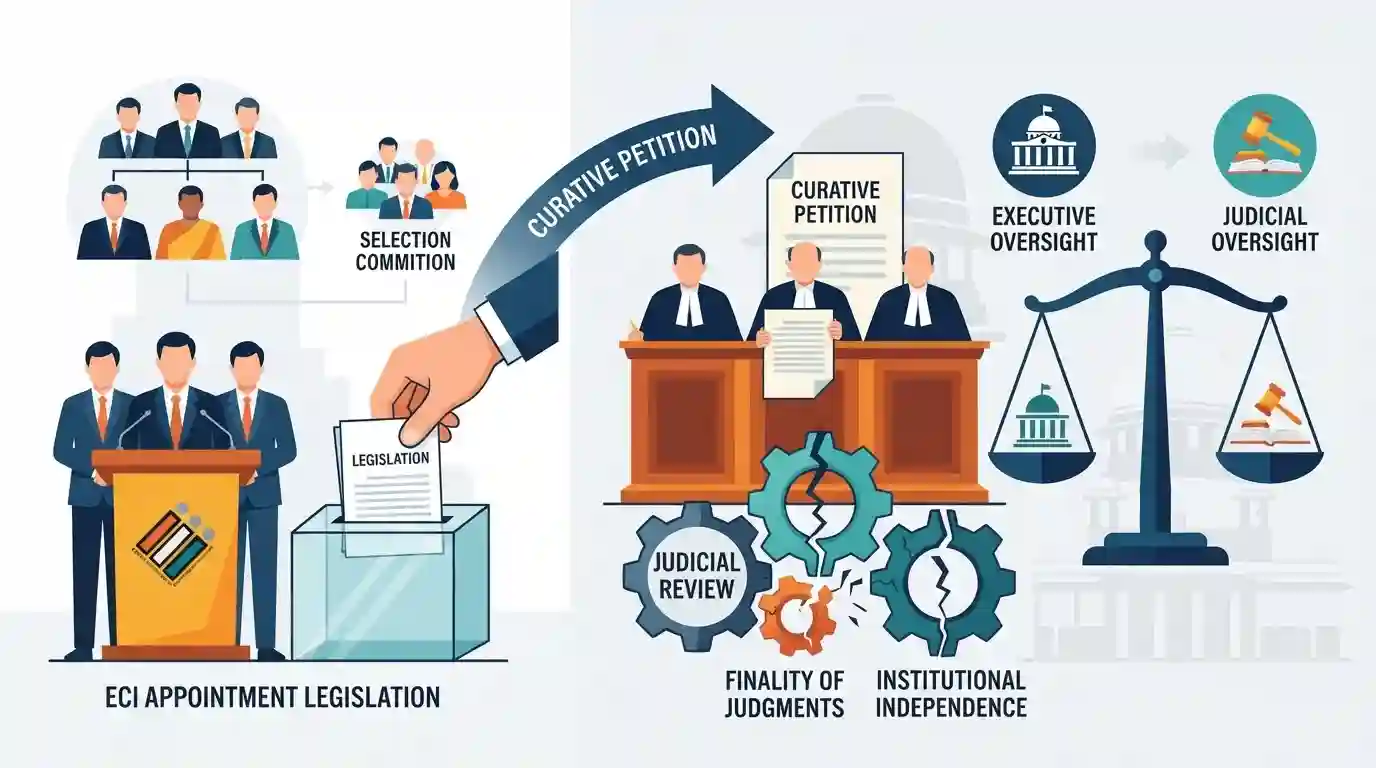
This development links two crucial areas of Indian polity: the institutional independence of the Election Commission of India through appointment mechanisms and the extraordinary constitutional jurisprudence surrounding curative petitions as the final remedy in the Supreme Court.
सारांश
A curative petition has been moved in the Supreme Court challenging the legislation governing the appointment of the Chief Election Commissioner and Election Commissioners, raising significant questions regarding judicial review, finality of judgments, and the institutional independence of the Election Commission of India.
मुख्य मुद्दे
- A curative plea has been filed in the Supreme Court challenging the constitutional validity of the law governing the appointment of the Chief Election Commissioner (CEC) and Election Commissioners (ECs).
- The petition challenges the Chief Election Commissioner and other Election Commissioners Act, 2023, which replaced the previous composition that included the Chief Justice of India in the selection panel with a Union Cabinet Minister.
- The curative petition represents the final judicial recourse available after a review petition is dismissed, following the landmark framework established in Rupa Hurra v. Ashok Hurra (2002).
महत्त्वाच्या संज्ञा
Chief Election Commissioner and other Election Commissioners (Appointment, Conditions of Service and Term of Office) Act, 2023

A 2023 legislation regulating the appointment, conditions of service, and term of office of the CEC and ECs, replacing the CJI with a Union Cabinet Minister on the selection committee.
UPSC context
Mains GS Paper II: Polity and Governance – Structure, Organization and Functioning of the Executive and the Judiciary, and Appointment to Constitutional Posts.
Article 324 of the Constitution
Article 324 provides for the superintendence, direction, and control of elections to be vested in an Election Commission consisting of the Chief Election Commissioner and other election commissioners.
UPSC context
Prelims and Mains GS Paper II: Constitutional provisions, structure, and independence of key constitutional bodies like the Election Commission of India.
Curative Petition
The final legal recourse available in the Supreme Court after a review petition is dismissed, aimed at preventing a gross miscarriage of justice or judicial bias.
UPSC context
Prelims and Mains GS Paper II: Judiciary, judicial review, curative powers under Article 137/142, and remedies against final judgments.
Election Commission of India
An autonomous constitutional body responsible for administering election processes in India under Article 324 of the Constitution.
UPSC context
Prelims and Mains GS Paper II: Constitutional bodies, their independence, functioning, and electoral reforms.
पूर्वपरीक्षा सापळा
A curative petition is a statutory right available to any litigant after the dismissal of a review petition under Article 137.
Aspirants often assume a curative petition is a constitutional remedy under Article 32 or a matter of right, whereas it is a rare, discretionary judicial innovation created entirely through case law.
संबंधित स्थिर संकल्पना
What is the legal framework and evolution of Curative Petitions in the Indian Supreme Court?
- Origin Case: Established in Rupa Hurra v. Ashok Hurra (2002) as the final constitutional recourse after a review petition is dismissed.
- Strict Grounds: Entertained only under extraordinary circumstances to prevent abuse of process and gross miscarriage of justice.
- Bench Composition: Generally circulated before a bench consisting of the CJI and the three senior-most judges who passed the impugned judgment.
How has the statutory framework governing the appointment of the Election Commission of India evolved?
- Constitutional Basis: Article 324(2) empowers the President to make appointments to the ECI subject to any law made by Parliament.
- SC Interim Norm: Anoop Baranwal v. Union of India (2023) ruled that the selection panel must include PM, Leader of Opposition, and the CJI until Parliament enacted a law.
- Legislative Change: The 2023 Act replaced the CJI with a Union Cabinet Minister, altering the balance of the selection committee.
आंतर-विषय नमुने
Judicial Independence vs Legislative Overrides
The debate over executive influence in the CEC appointment law directly mirrors legislative overrides of Supreme Court rulings on judicial appointments (NJAC case).
Curative Jurisdiction & Separation of Powers
Curative petitions represent the absolute frontier of judicial review, testing the doctrine of separation of powers when the judiciary re-examines a finalized legislative enactment.

Curative petitions (Rupa Hurra guidelines) combined with Article 324 institutional autonomy will likely appear as a 2-statement Prelims question.
संबंधित PYQ · 3
संबंधित PYQ · 3
- 2023MainsGS2
“Constitutionally guaranteed judicial independence is a prerequisite of democracy.” Comment.
- 2022MainsGS2
Discuss the role of the Election Commission of India in the light of the evolution of the Model Code of Conduct.
- 2020MainsGS2
Judicial Legislation is antithetical to the doctrine of separation of powers as envisaged in the Indian Constitution. In this context justify the filing of large number of public interest petitions praying for issuing guidelines to executive authorities.
