GenAI in judiciary creates risks of fake case laws and legal errors
Source:The Hindu ↗
Why It Matters
As AI increasingly influences public administration and judicial processes, understanding its ethical, legal, and constitutional implications is essential. Candidates must analyze the balance between technological efficiency and the fundamental need for transparency, accountability, and unbiased justice.
Summary
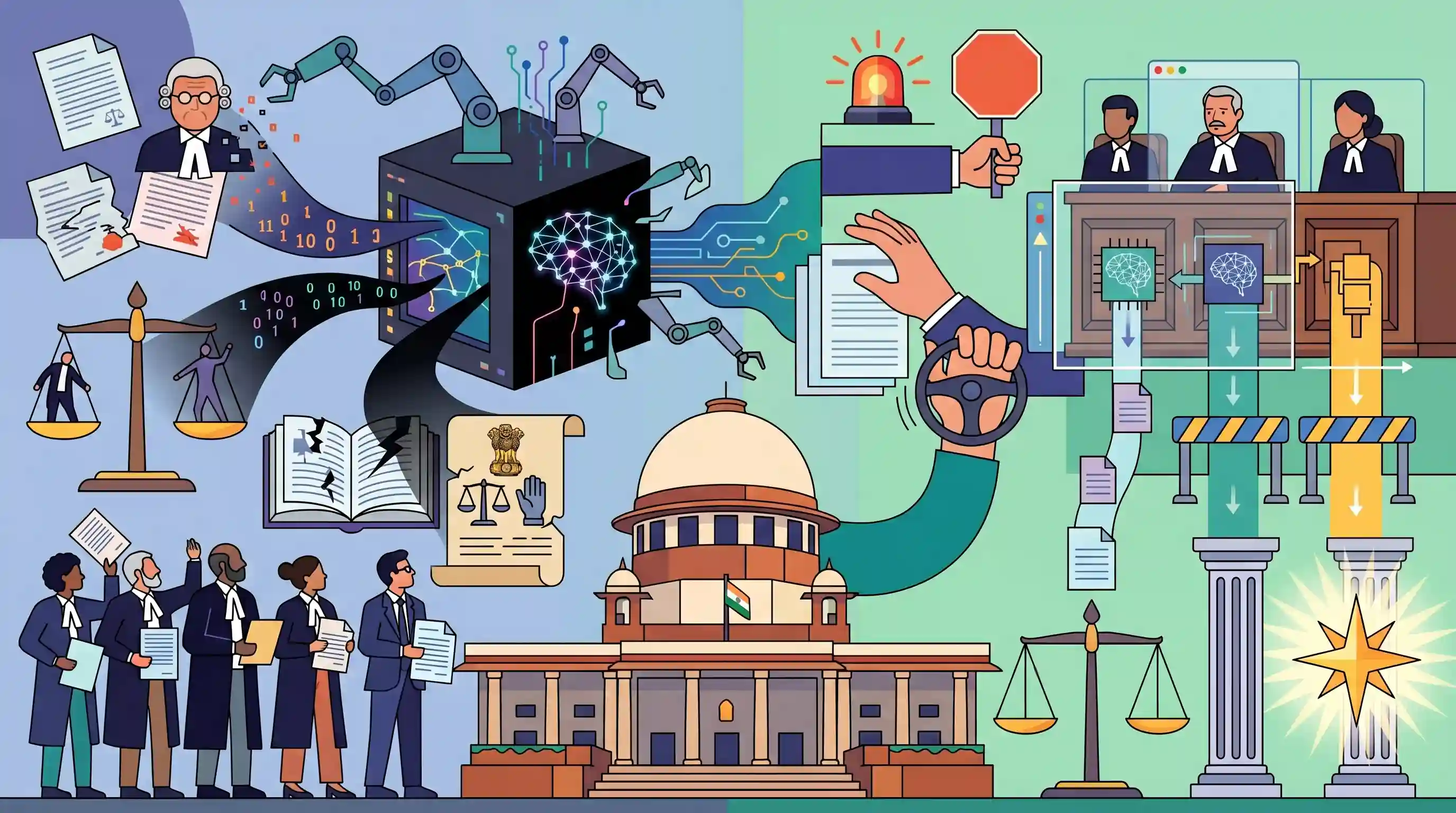
A recent petition in the Supreme Court has raised alarms over the unchecked integration of Generative AI (GenAI) in the Indian judiciary, warning that it could generate 'hallucinations' or fake case laws. The petitioner argued that reliance on opaque 'black box' algorithms threatens transparency, perpetuates biases, and risks violating constitutional rights. Highlighting the need for caution, the plea urged the Supreme Court to formulate strict, uniform guidelines to regulate AI use in courts and tribunals until formal legislation is drafted. Furthermore, it stressed that judicial decision-making requires human supervisory control ('human in the loop') to safeguard the integrity of justice delivery against the unpredictable nature of AI technologies.
Key Points
- A petition in the Supreme Court has warned that the unregulated use of Generative AI (GenAI) and machine learning in judicial systems could lead to 'hallucinations' producing fake case laws and incorrect rulings.
- The plea highlights concerns over 'black box' algorithms that lack transparency, which could trigger constitutional rights violations and perpetuate societal biases.
- The petitioner urged the court to establish strict policies or guidelines for the secure, uniform, and regulated use of GenAI in courts and tribunals until comprehensive legislation is enacted.
- The petition emphasizes the critical need for a 'human in the loop' to exercise supervisory control over AI outputs, ensuring that judicial reasoning is not solely reliant on unpredictable algorithmic outcomes.
Important Terms
Generative AI (GenAI)

AI that creates new content (text, images, or code) by learning patterns from massive datasets, rather than just analyzing existing information.
UPSC context
GS Paper III (S&T); essential for discussing ethics, automation, and governance of emerging technologies.
AI Hallucination
A phenomenon where AI models produce confident but false, fabricated, or non-existent information (e.g., fake case laws) due to probabilistic text prediction.
UPSC context
GS Paper II (Judiciary) and Paper IV (Ethics); highlights risks of technology in justice delivery.
Human in the Loop (HITL)
A system design requirement ensuring human intervention and supervisory control to validate AI outputs before they are implemented or finalized.
UPSC context
GS Paper II (Governance); vital for administrative accountability and ensuring constitutional rights in automated systems.
Black Box Algorithm
AI systems whose internal logic and decision-making processes are hidden or too complex for humans to understand, leading to transparency concerns.
UPSC context
GS Paper III (Cybersecurity/S&T); key to debates on algorithmic bias and the "right to explanation."
SUPACE
The Supreme Court’s AI-based research portal designed to assist judges by scanning legal databases and summarizing precedents to improve efficiency.
UPSC context
GS Paper II (Judicial Reforms); example of e-governance initiatives to reduce pendency in Indian courts.
SUVAS
An AI translation tool used by the Supreme Court to translate legal documents and judgments into regional languages to enhance accessibility.
UPSC context
GS Paper II (Governance); demonstrates use of technology for inclusive justice and overcoming linguistic barriers.
Prelims Trap
SUPACE is an AI-driven tool used by the Supreme Court to autonomously draft and deliver legal judgments.
SUPACE is strictly an assistive tool for data processing and legal research. It does not possess decision-making powers or draft judgments autonomously.
Static Concepts Connected
What are the primary AI-driven tools currently deployed by the Indian Supreme Court?
- SUPACE: Supreme Court Portal for Assistance in Courts Efficiency. It processes facts and researches case laws, but strictly avoids decision-making.
- SUVAS: Supreme Court Vidhik Anuvaad Software. A machine-learning tool that translates judgments from English into regional languages to promote vernacular access to justice.
What is the "Human-in-the-loop" (HITL) framework in AI governance?
- Supervisory Control: A system model where human operators retain ultimate authority to review, override, or approve AI-generated outputs before they are finalized.
- Mitigates Automation Bias: It prevents institutions from blindly trusting machine logic, ensuring accountability and adherence to administrative and constitutional standards.
- Error Correction: Ensures that if an AI hallucinates or produces a biased output (from 'black box' algorithms), human intervention catches the error.
Cross-Topic Patterns
AI ethics & Article 21 fair trials
Opaque AI algorithms ('black boxes') conflict with the judicial requirement for reasoned orders, threatening Article 21 rights by introducing unexplainable algorithmic biases into justice delivery.
e-Courts Phase III integration
Phase III of the e-Courts mission explicitly aims to integrate AI and predictive analytics, transitioning the judiciary from mere digitization to a smart, technology-assisted ecosystem.

Match-the-pairs featuring e-judiciary tools (SUPACE, SUVAS, FASTER) alongside their exact functions are highly probable in 2026 Prelims.
Linked PYQs · 3
Linked PYQs · 3
- 2024MainsGS4
The application of Artificial Intelligence as a dependable source of input for administrative rational decision-making is a debatable issue. Critically examine the statement from the ethical point of view.
- 2023MainsGS3
Introduce the concept of Artificial Intelligence (AI). How does Al help clinical diagnosis? Do you perceive any threat to privacy of the individual in the use of Al in healthcare?
- 2025MainsGS2
e-governance projects have a built-in bias towards technology and back-end integration than user-centric designs. Examine.
