Political Transition in Hungary and Rule of Law Reforms
Source:The Hindu ↗
Why It Matters
The regime change in Hungary provides a crucial case study on 'illiberal democracy', democratic backsliding, and institutional recovery. For UPSC aspirants, it illustrates how supranational bodies like the EU enforce rule-of-law standards through financial levers, and serves as an important reference point for GS2 topics concerning the functioning of democracies globally.
Summary
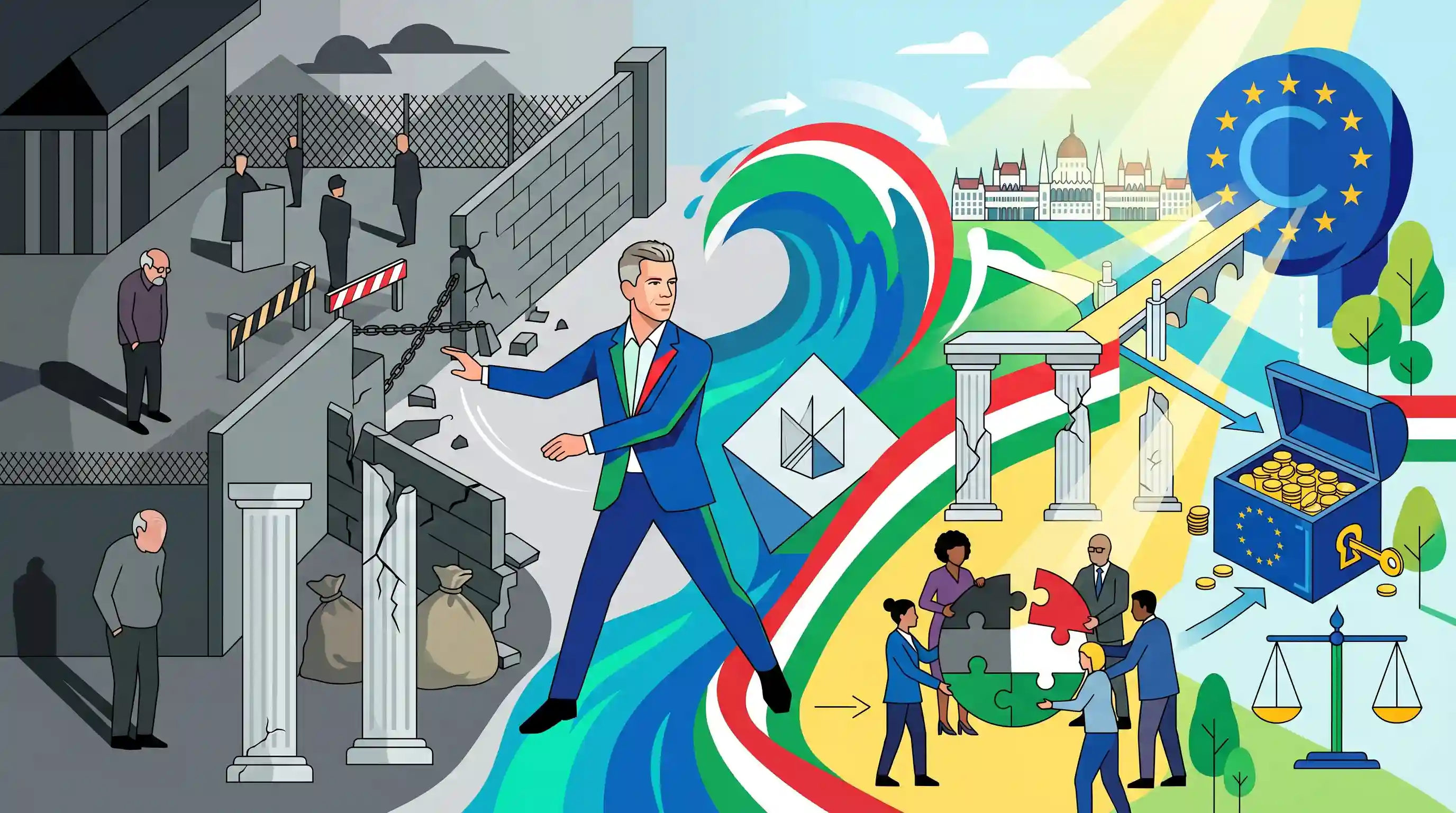
Pro-European conservative Peter Magyar has been sworn in as Hungary's Prime Minister following a landslide election victory by his Tisza party, which secured a two-thirds parliamentary majority and ended Viktor Orban's 16-year rule. Pledging sweeping reforms to dismantle Orban's 'illiberal democracy', Magyar aims to restore institutional independence, combat corruption, and unlock billions in frozen EU funds. His diverse cabinet appointments signal a shift toward national unity and closer alignment with European democratic norms.
Key Points
- Peter Magyar was sworn in as Hungary's Prime Minister, ending Viktor Orban's 16-year tenure characterized by an 'illiberal democracy'.
- Magyar's Tisza party secured a two-thirds majority (141 out of 199 seats) in the April 2026 parliamentary elections.
- The new government's primary goals include restoring the independence of the judiciary, media, and academia, and fighting corruption.
- A crucial task for Magyar is to unfreeze billions in EU funds blocked by Brussels due to rule-of-law concerns under the previous regime.
- To emphasize national unity, Magyar's cabinet features diverse representation, including women in senior roles, a visually impaired minister, and a Roma Deputy Parliament Speaker.
Important Terms
Tisza Party (TISZA)

A Hungarian centre-right, pro-European political party led by Péter Magyar. It won a two-thirds supermajority in the 2026 elections, campaigning on anti-corruption and the restoration of democratic norms.
UPSC context
GS Paper II (International Relations); significant for studying regime shifts and the role of opposition movements in transitioning democracies.
Illiberal Democracy
A political system where citizens can vote but are denied real knowledge about the activities of those who exercise real power due to the lack of civil liberties and transparency.
UPSC context
GS Paper II (Polity/Governance); tests the conceptual understanding of democratic backsliding and the distinction between electoral and substantive democracy.
European Commission
The executive branch of the European Union. It proposes legislation, implements decisions, upholds EU treaties, and manages the day-to-day business of the Union.
UPSC context
GS Paper II (International Relations); essential for understanding supranational governance structures and India-EU bilateral relations.
Rule of Law Conditionality Mechanism
An EU legal instrument allowing the withholding of funds from member states that violate democratic principles like judicial independence, effectively using financial leverage to enforce the Rule of Law.
UPSC context
GS Paper II (International Relations/Governance); relevant for analyzing international law enforcement and the protection of democratic standards in global blocs.
Constitutional Supermajority
A legislative majority (often two-thirds) required to pass laws or constitutional amendments that are more significant than ordinary legislation.
UPSC context
GS Paper II (Comparison of Constitutions); tests knowledge of parliamentary power, executive dominance, and constitutional stability in different political systems.
Rule of Law
The fundamental principle that all citizens and institutions within a country are accountable to the same laws, including lawmakers themselves, ensuring justice and fairness.
UPSC context
GS Paper II (Polity); a core concept in the Indian Constitution and essential for comparing global democratic frameworks.
Prelims Trap
The European Union can unilaterally expel a member state for violating democratic norms or rule-of-law principles.
The EU treaties provide no mechanism to expel a member state. Brussels can only freeze budget allocations or suspend voting rights (Article 7) for rule-of-law violations.
Static Concepts Connected
What is the EU's Rule of Law Conditionality Mechanism?
- Budget protection: Allows the EU to suspend budget payments to member states when breaches of the rule of law directly threaten the union's financial interests.
- Trigger conditions: Invoked for systemic issues like compromised judicial independence, failure to tackle high-level corruption, or lack of independent prosecution.
- Enforcement mechanism: Requires a qualified majority of member states in the EU Council to approve the European Commission's proposal to freeze the funds.
What defines an 'Illiberal Democracy'?
- Electoral facade: A system where regular multiparty elections take place, but civil liberties, press freedom, and independent institutions are systematically curtailed by the state.
- Lack of checks: Characterized by weak constitutionalism, where the ruling executive faces minimal effective checks and balances from the judiciary, legislature, or civil society.
Cross-Topic Patterns
India-EU FTA and European Council consensus
A pro-EU administration in Hungary removes a major dissenting veto within the European Council, potentially smoothing the bloc's internal consensus required to finalize the long-stalled India-EU Free Trade Agreement.
Mains GS-2: Constitutionalism vs. Majoritarianism
Hungary's political trajectory is a classic comparative politics case study on how overwhelming parliamentary majorities can legally dismantle institutional checks and independent media without officially suspending elections.

Expect a GS-2 Mains question comparing structural safeguards against democratic backsliding and majoritarianism in parliamentary systems.
Linked PYQs · 3
Linked PYQs · 3
- 2024MainsGS2
“The growth of cabinet system has practically resulted in the marginalisation of the parliamentary supremacy.” Elucidate.
- 2022MainsGS2
Critically examine the procedures through which the Presidents of India and France are elected.
- 2018MainsGS2
India and USA are two large democracies. Examine the basic tenets on which the two political systems are based.
