Spiti tourism operators protest wildlife permit fee hike
Source:himachalscape ↗
Why It Matters
The issue highlights the tension between wildlife conservation funding and local livelihoods dependent on ecotourism. For HPAS Prelims, the geographical locations mentioned (Kibber Wildlife Sanctuary, Churdhar Sanctuary, Parang La pass connecting Spiti to Ladakh) are highly recurrent facts in the state geography and environment syllabus.
Summary
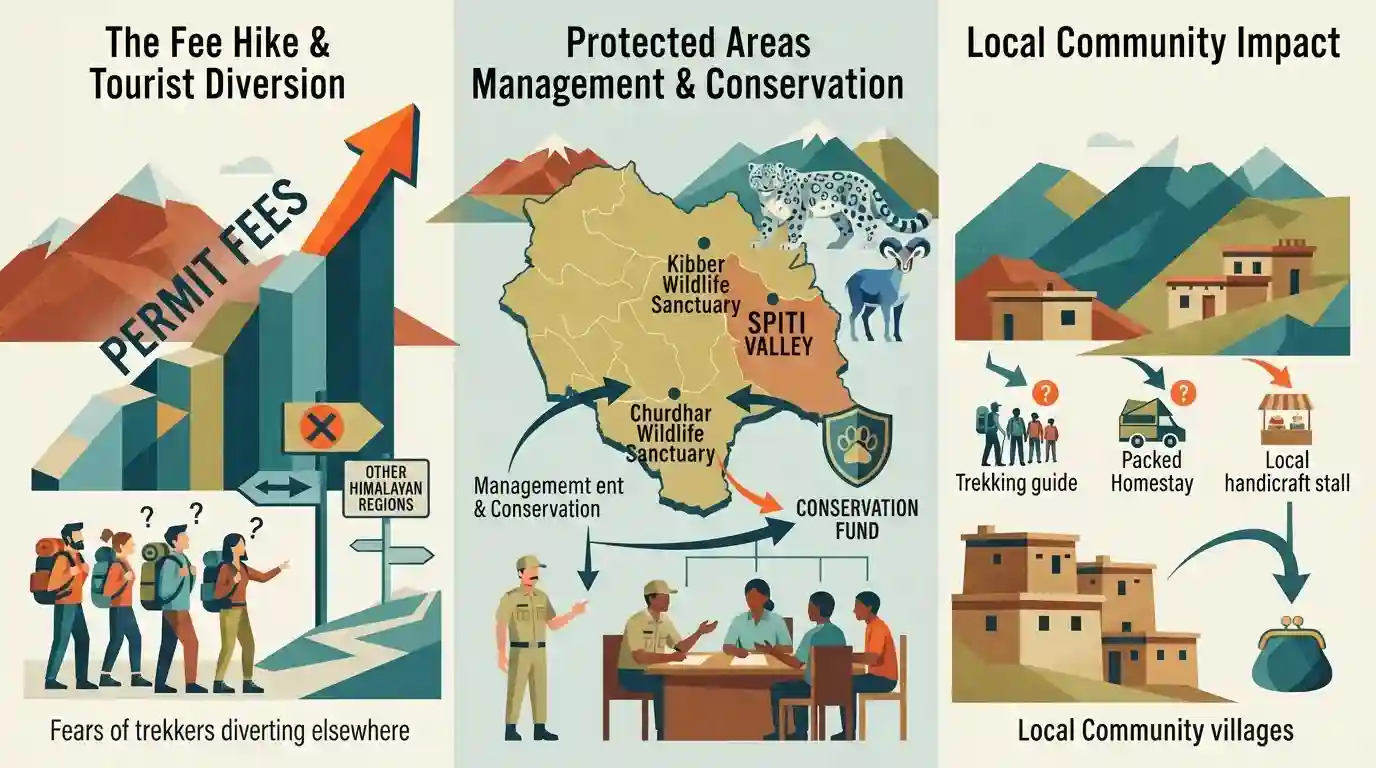
A steep hike in trekking permit fees introduced under the revised Himachal Pradesh Wildlife (Protection) Rules has alarmed tourism operators and local communities in Spiti Valley. Treks passing through protected areas like Kibber Wildlife Sanctuary, such as the Parang La trek to Ladakh, now require exceptionally high fees. This prompts fears that international and domestic trekkers will divert to other Himalayan regions. While the fees are intended to support wildlife conservation efforts, such as protecting snow leopards, the policy threatens the livelihoods of remote villages heavily dependent on adventure tourism. Similar concerns have also been raised regarding access to the Churdhar Wildlife Sanctuary.
Key Points
- The Himachal Pradesh Forest Department has significantly increased trekking permit fees in protected wildlife areas under revised wildlife protection rules.
- The fee hike heavily impacts popular routes like the Parang La trek, which connects Kibber in Spiti Valley to Korzok in Ladakh.
- Local communities in villages like Kibber, Chicham, and Tashigang fear severe economic losses as trekkers might divert to neighboring regions such as Ladakh, Uttarakhand, and Nepal.
- While the fees aim to fund wildlife conservation (including snow leopards), tourism operators warn it will decimate the adventure tourism economy in areas like Spiti and Churdhar Wildlife Sanctuary.
Important Terms
Himachal Pradesh Wildlife (Protection) Rules

State-level regulations managing activities within protected wildlife areas. Recent revisions implemented a steep hike in permit fees for trekking and camping, aiming to fund conservation but threatening local adventure tourism.
UPSC context
GS3 Environment. Tests the balance between wildlife conservation policies and local tourism-dependent livelihoods.
Kibber Wildlife Sanctuary
A high-altitude cold desert sanctuary in Himachal Pradesh's Lahaul and Spiti district. Located along the Spiti River, it serves as a crucial habitat for snow leopards, Tibetan wolves, and blue sheep.
UPSC context
GS3 Environment. Highly relevant for Prelims mapping and Trans-Himalayan biodiversity conservation topics.
Parang La
A high-altitude glaciated mountain pass at roughly 5,600 meters. It serves as a traditional trade and popular trekking route connecting the Spiti Valley in Himachal Pradesh to southeastern Ladakh.
UPSC context
GS1 Geography. Frequently tested in Prelims mapping of Himalayan mountain passes and strategic routes.
Churdhar Wildlife Sanctuary
A protected area in Himachal Pradesh's Sirmaur district encompassing Churdhar Peak, the highest in the outer Himalayas. It is renowned for medicinal plants, oak, deodar trees, and Himalayan black bears.
UPSC context
GS3 Environment. Tests awareness of lesser-known protected areas and Himalayan medicinal flora conservation.
Spiti Valley
A high-altitude, cold desert mountain valley in the Trans-Himalayan region of Himachal Pradesh. It is part of the Cold Desert Biosphere Reserve and known for its fragile ecology and adventure tourism.
UPSC context
GS1 Geography & GS3 Environment. Tests knowledge of cold desert ecosystems and sustainable mountain development.
Prelims Trap
Churdhar Wildlife Sanctuary is located in the Trans-Himalayan region of Spiti Valley.
Churdhar is in the Sirmaur district of the Outer Himalayas (Shivalik range), whereas Spiti lies in the Trans-Himalayan zone.
Static Concepts Connected
What defines the Trans-Himalayan Biogeographic Zone in India?
- Arid Climate: Cold desert ecosystem lying in the rain-shadow of the Greater Himalayas with sparse alpine vegetation.
- Unique Wildlife: Serves as a critical habitat for specialized species including the Snow Leopard, Bharal (Blue Sheep), and Tibetan Argali.
- Geographical Scope: Comprises Ladakh, Lahaul-Spiti, and parts of Sikkim, representing roughly 5.6% of India's landmass.
How does the Wildlife (Protection) Act, 1972 regulate entry into Protected Areas?
- Permit Authority: Section 28 empowers the Chief Wildlife Warden to grant permits to enter sanctuaries for tourism, photography, or scientific research.
- Fee Regulation: State governments can prescribe fees for entry, photography, and commercial activities within sanctuaries and national parks.
- Local Rights: Section 24 allows for the determination and settlement of existing rights of local/tribal populations before final sanctuary notification.
Cross-Topic Patterns
Eco-tourism vs Fifth Schedule Rights
High-altitude conservation policies often conflict with local tribal economic autonomy in Scheduled Areas like Lahaul-Spiti, testing the balance between state-led environmental protection and traditional livelihoods.
Transboundary Conservation and Security
Himalayan passes like Parang La are ecological corridors for wildlife and strategic frontier pathways, linking environmental conservation directly to border management and regional security.

High-altitude mountain passes and adjacent wildlife sanctuaries (like Parang La and Kibber) are highly prone to physical geography mapping questions.
Linked PYQs · 5
Linked PYQs · 5
- 2022HPAS_PRELIMSGS1
Which of the following statements is correct ? (i) 'Dhauladhar Range' branches off from the Great Himalayan Range near Badrinath (ii) The Pir-Panjal range separates the drainage of the river Spiti from that of the river Beas. (iii) The Zanskar range is the easternmost range which separates Spiti and Kashmir from Tibet. (iv) The 'Gumrang' and 'Sholarang' passes connect the basin of the river Chandrabhaga with its basin in Tibet.
- 2023HPAS_PRELIMSGS1
Match List I with List II : | List-I (District) | List-II (Wildlife Sanctuary) | |---|---| | (a) Kinnaur | (i) Rupi Bhaba | | (b) Chamba | (ii) Sechu Tuan Nala | | (c) Mandi | (iii) Kibber | | (d) Lahaul and Spiti | (iv) Nargu | Choose the correct answer from the options given below : Code: (a) (b) (c) (d)
- 2024HPAS_PRELIMSGS1
Consider the following statements : (1) Monkey valley lies in Chamba. (2) Kiarda Dun valley lies in Kangra. (3) The Great Himalayas are referred as Alpine zone in Himachal Pradesh. (4) Churadhar pertain to Zanskar range in Himachal Pradesh Choose the correct answer from the options given below :
- 2025HPAS_PRELIMSGS1
Consider the following statements : (1) Kibbar is the largest wildlife sanctuary in Himachal Pradesh. (2) Kheerganga National Park was established in 1994 in Himachal Pradesh. (3) Tarla wildlife sanctuary of Himachal Pradesh has an area of 46.4 km². (4) Chail wildlife sanctuary of Himachal Pradesh was established in 1962. Choose the correct answer from the options given below :
- 2024HPAS_PRELIMSGS1
Arrange the following years based on the number of foreign tourist arrivals in Himachal Pradesh in descending order : (1) 2020 (2) 2021 (3) 2022 (4) 2023 (up to December 2023) Choose the correct option :
