NIMHANS study links peripheral inflammation to brain damage
Source:The Hindu ↗
Why It Matters
The article touches on applied biomedical research, which is a core component of the GS-3 Science & Technology syllabus. The focus on neuroimmunology and rare diseases highlights the need for indigenous R&D capabilities (GS-3) and touches upon the broader public health and policy framework (GS-2) required to support patients with neglected and rare medical conditions.
Summary
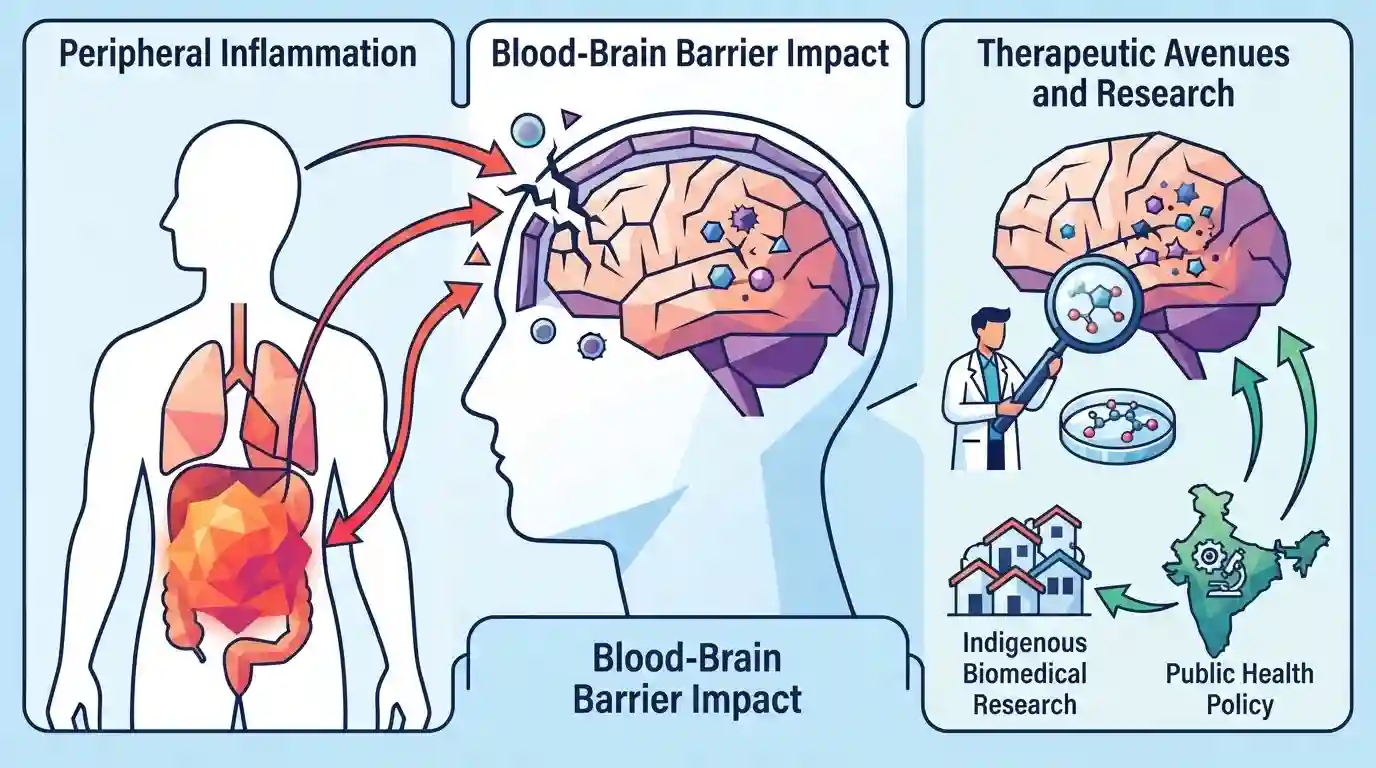
A recent study by the National Institute of Mental Health and Neuro Sciences (NIMHANS) has revealed that peripheral inflammation—inflammation occurring outside the central nervous system—may play a key role in driving brain damage in a rare neurological disorder. The research suggests that systemic immune responses can significantly impact the brain, likely by affecting the blood-brain barrier and triggering neurodegeneration. This discovery is a major step forward in neuroimmunology, indicating that treating systemic inflammation could offer new therapeutic avenues for rare and debilitating neurological conditions. The findings also underscore the need for enhanced indigenous biomedical research and robust health policies to tackle rare diseases in India.
Key Points
- A new study by NIMHANS establishes a crucial link between peripheral inflammation and brain damage in a rare neurological disorder.
- Peripheral inflammation (immune responses outside the brain and spinal cord) was found to cross or impact the blood-brain barrier, triggering or exacerbating neurodegeneration.
- The findings challenge the traditional approach of focusing solely on the central nervous system (CNS), pointing instead to systemic immunity as a driver of neural damage.
- Targeting and mitigating peripheral inflammatory markers could provide novel therapeutic pathways to slow down brain damage in affected patients.
- The breakthrough highlights the importance of neuroimmunology and emphasizes the need for increased research and funding for rare diseases in India.
Important Terms
National Policy for Rare Diseases (NPRD)

A framework by the Ministry of Health and Family Welfare providing structured treatment, indigenous research, and financial aid up to ₹50 lakh per patient across three categorized disease groups.
UPSC context
GS Paper II (Health & Welfare); tests public health policy, healthcare financing, and support schemes for vulnerable sections.
National Institute of Mental Health and Neuro Sciences (NIMHANS)
An autonomous Institute of National Importance in Bengaluru, functioning under the Ministry of Health and Family Welfare as the apex center for mental health and neuroscience research.
UPSC context
GS Paper II (Governance & Health); tests national medical institutions, mental health frameworks, and clinical research capacities.
Blood-Brain Barrier (BBB)
A highly selective semipermeable border of endothelial cells, pericytes, and astrocytes that regulates substance passage between blood circulation and the brain's extracellular fluid.
UPSC context
GS Paper III (Science & Technology); tests human biology, neurodegenerative disease mechanisms, and advanced drug delivery research.
Neuroimmunology
An interdisciplinary scientific field combining neuroscience and immunology to study the mutual interactions of the nervous and immune systems in health and disease.
UPSC context
GS Paper III (Science & Tech); tests biotechnology advancements, medical research trends, and chronic disease pathologies.
Prelims Trap
Financial aid under the National Policy for Rare Diseases is strictly limited to Group 1 diseases and BPL families.
The 2021 policy originally had narrower limits, but subsequent amendments expanded the Rs. 50 lakh financial support to all rare disease groups and broadened eligibility to 40% of the population (PM-JAY beneficiaries), not just BPL.
Static Concepts Connected
How are rare diseases classified under the National Policy for Rare Diseases (NPRD) 2021?
- Group 1: Disorders amenable to one-time curative treatment, such as osteopetrosis or specific immune deficiencies.
- Group 2: Diseases requiring long-term or lifelong treatment where the medical cost is relatively lower and efficacy is documented.
- Group 3: Diseases with available definitive treatments that carry extremely high costs and require lifelong therapy.
What is the Blood-Brain Barrier (BBB) and its primary function?
- Structure: A highly selective, semipermeable barrier composed of endothelial cells, astrocyte end-feet, and pericytes.
- Function: Crucially regulates the passage of systemic cells, pathogens, and large molecules into the CNS to maintain neural homeostasis.
- Pathology: Infections, chronic systemic inflammation, or trauma can compromise tight junctions, leading to neurodegenerative damage.
Cross-Topic Patterns
Rare Diseases + IP Rights
High costs of orphan drugs stem from global patent protections, forcing a policy debate on utilizing TRIPS flexibilities to manufacture affordable, indigenous generic therapies.
Health Federalism + Tertiary Care
While Health is a State subject, central schemes like NPRD rely heavily on centrally-funded tertiary Centres of Excellence (CoEs) for implementation, testing federal health architecture.

NIMHANS statutory status, BBB physiology, or NPRD 2021 funding changes likely to feature in multi-statement S&T/policy MCQs.
Linked PYQs · 4
Linked PYQs · 4
- 2021MainsGS3
What are the research and developmental achievements in applied biotechnology? How will these achievements help to uplift the poorer sections of the society?
- 2024MainsGS2
In a crucial domain like the public healthcare system the Indian State should play a vital role to contain the adverse impact of marketisation of the system. Suggest some measures through which the State can enhance the reach of public healthcare at the grassroots level.
- 2023MainsGS3
Introduce the concept of Artificial Intelligence (AI). How does Al help clinical diagnosis? Do you perceive any threat to privacy of the individual in the use of Al in healthcare?
- 2021PrelimsGS1
In the context of hereditary diseases, consider the following statements : 1. Passing on mitochondrial diseases from parent to child can be prevented by mitochondrial replacement therapy either before or after in vitro fertilization of egg. 2. A child inherits mitochondrial diseases entirely from mother and not from father. Which of the statements given above is/are correct?
