Gram Sabha Powers and Tribal Land Issues in Scheduled Areas
Source:The Hindu ↗
हे का महत्त्वाचे आहे
It directly addresses decentralized governance, protection of tribal rights, and statutory compliance with laws like the Forest Rights Act and PESA, which are core themes in UPSC GS Paper II (Governance, Polity, and Social Justice).
सारांश
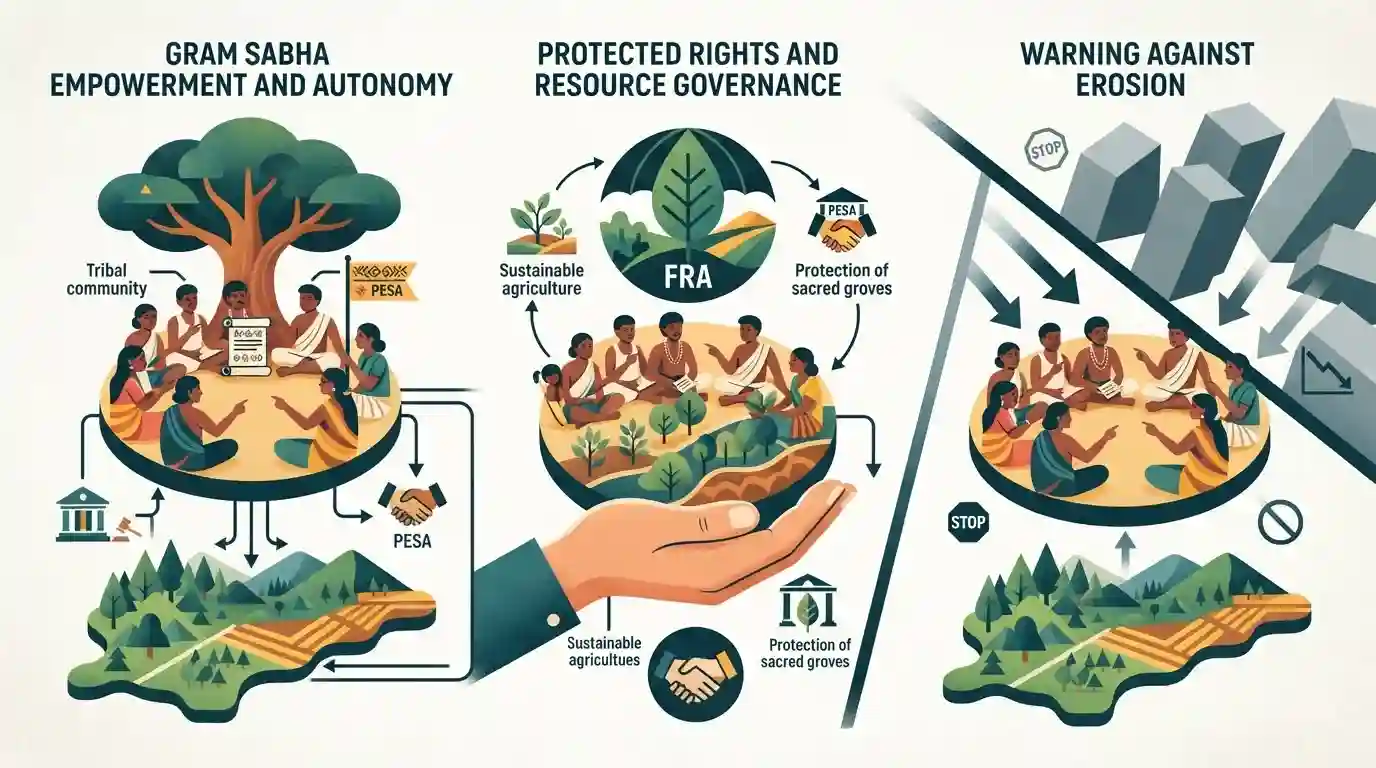
The editorial examines the critical issue of eroding Gram Sabha powers regarding tribal land and resource governance, emphasizing the protection of rights under the Forest Rights Act and PESA, and warning against any regression in participatory grassroots democracy.
मुख्य मुद्दे
- The article discusses concerns regarding the dilution or weakening of Gram Sabha powers concerning tribal land issues and resource management.
- Gram Sabhas are vital statutory entities under the Forest Rights Act (FRA) 2006 and PESA 1996, tasked with protecting tribal land rights, cultural heritage, and giving mandatory consent for land acquisition or diversion.
- Proposals or actions that bypass or undermine Gram Sabha consent threaten indigenous livelihoods, ecological security, and statutory democratic decentralization in scheduled areas.
- Strong legal safeguards and adherence to constitutional provisions (like Schedule V) are crucial to prevent the alienation of tribal lands and ensure inclusive governance.
महत्त्वाच्या संज्ञा
Forest Rights Act (FRA), 2006

A landmark legislation enacted to recognize and vest forest rights and occupation in forest land in forest-dwelling Scheduled Tribes and traditional forest dwellers who have been residing in such forests for generations.
UPSC context
GS Paper II/III (Governance, Environment); tests understanding of tribal rights, historical injustice rectification, and decentralized forest governance.
Panchayats (Extension to the Scheduled Areas) Act (PESA), 1996
An act that extends the provisions of Panchayats to the Scheduled Areas of India, empowering Gram Sabhas with self-governance and control over local resources, minor forest produce, and dispute resolution.
UPSC context
GS Paper II (Governance, Polity); tests devolution of powers, tribal self-rule, and grassroots local democracy in Scheduled Areas.
Gram Sabha
The primary body of local self-government at the village level under the Panchayati Raj system, comprising all adult registered voters within the village area.
UPSC context
GS Paper II (Polity and Governance); tests grassroots participatory democracy, direct democracy mechanisms, and tribal resource management.
पूर्वपरीक्षा सापळा
PESA 1996 automatically extends central Panchayat provisions uniformly to all tribal-majority districts across India.
Aspirants often assume PESA automatically applies across all states and districts, missing that it specifically applies only to Fifth Schedule areas across ten states, requiring separate state-level adaptations.
संबंधित स्थिर संकल्पना
What are the key constitutional and statutory powers of Gram Sabhas under PESA and FRA?
- PESA Mandate: PESA mandate: Empowers Gram Sabhas in Fifth Schedule areas to approve development plans, select beneficiaries, and grant mandatory consent for land acquisition.
- FRA Authority: FRA authority: Designates the Gram Sabha as the foundational statutory authority to initiate, process, and recommend claims for community and individual forest rights.
- Governor Powers: Fifth Schedule: Grants Governors sweeping powers to modify central and state laws to prohibit or restrict the transfer of tribal land.
आंतर-विषय नमुने
Environmental Clearance vs. Grassroots Democracy
The weakening of Gram Sabha consent mirrors debates in environmental clearance streamlining, where mandatory public hearings and local consultations are increasingly sidelined for infrastructure speed.
PESA, Tribal Alienation, and LWE Linkages
PESA implementation failure intersects directly with Left-Wing Extremism (LWE) hotspots, as alienation from land and resources feeds systemic tribal grievances.

Expect an assertion-reasoning or multi-statement prelims question testing exact statutory powers of Gram Sabhas under FRA vs. PESA.
संबंधित PYQ · 3
संबंधित PYQ · 3
- 2013PrelimsGS1
Under the Scheduled Tribes and Other Traditional Forest Dwellers (Recognition of Forest Rights) Act, 2006, who shall be the authority to initiate the process for determining the nature and extent of individual or community forest rights or both?
- 2019PrelimsGS1
Consider the following statements: 1. As per recent amendment to the Indian Forest Act, 1927, forest dwellers have the right to fell the bamboos grown on forest areas. 2. As per the Scheduled Tribes and Other Traditional Forest Dwellers (Recognition of Forest Rights) Act, 2006, bamboo is a minor forest produce. 3. The Scheduled Tribes and Other Traditional Forest Dwellers (Recognition of Forest Rights) Act, 2006 allows ownership of minor forest produce to forest dwellers. Which of the statements given above is/are correct?
- 2021PrelimsGS1
At the national level, which ministry is the nodal agency to ensure effective implementation of the Scheduled Tribes and Other Traditional Forest Dwellers (Recognition of Forest Rights) Act, 2006?
