Gram Sabha Powers and Tribal Land Rights Implementation in India
Source:The Hindu ↗
Why It Matters
It highlights critical issues regarding the enforcement of statutory rights and decentralised governance for Scheduled Tribes in India, intersecting directly with the implementation of the Forest Rights Act and PESA.
Summary
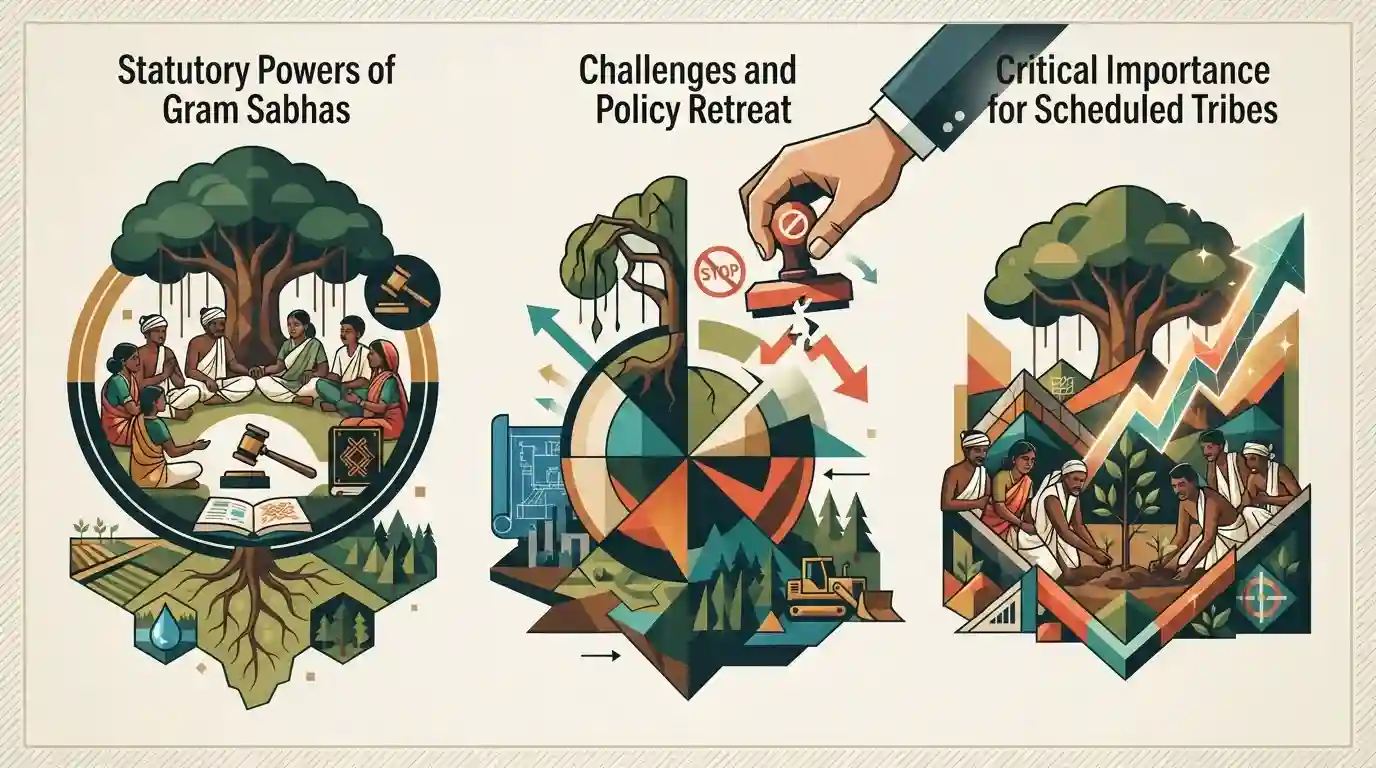
The editorial critically examines the policy retreat and challenges surrounding the statutory powers of Gram Sabhas in protecting tribal land and deciding on forest diversions, highlighting the critical importance of decentralized grassroots democracy for Scheduled Tribes.
Key Points
- The editorial discusses the growing concerns over the dilution or bypassing of Gram Sabha powers concerning tribal land issues and forest land diversion.
- Gram Sabhas serve as the foundational pillar for decentralized governance and tribal rights under the Forest Rights Act (FRA), 2006, and PESA, 1996.
- Erosion of Gram Sabha consent mechanisms threatens tribal livelihoods, ecological sustainability, and constitutional safeguards meant for Scheduled Areas.
Important Terms
Forest Rights Act (FRA) 2006

A landmark 2006 legislation that recognizes and vests forest rights and occupation in forest land in forest-dwelling Scheduled Tribes and traditional forest dwellers, aiming to correct historical injustices and empower Gram Sabhas in forest management.
UPSC context
Critical for GS Paper II (Governance, Social Justice) and GS Paper III (Environment, Biodiversity), focusing on tribal rights and forest governance.
PESA Act 1996
An enactment that extends the provisions of Part IX of the Constitution relating to Panchayats to the Fifth Schedule Scheduled Areas, granting sweeping self-governance powers and control over local natural resources to Gram Sabhas.
UPSC context
Important for GS Paper II (Polity and Governance), testing decentralization, grassroots democracy, and administration of Scheduled Areas.
Gram Sabha
The primary village-level assembly comprising all registered voters in a village area, vested with critical statutory powers under the PESA Act and FRA to protect tribal lands, customs, and forest resources.
UPSC context
Essential for GS Paper II under local self-government, decentralized democracy, and empowerment of vulnerable sections.
Ministry of Tribal Affairs
The nodal central government ministry in India responsible for formulating policies, planning, and coordinating programs for the socio-economic development and legal protection of Scheduled Tribes.
UPSC context
Relevant for GS Paper II (Governance and Institutional Frameworks for Vulnerable Sections).
Static Concepts Connected
What are the key provisions and institutional mechanism of the Panchayats (Extension to Scheduled Areas) Act, 1996?
- Constitutional Extension: Extends Part IX of the Constitution with modifications to Fifth Schedule areas across ten states.
- Gram Sabha Supremacy: Vests sweeping powers in Gram Sabhas including ownership of minor forest produce and mandatory consultation for land acquisition.
- Social Safeguards: Prevents alienation of land in Scheduled Areas and empowers Panchayats to regulate sale of intoxicants.
Cross-Topic Patterns
PESA vs. Industrial Land Acquisition
Tribal self-governance under PESA often clashes with infrastructure-driven development pushes in Fifth Schedule areas, testing the balance between state-led growth and constitutional safeguards.

Expect a multi-statement question combining PESA, FRA 2006, and Governor's special powers in Fifth Schedule areas.
Linked PYQs · 3
Linked PYQs · 3
- 2013PrelimsGS1
Under the Scheduled Tribes and Other Traditional Forest Dwellers (Recognition of Forest Rights) Act, 2006, who shall be the authority to initiate the process for determining the nature and extent of individual or community forest rights or both?
- 2019PrelimsGS1
Consider the following statements: 1. As per recent amendment to the Indian Forest Act, 1927, forest dwellers have the right to fell the bamboos grown on forest areas. 2. As per the Scheduled Tribes and Other Traditional Forest Dwellers (Recognition of Forest Rights) Act, 2006, bamboo is a minor forest produce. 3. The Scheduled Tribes and Other Traditional Forest Dwellers (Recognition of Forest Rights) Act, 2006 allows ownership of minor forest produce to forest dwellers. Which of the statements given above is/are correct?
- 2021PrelimsGS1
At the national level, which ministry is the nodal agency to ensure effective implementation of the Scheduled Tribes and Other Traditional Forest Dwellers (Recognition of Forest Rights) Act, 2006?
