Judicial Perspective on Air Pollution Policies and Livelihoods
Source:The Hindu ↗
Why It Matters
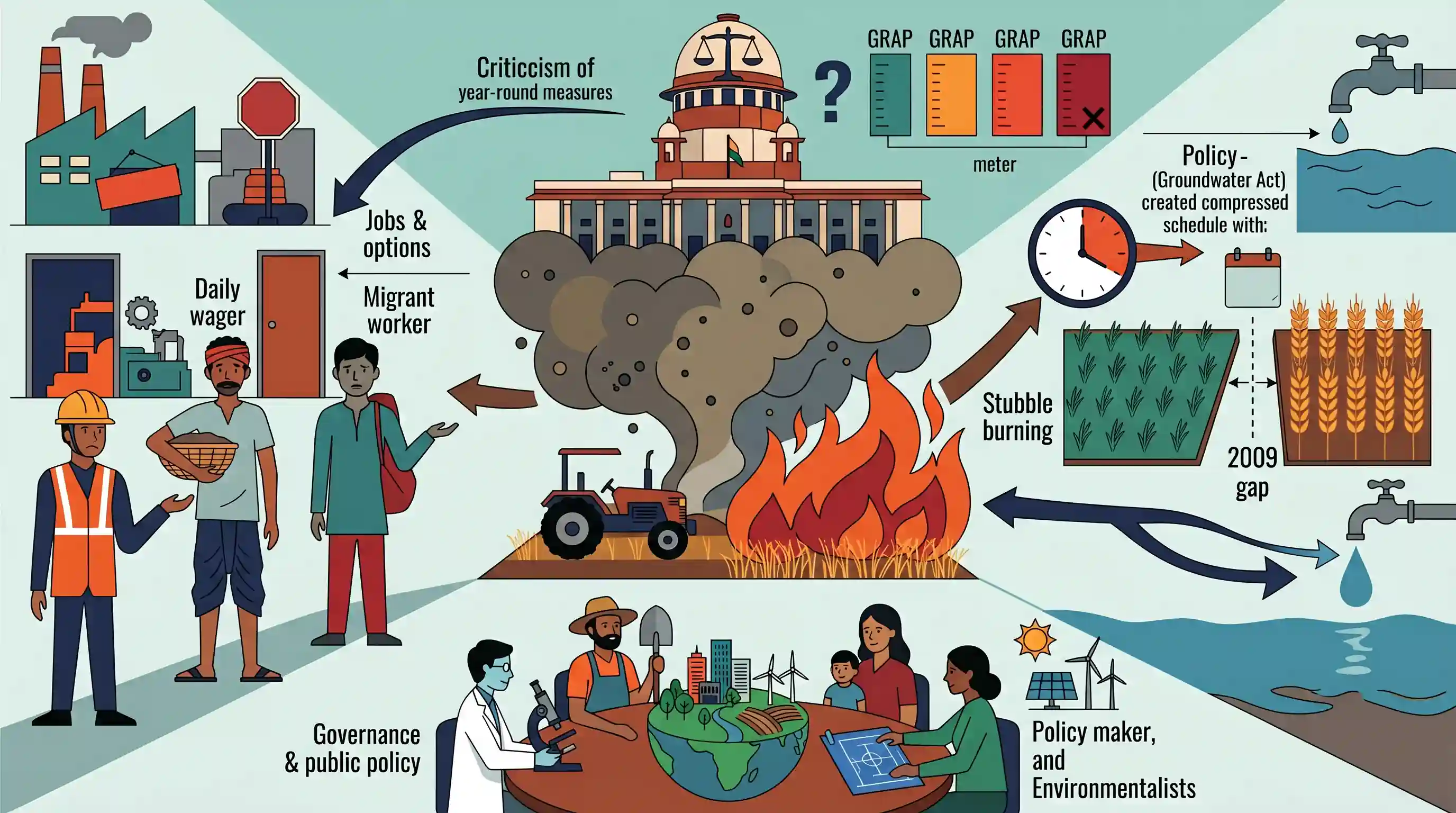
The article perfectly illustrates the concept of policy trade-offs and unintended consequences. It links agricultural water conservation policies (Groundwater Preservation Act) to an environmental crisis (stubble burning and air pollution), while simultaneously highlighting the conflict between environmental regulation (GRAP) and socio-economic survival (livelihoods of daily wagers). This multi-dimensional issue is highly relevant for GS-3 answers on environmental impact, agriculture, and inclusive growth.
Summary
The Supreme Court of India has criticized the proposition of maintaining a year-round Graded Response Action Plan (GRAP) to resolve Delhi\'s severe air pollution, warning that such measures disproportionately harm the livelihoods of daily wagers and migrant workers. During the hearing, it was revealed that agricultural policies like the Groundwater Preservation Act of 2009 indirectly worsened stubble burning by shrinking the window between paddy harvesting and wheat sowing. The Court directed the Centre to move beyond short-term fixes and machinery allocations, urging widespread stakeholder consultation to formulate a holistic, long-term environmental policy that balances ecological needs with socio-economic realities.
Key Points
- The Supreme Court rejected the idea of implementing a "perennial GRAP" to combat Delhi\'s air pollution, warning that prolonged harsh measures would devastate the livelihoods of migrant labourers and daily wagers.
- Chief Justice B.R. Gavai emphasized the need for a gradual, long-term policy involving all stakeholders rather than knee-jerk, short-term measures.
- Amicus curiae Aparajita Singh highlighted that the Groundwater Preservation Act of 2009 inadvertently exacerbated stubble burning by shortening the time available between harvesting paddy and sowing wheat.
- Despite the Centre allocating over ₹2,000 crore to states like Punjab and Haryana for in situ stubble management machinery, experts argued that financial allocation alone is insufficient.
- The Court suggested exploring structural solutions, such as advancing the farmers\' schedule for harvesting paddy to prevent crop burning fumes from reaching Delhi during unfavorable wind conditions.
Important Terms
Graded Response Action Plan (GRAP)

A set of emergency response measures implemented in Delhi-NCR to curb air pollution based on rising AQI levels. It features four stages of escalating restrictions on vehicles, construction, and industries.
UPSC context
GS Paper 3: Environmental Pollution. Tests understanding of emergency frameworks and the role of the judiciary in directing environmental policy.
Punjab Preservation of Subsoil Water Act, 2009
A legislation that delays paddy sowing/transplanting to align with monsoons for groundwater conservation. It inadvertently shortens the harvest-to-sowing window, making stubble burning the fastest field-clearing option for farmers.
UPSC context
GS Paper 3: Agriculture/Resource Management. Tests the analysis of policy trade-offs and unintended environmental consequences of state-level agricultural laws.
Commission for Air Quality Management (CAQM)
The statutory body responsible for coordinating air quality management in Delhi-NCR and adjoining states. It implements GRAP and formulates long-term strategies for emission reduction and clean energy transitions.
UPSC context
GS Paper 2: Statutory Bodies. Tests knowledge of specialized governance institutions created to address regional environmental crises.
Stubble Burning (Parali Burning)
The practice of burning crop residue (paddy straw) to quickly prepare fields for the next crop. It is a major seasonal source of particulate matter pollution in North India during winter.
UPSC context
GS Paper 3: Environmental Pollution & Degradation. Tests the socio-economic and technological challenges in farm waste management and rural-urban environmental linkages.
Air Quality Index (AQI)
A color-coded index that measures the concentration of eight major pollutants (including PM2.5, PM10) to inform the public about air quality levels and associated health risks.
UPSC context
GS Paper 3: Science & Environment. Tests technical literacy regarding national standards for monitoring and reporting environmental pollution.
Environmental Jurisprudence (Judicial Activism)
The Supreme Court's active role in environmental protection through orders, monitoring committees, and the ‘Green Bench’ to compel the executive to enforce pollution laws.
UPSC context
GS Paper 2: Judiciary. Tests the scope of judicial overreach versus oversight in public health and environmental crises.
Prelims Trap
"GRAP is a statutory year-round mechanism continuously implemented to maintain baseline air quality in the NCR."
GRAP is an emergency response triggered only by deteriorating AQI levels (Stages I-IV), not a continuous, year-round (perennial) policy mechanism.
Static Concepts Connected
What is GRAP and who enforces it in the National Capital Region?
- Statutory backing: It is legally enforced by the Commission for Air Quality Management (CAQM), a statutory body that replaced the EPCA.
- Emergency nature: It is a reactive, step-wise set of emergency restrictions triggered only when the Air Quality Index (AQI) breaches specific severe thresholds.
What are 'in-situ' and 'ex-situ' crop residue management methods?
- In-situ management: Treating residue directly on the field using specialized agricultural machinery like Happy Seeders, Super SMS, or bio-enzymes like Pusa Decomposer.
- Ex-situ management: Removing residue for off-field industrial uses, such as biomass power generation, compressed biogas (CBG), or pellet manufacturing.
Cross-Topic Patterns
Groundwater conservation vs. Air quality
Punjab’s 2009 Groundwater Act delayed paddy sowing to align with monsoons. This shrank the turnaround time for wheat sowing, inadvertently driving up winter stubble burning.
Environmental curbs vs. Informal livelihoods
Harsh GRAP measures, such as construction bans, protect public health but immediately devastate the incomes of daily wagers, highlighting the classic GS-3 Environment vs. Livelihoods debate.

The Punjab Groundwater Act's unintended link to winter smog via shortened crop cycles is a high-probability 2026 Prelims/GS3 question.
Linked PYQs · 3
Linked PYQs · 3
- 2020MainsGS3
What are the key features of the National Clean Air Programme (NCAP) initiated by the Government of India?
- 2025MainsGS3
Examine the factors responsible for depleting groundwater in India. What are the steps taken by the government to mitigate such depletion of groundwater?
- 2023MainsGS3
Explain the changes in cropping pattern in India in the context of changes in consumption pattern and marketing conditions.
