Air Pollution Health Crises and Vulnerable Population Impacts
Source:The Hindu ↗
Why It Matters
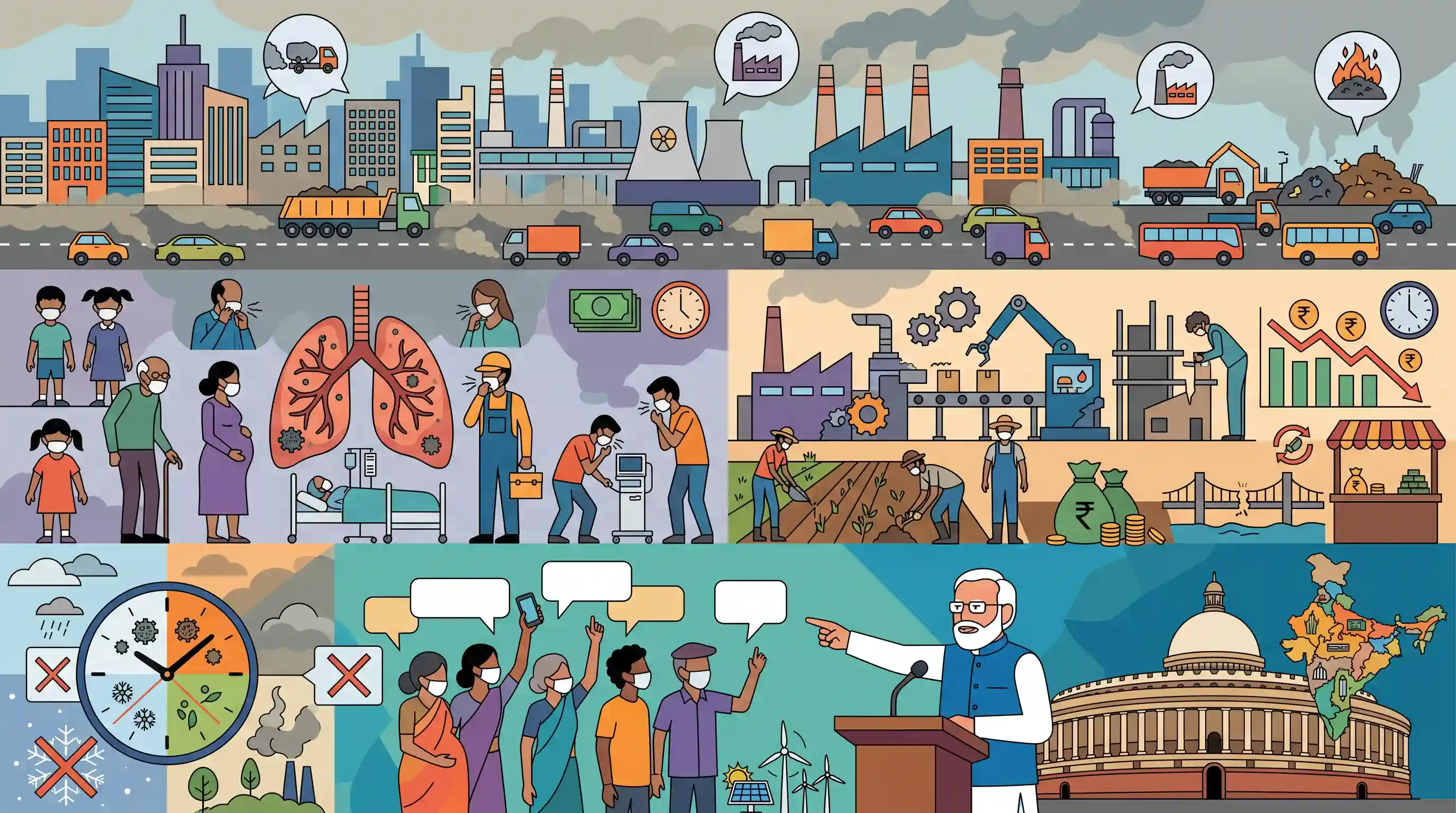
The article highlights the critical intersection of environmental pollution, public health, and livelihoods. It underscores the importance of viewing air pollution not just as a seasonal winter crisis, but as a continuous socio-economic challenge affecting vulnerable populations, requiring sustained policy attention and public discourse.
Summary
Congress leader Rahul Gandhi expressed grave concern over the adverse impacts of air pollution on public health and the economy in India. He highlighted that vulnerable sections such as children, the elderly, and daily wage earners bear the maximum brunt of the crisis. Emphasizing the need for year-round focus instead of seasonal reactions during winter, he urged citizens to voice their concerns and share their personal experiences, assuring them that he would raise the issue at the national level.
Key Points
- Leader of the Opposition Rahul Gandhi highlighted the severe health and economic impacts of air pollution in India, calling it a heavy burden on citizens.
- He noted that vulnerable groups, including children, the elderly, construction workers, and daily wage earners, are disproportionately affected by the pollution.
- Stressing that the crisis must not be forgotten until the next winter season, he launched a platform for people to share their experiences with air pollution.
- Gandhi reiterated his commitment to raising the issue, following his previous demand for a discussion on it during the Winter Session of Parliament.
Important Terms
Air Quality Index (AQI)

A single-number metric (0–500) and color-coded system that communicates daily air quality by monitoring eight key pollutants, helping the public understand potential health impacts at a glance.
UPSC context
GS Paper III (Environment); vital for understanding environmental monitoring and public health communication standards in India.
PM 2.5
Fine inhalable particles with diameters 2.5 micrometers or smaller that can penetrate deep into lungs and enter the bloodstream, causing severe respiratory and cardiovascular diseases.
UPSC context
GS Paper III (Pollution); the primary pollutant of concern in urban air quality and environmental health discussions.
Graded Response Action Plan (GRAP)
A set of emergency measures (Stage I to IV) implemented in Delhi-NCR that automatically trigger based on AQI levels to prevent further deterioration of air quality during peak pollution periods.
UPSC context
GS Paper III (Environment); tests knowledge of administrative responses to environmental crises and inter-state coordination.
National Clean Air Programme (NCAP)
India's flagship long-term strategy launched in 2019 to reduce particulate matter concentrations by 40% by 2026 across 131 'non-attainment' cities through city-specific action plans.
UPSC context
GS Paper II & III; crucial for governance, policy implementation, and environmental sustainability targets.
Article 21
The Right to Life, which the Supreme Court has judicially expanded to include the right to a clean and healthy environment as essential for living with human dignity.
UPSC context
GS Paper II (Polity); central to the 'Fundamental Rights' topic and judicial activism regarding environmental jurisprudence.
Leader of the Opposition (LoP)
A statutory position in the Lok Sabha held by the leader of the largest opposition party (with 10%+ seats), responsible for critiquing government policy and ensuring accountability.
UPSC context
GS Paper II (Parliament); tests understanding of parliamentary roles, checks and balances, and democratic accountability.
Prelims Trap
"India's annual PM2.5 limit is aligned with WHO's 2021 Air Quality Guidelines."
India's National Ambient Air Quality Standards (NAAQS) set the annual PM2.5 limit at 40 µg/m³, which is significantly higher (weaker) than the WHO's strict 5 µg/m³ recommendation.
Static Concepts Connected
What distinguishes the National Clean Air Programme (NCAP) from NAAQS?
- NCAP: A non-binding national strategy launched in 2019, now aiming for a 40% reduction in PM concentrations by 2025-26 in 131 non-attainment cities.
- NAAQS: Statutory standards notified by the CPCB under the Air Act 1981, covering 12 specific pollutants including PM2.5, PM10, Lead, and Ozone.
What are the macro-economic and health burdens of air pollution in India?
- GDP Loss: Estimated to cost India around 1.36% of its GDP annually due to lost productivity and premature deaths (The Lancet).
- Life Expectancy: The Air Quality Life Index (AQLI) estimates severe pollution cuts average Indian life expectancy by 3.5 to 5 years.
- NCD Link: Serves as a leading risk factor for Non-Communicable Diseases (NCDs) like COPD and ischemic heart disease.
Cross-Topic Patterns
Environmental degradation & human capital
Pollution's disproportionate impact on children and daily-wage earners directly erodes India's demographic dividend by increasing morbidity and out-of-pocket healthcare expenditure.
Statutory vs Executive environmental action
UPSC frequently tests the difference in mandate between statutory bodies like CAQM (NCR specific) and executive schemes like NCAP (national non-attainment cities).

A multi-statement question blending the WHO's 2021 PM2.5 guidelines, NAAQS 12 pollutants, and NCAP's revised 2026 targets is highly likely.
Linked PYQs · 2
Linked PYQs · 2
- 2021MainsGS3
Describe the key points of the revised Global Air Quality Guidelines (AQGs) recently released by the World Health Organisation (WHO). How are these different from its last update in 2005? What changes in India's National Clean Air Programme are required to achieve these revised standards?
- 2020MainsGS3
What are the key features of the National Clean Air Programme (NCAP) initiated by the Government of India?
