Uttarakhand Infrastructure Gaps Persist After Twenty Six Years
Source:etv-bharat ↗
Why It Matters
Provides a critical assessment of flagship schemes (PMGSY, Ayushman Bharat) in a hill state context, illustrating the geography-specific challenges in policy implementation and service delivery. This is highly relevant for UKPSC candidates studying state governance, healthcare, and infrastructure development.
Summary
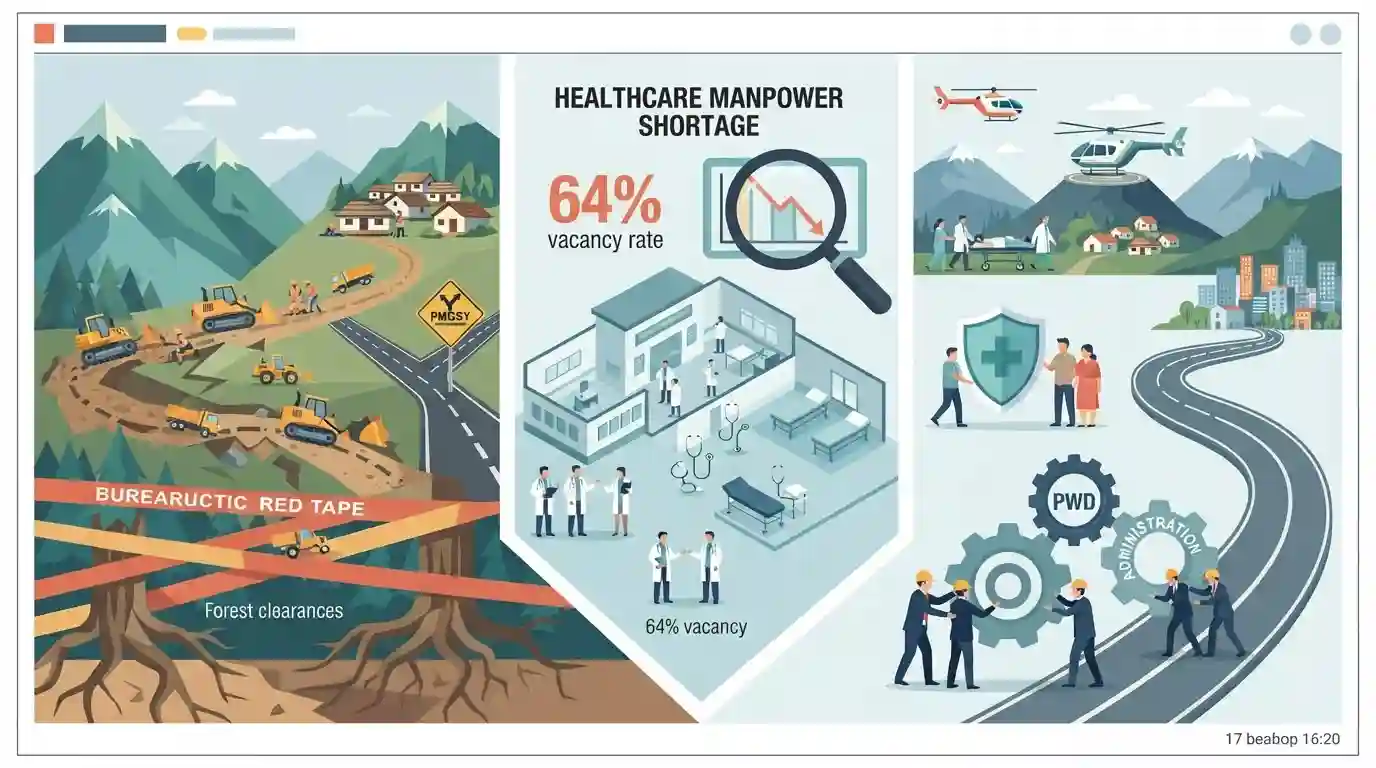
The article evaluates the state of basic amenities in Uttarakhand 26 years after its formation, highlighting critical gaps in rural road connectivity and healthcare. Despite initiatives like the Pradhan Mantri Gram Sadak Yojana (PMGSY), infrastructure development in remote villages is hindered by geographical challenges and complex forest clearances. The healthcare sector suffers from severe manpower shortages, with a CAG report pointing out a 64% vacancy rate for doctors in the Medical Education Department. Although the Ayushman Bharat scheme and upcoming heli-ambulance services offer some relief, substantial institutional reforms in departments like the PWD are required to overcome the developmental challenges unique to the hill state.
Key Points
- Even 26 years after its formation, remote villages in Uttarakhand suffer from a lack of basic road connectivity and accessible healthcare.
- Road construction under PMGSY is hindered by mountainous terrain, frequent landslides, and complex forest land transfer processes, despite relaxed population norms (250+) for Himalayan states.
- A recent CAG report exposed severe healthcare deficiencies, highlighting that 64% of doctor positions in the Medical Education Department are vacant.
- While the Ayushman Bharat scheme has aided 12 lakh patients, emergency care remains a challenge, prompting government plans for heli-ambulance services.
- Institutional reforms and filling vacant technical posts in the Public Works Department (PWD) are essential to improve infrastructure execution in the hill districts.
Important Terms
Pradhan Mantri Gram Sadak Yojana (PMGSY)

A centrally sponsored scheme launched to provide all-weather road connectivity to unconnected rural habitations, reducing the population threshold to 250 for Himalayan states like Uttarakhand.
UPSC context
Important for UKPSC GS Paper 3 (Infrastructure) when analyzing the state's geographic and rural connectivity challenges.
Ayushman Bharat scheme
A flagship national health insurance scheme providing free coverage of up to ₹5 lakh per family per year for secondary and tertiary hospitalization care.
UPSC context
Relevant for UKPSC GS Paper 2 (Welfare Schemes). Evaluates state healthcare initiatives and coverage of vulnerable populations.
Heli-ambulance services
Emergency medical transport via helicopters. In Uttarakhand, "Project Sanjeevani" launched at AIIMS Rishikesh offers free transport for critical patients from inaccessible hilly areas.
UPSC context
High priority for UKPSC (Disaster Management/Health). Tests awareness of modern healthcare delivery solutions in difficult Himalayan terrains.
Comptroller and Auditor General (CAG)
A constitutional body (Article 148) responsible for auditing government receipts and expenditure to ensure public accountability and financial propriety.
UPSC context
Core Polity topic (UKPSC GS Paper 2). State governance is often evaluated using CAG reports on departmental inefficiencies and resource gaps.
Public Works Department (PWD)
The premier government agency responsible for planning, designing, constructing, and maintaining public infrastructure like roads, bridges, and government buildings.
UPSC context
Relevant for UKPSC GS Paper 3 (Infrastructure). Discussions on state development often center on the need for institutional reforms within PWD.
Prelims Trap
PMGSY mandates road connectivity for unconnected habitations with a population of 500+ uniformly across all states.
Aspirants often miss special category relaxations. Himalayan, Desert, and Tribal areas (including Uttarakhand) have a lowered population threshold of 250+ under PMGSY, not 500+.
Static Concepts Connected
What are the core parameters of the Pradhan Mantri Gram Sadak Yojana (PMGSY)?
- Core Mandate: Provides all-weather single-road connectivity to eligible unconnected habitations across rural India.
- Special Threshold: The population norm is 500+ for plains, but relaxed to 250+ for Special Category and Himalayan states like Uttarakhand.
- Funding Ratio: The scheme operates on a 90:10 (Centre:State) funding pattern for Himalayan and North-Eastern states.
How does the CAG evaluate state public health and infrastructure schemes?
- Constitutional Role: Article 149 empowers the CAG to audit all state receipts and expenditures, ensuring financial accountability of departments like Medical Education and PWD.
- Performance Audits: Beyond financial audits, CAG conducts performance audits to assess whether government programs achieve intended objectives, frequently highlighting execution delays and manpower shortages.
Cross-Topic Patterns
Hill Geography + Out-Migration (Palayan)
Structural deficits in healthcare and road infrastructure are primary drivers of out-migration (Palayan) from Uttarakhand's hill districts, a central socio-economic theme in state exams.
Infrastructure + Forest Clearances
The administrative clash between infrastructure expansion (PMGSY roads) and environmental conservation (forest land transfer hurdles) remains a classic Mains debate for Himalayan states.

Expect a multi-statement question combining PMGSY special norms for Himalayan states with Atal Ayushman Uttarakhand Yojana details.
Linked PYQs · 3
Linked PYQs · 3
- 2025UKPSC_PRELIMSGS1
Which programme was approved by the Union Cabinet in April, 2025 to develop border villages ?
- 2025UKPSC_PRELIMSGS1
Arrange the following social welfare schemes in chronological order: i. Integrated Rural Development Programme (IRDP) ii. Rural Employment Generation Programme (REGP) iii. Prime Minister Rojgar Yojana (PMRY) iv. Rural Landless Employment Guarantee Programme (RLEGP)
- 2024UKPSC_PRELIMSGS1
What is the main function of Public Accounts Committee ?
