Penumaka farmers surrender lands for amaravati capital
Source:The Hindu ↗
Why It Matters
The Land Pooling Scheme (LPS) serves as a critical alternative to traditional land acquisition for large-scale urbanization and infrastructure projects, such as building a new capital city. Understanding such models is relevant for questions on urban planning, infrastructure development, and regional administration.
Summary
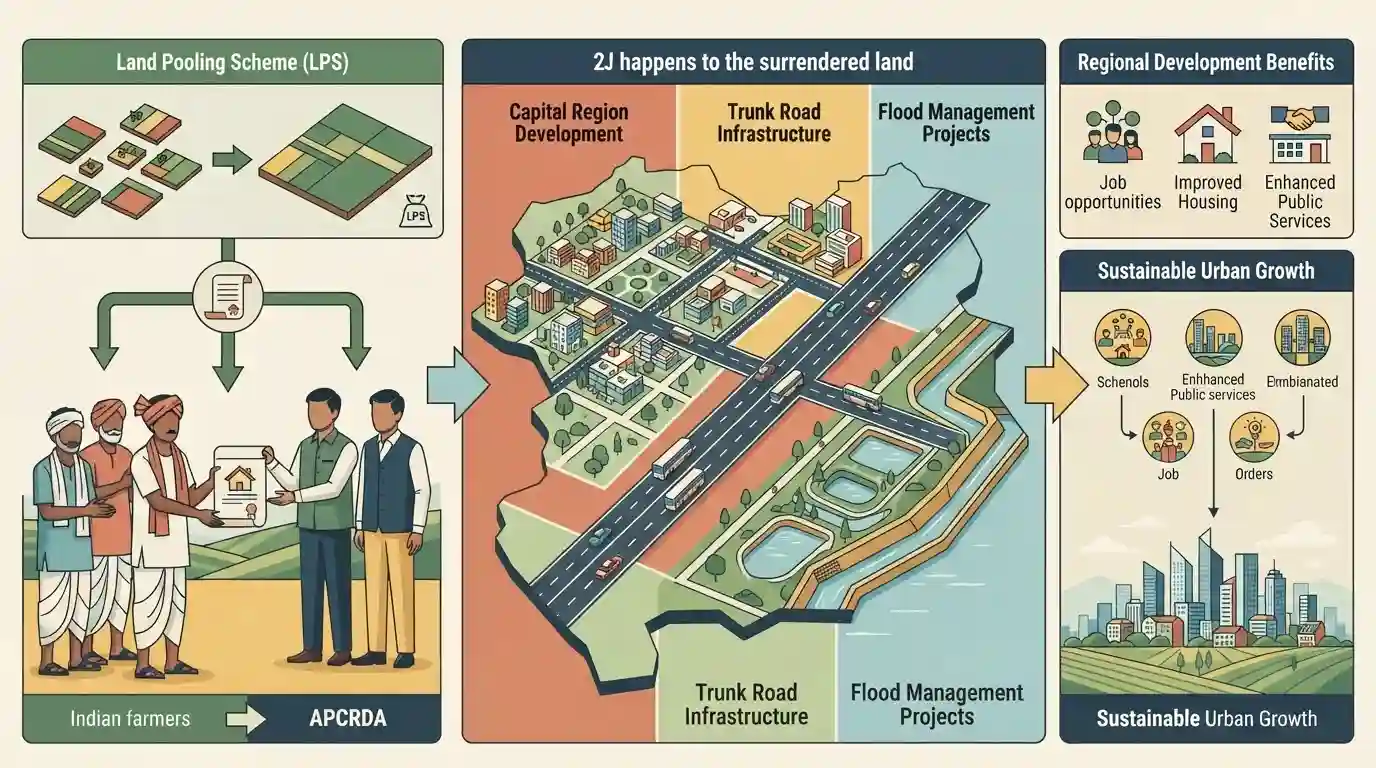
Farmers from Penumaka village have voluntarily surrendered 7.10 acres of land to the Andhra Pradesh Capital Region Development Authority (APCRDA) under the Land Pooling Scheme (LPS) for the development of the Amaravati capital city. The contributed land will be utilized for capital region development, trunk road infrastructure, and flood management projects.
Key Points
- Eight farmers from Penumaka voluntarily contributed 7.10 acres of land to the APCRDA under the Land Pooling Scheme (LPS) for Amaravati\'s development.
- The land is earmarked for specific purposes: 0.54 acres for LPS zones, 3.07 acres for trunk roads, and 2.12 acres for flood management projects.
- The farmers submitted their consent letters at the APCRDA headquarters in Rayapudi.
- Penumaka falls under Amaravati LPS 1; some villagers had previously refrained from participating in the scheme prior to 2019.
Important Terms
Land Pooling Scheme (LPS)

A mechanism where farmers voluntarily hand over their agricultural land to the government in exchange for developed plots and other benefits, used to acquire land for the Amaravati capital region.
UPSC context
Important for APPSC Paper II (AP Economy & Development). Illustrates alternative land acquisition strategies for urban infrastructure and capital development.
Andhra Pradesh Capital Region Development Authority (APCRDA)
A statutory urban planning agency formed in 2014 by the AP government. It is responsible for planning, executing, and supervising the development of the Amaravati capital region, including managing the Land Pooling Scheme.
UPSC context
Relevant for APPSC Paper II & III. Tests knowledge of state-level institutions driving regional development, urbanization, and the Amaravati project.
Amaravati LPS 1
A specific phase or zone under the broader Amaravati Land Pooling Scheme. It encompasses initial villages, including Penumaka, where farmers surrendered land for capital development.
UPSC context
Highlights specific geographical and policy implementation details of the AP capital project, relevant for APPSC questions on state infrastructure initiatives.
Prelims Trap
The Land Pooling Scheme involves compulsory land acquisition by the State with one-time cash compensation.
LPS is a voluntary, non-expropriative alternative to compulsory acquisition. Landowners receive reconstituted residential and commercial plots instead of immediate cash compensation.
Static Concepts Connected
What are the key features of the Land Pooling Scheme (LPS) used for Amaravati?
- Voluntary surrender: Unlike compulsory acquisition, landowners voluntarily surrender their land to the development authority.
- Reconstituted plots: Instead of cash compensation, farmers receive high-value, reconstituted residential and commercial plots in the developed city.
- Annuity payments: The scheme provides a ten-year annuity payment to support the livelihoods of farmers and landless agricultural laborers.
What is the statutory mandate of the APCRDA under the 2014 Act?
- Statutory body: Established under the APCRDA Act, 2014 (Entry 5, State List) to plan, execute, and govern the capital region's development.
- Implementation powers: Empowered to execute master plans, implement land pooling schemes, and levy Betterment Charges to fund infrastructure.
Cross-Topic Patterns
Land Pooling in Urbanization
The Amaravati LPS model is frequently contrasted with traditional LARR methods and linked to broader national urbanization strategies like the Town Planning Schemes (TPS) used in Gujarat.
Sivaramakrishnan Committee vs Single Capital
The 2026 Amendment cementing Amaravati as the sole capital directly contrasts the Sivaramakrishnan Committee's 2014 recommendation for decentralized, distributed capital functions across regional sub-zones.

Expect a multi-statement question contrasting AP's Land Pooling Scheme with the LARR Act 2013, focusing on consent and compensation modes.
Linked PYQs · 4
Linked PYQs · 4
- 2023APPSC_PRELIMSGS1
Part V of the Andhra Pradesh Reorganisation Act deals with
- 2023APPSC_PRELIMSGS1
How many Schedules are there in the Andhra Pradesh Reorganisation Act?
- 2024APPSC_PRELIMSGS1
The strategic objective of Asset Monetization Programme may be explained as :
- 2024APPSC_PRELIMSGS1
Which of the following statement/statements is/are valid regarding the National Infrastructure Pipeline (NIP)? I. NIP includes only economic infrastructure projects but not social infrastructure projects. II. NIP is aimed to focus on key greenfield projects alone. Brownfield projects are excluded from the NIP's coverage. III. NIP aims to offer investment opportunities in India's infrastructure sector, and to attract investments into India. IV. India Investment Grid (IIG) as a platform has ceased to facilitate the NIP and instead 'Invest India' is presently facilitating NIP. Select the correct answer using the codes given below:
