Amaravati Land Pooling Scheme Participation in Penumaka
Source:The Hindu ↗
ఇది ఎందుకు ముఖ్యం
The Amaravati capital city project is a flagship initiative of the Andhra Pradesh government. The Land Pooling Scheme (LPS) represents a unique participatory approach to urban land assembly, bypassing traditional, often contentious, land acquisition methods. Understanding the dynamics of LPS, APCRDA's role, and the state's urban development strategies is crucial for APPSC aspirants, particularly regarding state-specific governance and infrastructure development.
సారాంశం
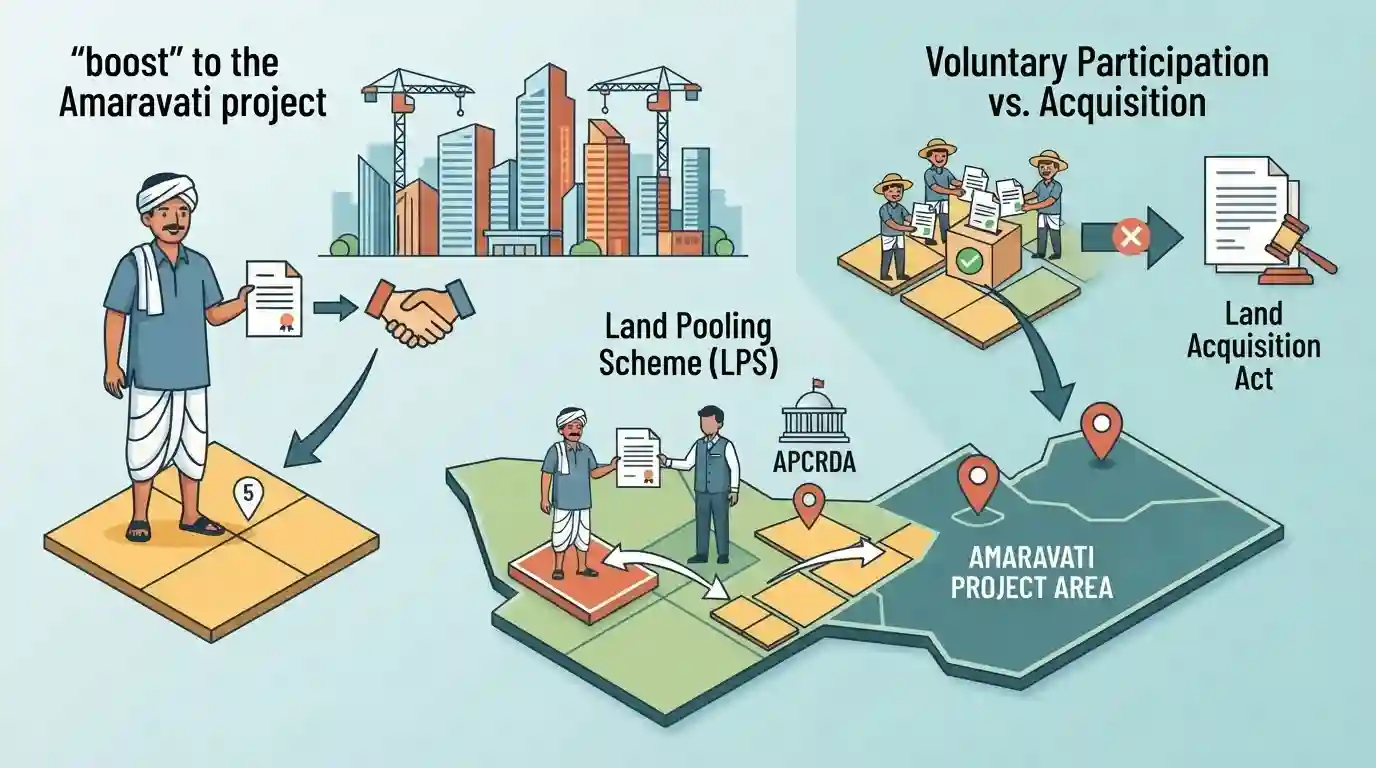
In a boost to the Amaravati capital city project, a farmer from Penumaka village voluntarily offered five acres of land under the Land Pooling Scheme (LPS). The consent letters were submitted to the APCRDA, reflecting the Andhra Pradesh government's strategy to secure the remaining 1,400 acres of unpooled land through voluntary participation rather than utilizing the Land Acquisition Act. This step is pivotal for the revived development of Amaravati as the state capital.
ముఖ్య అంశాలు
- A farmer from Penumaka, Meka Sambi Reddy, submitted consent letters to offer five acres of land for the Amaravati capital project under the Land Pooling Scheme (LPS).
- The Andhra Pradesh Capital Region Development Authority (APCRDA) received the consent letters, signaling renewed momentum for land pooling under the TDP-led alliance government.
- Approximately 34,400 acres have been pooled so far for the Amaravati project, leaving around 1,400 acres unpooled, predominantly in villages like Penumaka and Undavalli.
- The State government prefers farmers to voluntarily pool their lands through LPS rather than invoking the coercive Land Acquisition Act.
ముఖ్యమైన పదాలు
Land Pooling Scheme (LPS)

A cooperative land assembly mechanism where landowners voluntarily surrender agricultural parcels to a development authority, receiving back smaller, fully developed, high-value plots with annuity payments.
UPSC context
GS Paper III (Land Reforms): Tests knowledge of participatory alternatives to compulsory land acquisition for urban planning.
Land Acquisition Act
Formally the RFCTLARR Act, 2013, it regulates compulsory state takeover of private land, mandating fair compensation, social impact assessments, and strict rehabilitation and resettlement.
UPSC context
GS Paper III (Land Reforms): Tests statutory frameworks balancing public infrastructure needs with landowners' rights and welfare.
Andhra Pradesh Capital Region Development Authority (APCRDA)
A statutory authority established under Andhra Pradesh legislation to plan, coordinate, execute, and finance infrastructure and urban development within the state's designated capital region.
UPSC context
GS Paper II (Statutory Bodies): Tests comprehension of urban governance, regional planning institutions, and capital-building administrative challenges.
ప్రిలిమ్స్ ఉచ్చు
Land Pooling Schemes (LPS) involve the compulsory acquisition of land by the State with mandatory monetary compensation.
LPS is voluntary. Landowners surrender land in exchange for a smaller, developed plot with better infrastructure (value appreciation), not primarily monetary compensation, thereby bypassing compulsory acquisition laws.
అనుసంధానమైన స్థిర భావనలు
How does the Land Pooling Scheme (LPS) differ from the Land Acquisition Act (2013)?
- Voluntary vs. Coercive: LPS is a voluntary mechanism where owners agree to pool land. LAA allows the state to forcibly acquire land for "public purpose" even if owners resist.
- Compensation Model: LPS returns a smaller, developed, high-value land parcel to the owner. LAA primarily provides monetary compensation (e.g., up to 4x market value in rural areas).
- Infrastructure Financing: Under LPS, the authority retains a portion of the pooled land to finance infrastructure construction and public utilities, making the project self-financing.
How do statutory urban bodies interact with local Panchayats under the 73rd Amendment?
- Overriding Powers: Statutory bodies like APCRDA are given overriding powers over land use and planning, often superseding standard Gram Panchayat powers under the Panchayati Raj Act.
- Constitutional Friction: This creates friction with Articles 243G and 243W, which mandate the devolution of powers and responsibilities to local bodies for economic development and social justice.
అంతర-అంశ నమూనాలు
Urban Sprawl vs. Food Security
The Sivaramakrishnan Committee explicitly warned against building Amaravati between Vijayawada and Guntur to protect fertile agricultural lands, highlighting the recurrent policy clash between greenfield urbanisation and food security.
Federalism, State Reorganization, and Capitals
The decade-long delay and policy reversals on Amaravati vs. 3-capitals reflect state-level political shifts impacting long-term infrastructure, echoing broader debates around Article 3, state reorganization, and federal stability.

Expect a GS Mains question comparing Land Pooling Schemes (e.g., Amaravati/DDA models) with the 2013 Land Acquisition Act for rapid urbanisation.
అనుసంధాన PYQలు · 2
అనుసంధాన PYQలు · 2
- 2023APPSC_PRELIMSGS1
The CCRC introduced by Government of Andhra Pradesh stands for
- 2023APPSC_PRELIMSGS1
Part V of the Andhra Pradesh Reorganisation Act deals with
