Byculla zoo penguin population growth and ex situ conservation
Source:Indian Express ↗
Why It Matters
The article illustrates a real-world example of ex-situ conservation success (successful breeding of non-native species) coupled with the practical and economic limitations of animal exchange programmes between zoos in India.
Summary
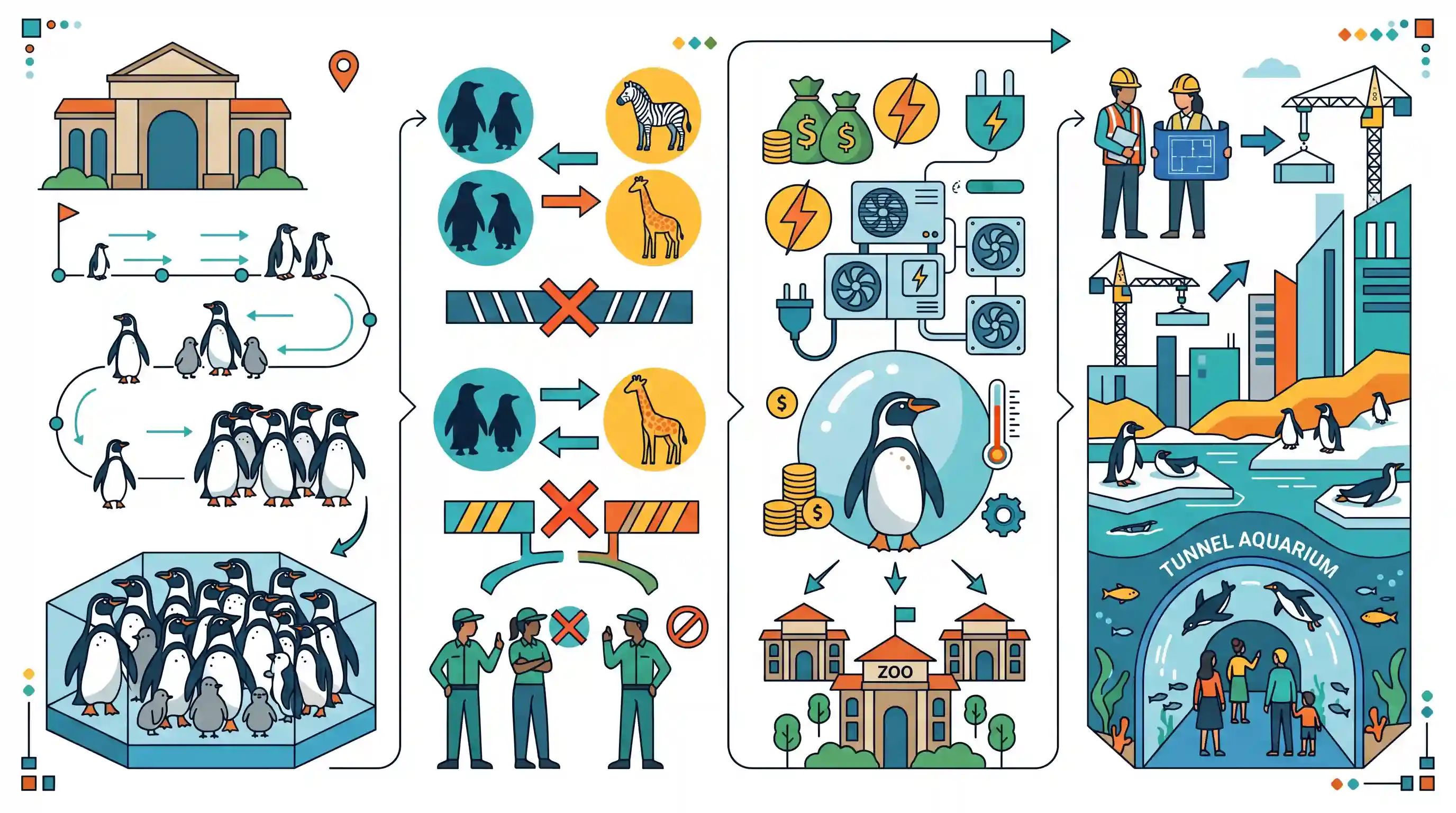
The Brihanmumbai Municipal Corporation (BMC) is preparing to expand the Humboldt penguin enclosure at Mumbai's Byculla Zoo to accommodate a growing population, which has risen to 18 since 2016. Despite initiating animal exchange programmes to trade penguins for other exotic species like zebras and giraffes, the zoo has found no takers. Other zoological parks are deterred by the high financial and infrastructural costs required to maintain the specialized, temperature-controlled environments necessary for penguins. Consequently, the BMC is advancing its Phase-3 zoo expansion plan to build larger habitats and a new tunnel aquarium to house the expanding local colony.
Key Points
- The Humboldt penguin population at Mumbai's Byculla Zoo has successfully bred and increased from seven to 18 since their introduction.
- To accommodate the growing numbers, the BMC plans to expand the penguin enclosure and build an adjoining tunnel aquarium.
- Efforts to trade the surplus penguins for other exotic animals (like zebras or chimpanzees) via exchange programmes have failed, as other zoos cannot afford the high maintenance costs of air-conditioned enclosures.
- The situation highlights a practical constraint of ex-situ conservation and zoo management: the financial viability of sustaining non-native exotic species in tropical environments.
Important Terms
Humboldt Penguin

A medium-sized penguin species (Spheniscus humboldti) native to the Pacific coasts of Chile and Peru; it is characterized by a black breast band and pink facial patches.
UPSC context
GS Paper III (Environment): Important for Prelims as a 'species in news' and its Vulnerable IUCN conservation status.
Veermata Jijabai Bhosale Botanical Udyan and Zoo
Established in 1862, it is Mumbai's only zoo and one of India's oldest botanical gardens, formerly known as Victoria Gardens or Rani Baug.
UPSC context
GS Paper III (Biodiversity): A case study for urban ex-situ conservation and the management of captive exotic species.
Ex-situ Conservation
The conservation of components of biological diversity outside their natural habitats, such as in zoos, botanical gardens, and seed banks.
UPSC context
GS Paper III (Environment): A core syllabus concept regarding strategies to protect endangered species from extinction.
Brihanmumbai Municipal Corporation (BMC)
The governing civic body of Mumbai, responsible for the city's infrastructure and public services, including the management of the Byculla Zoo.
UPSC context
GS Paper II (Governance): Tests knowledge of Urban Local Bodies (ULBs) and their role in environmental management.
Animal Exchange Programme
A regulated system where zoos trade surplus animals to maintain genetic diversity and manage population levels within enclosures.
UPSC context
GS Paper III (Wildlife): Relevant for understanding administrative mechanisms in wildlife conservation and zoo management.
Prelims Trap
"Humboldt penguins are endemic to the polar regions of Antarctica and require sub-zero environments for survival."
Humboldt penguins are native to the temperate Pacific coasts of South America (Chile and Peru), not Antarctica. They rely on the nutrient-rich cold upwelling of the Humboldt Current, rather than polar ice.
Static Concepts Connected
What is the mandate of the Central Zoo Authority (CZA)?
- Statutory status: Established in 1992 as a statutory body under the Wildlife (Protection) Act, 1972.
- Core functions: Responsible for recognizing zoos, evaluating enclosures, and setting standards for animal upkeep and veterinary care.
- Exchange regulation: Mandatory approval from CZA is required for exchanging exotic animals between zoos before CITES or EXIM permits are issued.
How does the Humboldt Current shape its regional ecosystem?
- Current type: A cold, low-salinity eastern boundary ocean current flowing north along the western coast of South America.
- Marine productivity: Drives coastal upwelling that brings nutrient-rich deep water to the surface, supporting massive populations of anchovies and endemic predators.
- Climate impact: Cools the overlying air, preventing precipitation and contributing directly to the hyper-aridity of the Atacama Desert.
Cross-Topic Patterns
Exotic Species & WPA 2022
The Wildlife (Protection) Amendment Act 2022 introduced a new Schedule IV dedicated to CITES-listed exotic species, creating stricter legal frameworks for zoo exchanges and the possession of foreign fauna in India.
Ocean Currents & Endemism
Physical geography drivers like cold ocean currents are frequently linked by UPSC to marine productivity, atmospheric aridity (Atacama Desert), and the survival of specific endemic species.

Expect a linked geography/environment question matching cold eastern boundary ocean currents (Humboldt, Benguela) with endemic coastal species.
Linked PYQs · 1
Linked PYQs · 1
- 2011PrelimsGS1
Which one of the following is not a site for in-situ method of conservation of flora?
