National Green Tribunal Rulings on Environmental Degradation in Ropar
Source:Indian Express ↗
Why It Matters
This issue is highly relevant for the UPSC syllabus as it touches upon the regulation of minor minerals, environmental degradation caused by industrial activities, and the crucial enforcement role of statutory bodies like the NGT and state pollution control boards. It specifically illustrates the conflict between economic activities (stone crushing/mining) and ecological conservation in sensitive geographical zones.
Summary
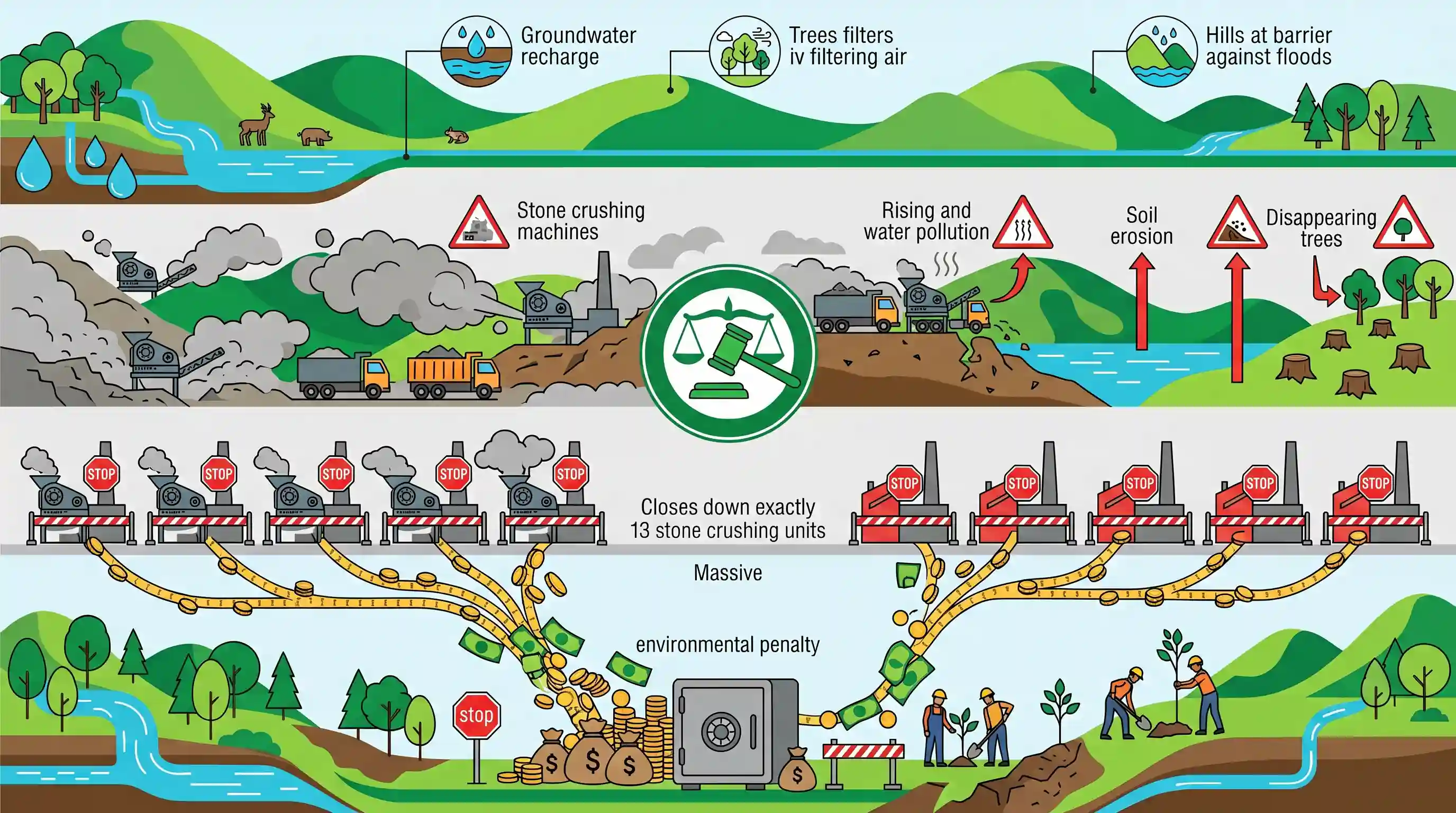
The National Green Tribunal (NGT) has ordered the immediate closure of 13 stone-crushing units in Punjab's Ropar district, imposing a massive Rs 180.70 crore environmental penalty for devastating the fragile Shivalik hills ecosystem. The tribunal noted that unchecked illegal mining and crushing activities violated foundational environmental laws, including the Air and Water Acts, resulting in severe groundwater depletion, soil erosion, and deforestation. Recognizing the Shivalik hills as a crucial groundwater recharge zone and a natural defense against flash floods, the NGT's ruling underscores the urgent need for robust enforcement of minor mineral policies and environmental protections to prevent irreversible ecological damage.
Key Points
- The National Green Tribunal (NGT) imposed an environmental compensation of Rs 180.70 crore on 13 stone-crushing units in Ropar, Punjab, and ordered their closure due to severe ecological degradation.
- The stone crushers were found violating the Water and Air Acts, causing illegal tree felling, large-scale soil erosion, and severe groundwater depletion in the ecologically sensitive Shivalik hills.
- The Shivalik range is ecologically vital as a primary groundwater recharge zone and a natural barrier preventing flash floods in the plains.
- The ruling emphasizes the necessity of strict enforcement of state minor mineral policies and environmental norms to regulate the mining and crushing of stone and sand.
- The NGT intervened after observing that local authorities and the state pollution control board had failed to implement necessary environmental safeguards, highlighting the role of the tribunal in ensuring statutory compliance.
Important Terms
National Green Tribunal (NGT)

A specialized judicial body established under the NGT Act (2010) for expeditious disposal of cases relating to environmental protection and conservation of forests and other natural resources.
UPSC context
GS II/III: Quasi-judicial bodies; tests understanding of environmental governance and the Polluter Pays Principle.
Punjab Regulation of Crusher Units Act, 2025
A state law enacted to regulate the operation, registration, and raw material sourcing of stone-crushing units and screening plants to curb illegal mining and ensure environmental compliance.
UPSC context
GS III: Management of natural resources; tests knowledge of state-level regulatory frameworks for minor minerals.
Punjab State Minor Mineral Policy, 2025
A comprehensive framework governing the extraction and sale of minor minerals (sand/gravel), emphasizing technology-driven monitoring and the creation of dedicated 'Crusher Owner Mining Sites' to reduce illegal extraction.
UPSC context
GS III: Indian Economy and Land Reforms; relevant for federal division of mineral rights and resource conservation.
Water (Prevention and Control of Pollution) Act, 1974
A primary environmental legislation that provides for the prevention and control of water pollution and the maintaining or restoring of wholesomeness of water in the country.
UPSC context
GS III: Environmental pollution and degradation; core act for statutory control of industrial discharge.
Air (Prevention and Control of Pollution) Act, 1981
Legislation aimed at preventing, controlling, and abating air pollution through the establishment of boards and the regulation of industrial emissions via 'Consent to Operate' (CTO).
UPSC context
GS III: Environmental impact assessment; fundamental for understanding regulatory enforcement against industrial pollution.
Punjab Pollution Control Board (PPCB)
The state-level statutory authority responsible for implementing environmental laws, monitoring pollution levels, and issuing closure notices to non-compliant industrial units in Punjab.
UPSC context
GS II: Statutory bodies; tests the role of sub-national institutions in environmental governance.
Prelims Trap
"State governments hold the power to notify new 'minor minerals' under the MMDR Act, 1957."
This is a classic trap. The Central Government holds exclusive power to *notify* minor minerals, while State Governments have the power to *regulate* their extraction.
Static Concepts Connected
What is the statutory jurisdiction and guiding philosophy of the NGT?
- Included Acts: It adjudicates civil cases under seven laws, including the Water Act (1974), Air Act (1981), Environment Protection Act (1986), and Forest Conservation Act (1980).
- Excluded Acts: The NGT explicitly does not have jurisdiction over the Wildlife (Protection) Act, 1972, and the Indian Forest Act, 1927.
- Guiding Principles: It is not bound by the Code of Civil Procedure but operates on the 'polluter pays' principle, the precautionary principle, and natural justice.
How are minor minerals regulated under the MMDR Act, 1957?
- Notification Power: The Central Government retains exclusive authority to classify, declare, and notify any mineral as a 'minor mineral' (e.g., sand, gravel, building stones).
- Regulatory Power: State Governments hold exclusive administrative powers to frame rules, prescribe royalty rates, grant leases, and prevent illegal mining for minor minerals.
- Environmental Clearance: Following a 2016 amendment to the EIA Notification, Environmental Clearance (EC) is mandatory for all minor mineral mining leases, regardless of the lease area size.
Cross-Topic Patterns
Geomorphology and regional hydrology
The Shivaliks' geologically fragile, unconsolidated sediments make them vulnerable to mining-induced soil erosion, directly destroying their vital function as a primary groundwater recharge zone for the Indo-Gangetic plains.
Ecological jurisprudence vs State policies
This highlights a frequent UPSC theme: the NGT stepping in via the Air/Water Acts to apply the 'polluter pays' principle when State authorities fail to enforce minor mineral regulations.

Expect a 2026 Prelims statement mixing NGT's excluded jurisdiction (WPA 1972) with the State's rule-making powers over minor minerals.
Linked PYQs · 4
Linked PYQs · 4
- 2019PrelimsGS1
With reference to the management of minor minerals in India, consider the following statements: 1. Sand is a 'minor mineral' according to the prevailing law in the country. 2. State Governments have the power to grant mining leases of minor minerals, but the powers regarding the formation of rules related to the grant of minor minerals lie with the Central Government. 3. State Governments have the power to frame rules to prevent illegal mining of minor minerals. Which of the statements given above is/are correct?
- 2025PrelimsGS1
Consider the following statements : Statement I: In India, State Governments have no power for making rules for grant of concessions in respect of extraction of minor minerals even though such minerals are located in their territories. Statement II: In India, the Central Government has the power to notify minor minerals under the relevant law. Which one of the following is correct in respect of the above statements?
- 2025MainsGS3
Mineral resources are fundamental to the country's economy and these are exploited by mining. Why is mining considered an environmental hazard? Explain the remedial measures required to reduce the environmental hazard due to mining.
- 2019MainsGS3
Coastal sand mining, whether legal or illegal, poses one of the biggest threats to our environment. Analyze the impact of sand mining along the Indian coasts, citing specific examples.
