Supreme Court stance on pedestrian safety and walkable cities
Source:Indian Express ↗
Why It Matters
Urbanization and urban transport are key syllabus areas for GS1 and GS3. The integration of pedestrian safety as an aspect of the Right to Life by the Supreme Court provides a critical cross-disciplinary linkage for GS2 (Polity) and GS1 (Urban issues).
Summary
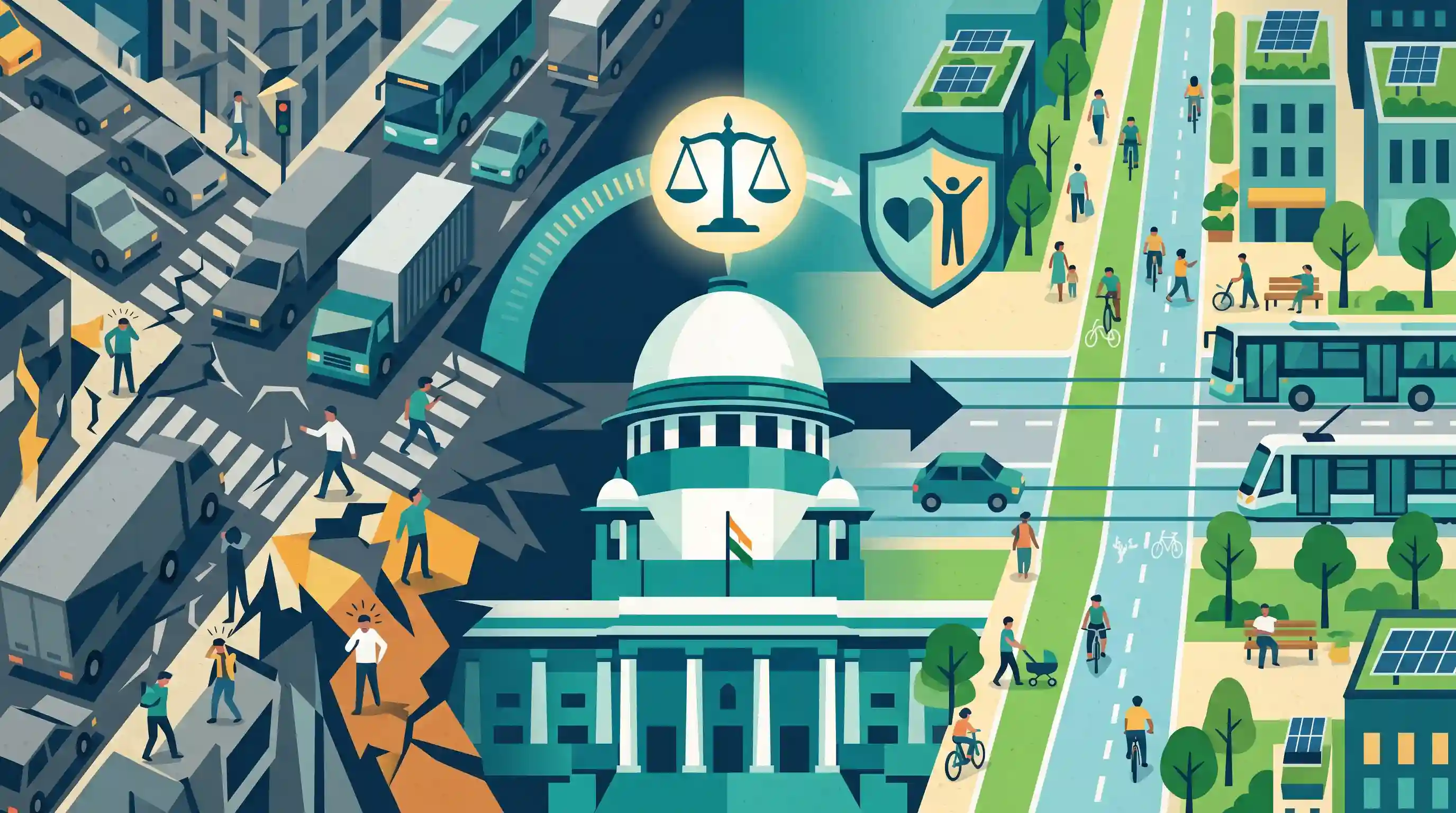
The article highlights the Supreme Court's recent call to prioritize pedestrian safety and develop walkable cities in India. As rapid urbanization leads to congested and car-centric infrastructure, pedestrians are increasingly marginalized and exposed to risks. The Supreme Court's intervention emphasizes the need to shift towards sustainable, human-centric urban planning. Securing safe and accessible public pathways is not only crucial for sustainable development and public health but also resonates with the expanding horizons of the Right to Life under Article 21. The article urges urban local bodies and policymakers to actively incorporate non-motorized transport and pedestrian rights into city design.
Key Points
- The Supreme Court has emphasized the necessity of walkable cities and pedestrian-friendly infrastructure in urban planning.
- Current Indian city designs are excessively car-centric, often sidelining non-motorized transport and pedestrian safety.
- Developing walkable cities aligns with sustainable urbanization goals, reducing pollution and promoting public health.
- Ensuring safe public mobility and accessible streets can be viewed as an extension of the Right to Life under Article 21.
- There is an urgent need for municipal corporations and policymakers to bridge the gap between urban mobility guidelines and on-ground implementation.
Important Terms
Article 21

A fundamental right in the Indian Constitution protecting life and personal liberty. It has been judicially expanded to include rights to health, environment, and now safe pedestrian movement.
UPSC context
GS II: Fundamental Rights. Tests understanding of the judiciary's role in expanding the 'Right to Life' to encompass dignified urban living.
Non-Motorized Transport (NMT)
Human-powered travel modes, primarily walking and cycling. These are carbon-neutral, cost-effective, and essential for sustainable urban mobility and last-mile connectivity in Indian cities.
UPSC context
GS III: Infrastructure and Environment. Relevant for discussing sustainable transport, reducing urban congestion, and meeting climate goals.
Urban Local Bodies (ULBs)
Constitutionally mandated municipal institutions (74th Amendment) responsible for urban governance. They are the primary 'duty-bearers' for maintaining public infrastructure like footpaths and roads.
UPSC context
GS II: Governance and Decentralization. Focuses on the challenges of municipal administration and the devolution of powers (3Fs).
Judicial Activism
A proactive role played by the judiciary to protect rights and address legislative gaps. The Supreme Court's mandate for walkable cities is a contemporary example.
UPSC context
GS II: Polity. Tests the concept of separation of powers and the judiciary's influence on public policy and urban planning.
Smart Cities Mission
A flagship urban renewal mission launched in 2015 to create citizen-friendly, sustainable cities. It includes specific initiatives like 'Streets4People' to promote pedestrian-centric urban design.
UPSC context
GS II/III: Government Schemes and Urbanization. Evaluates the implementation and success of technology-driven solutions for urban problems.
Right to Walk
A specific legal recognition by the Supreme Court that safe, unobstructed footpaths are a constitutional imperative, prioritizing human movement over motorized vehicle speed.
UPSC context
GS II: Current Affairs. A landmark judicial pronouncement affecting urban development and the legal hierarchy between pedestrians and vehicles.
Sustainable Development Goal 11 (SDG 11)
The UN global goal to make cities inclusive, safe, resilient, and sustainable by 2030, specifically targeting safe transport systems and public spaces for all.
UPSC context
GS III: Environment and Development. Relevant for international commitments and the shift toward human-centric, sustainable urban planning.
Prelims Trap
"The right to safe footpaths is explicitly guaranteed under Article 19's freedom of movement."
Pedestrian rights are an implicit part of the Right to Life and Dignity under Article 21, expanded through judicial interpretation. They are not explicitly written in the Constitution.
Static Concepts Connected
How has Article 21 been expanded to cover urban mobility?
- Judicial expansion: Article 21 protects the right to a decent environment and dignity, extending beyond mere animal existence to include safe urban living conditions.
- Pedestrian rights: Unobstructed footpaths and safe public mobility are increasingly interpreted by courts as essential components of a dignified life.
- Public Trust Doctrine: The State holds roads and pavements in trust for the public, making safe non-motorized transport a right rather than a privilege.
What are the core pillars of India's National Urban Transport Policy (NUTP)?
- Moving people: Focuses on "moving people, not vehicles" by prioritizing mass transit and non-motorized transport (NMT) over private cars.
- Equitable allocation: Mandates fair distribution of road space to ensure safety, access, and spatial equity for pedestrians and cyclists.
- Transit-oriented development: Promotes integrating land use with transport planning to reduce travel distances, vehicular congestion, and emissions.
Cross-Topic Patterns
Urban Heat Islands + Walkable infrastructure
Green pedestrian corridors mitigate Urban Heat Island (UHI) effects. This bridges GS1 urbanization geography with GS3 climate adaptation and sustainable city models.
Spatial Equity + Inclusive Growth
Car-centric designs marginalize the urban poor. Implementing 'Complete Streets' shifts mobility from a luxury to a tool for distributive justice and economic inclusion.

Expect a GS2 mains question evaluating how the judicial expansion of Article 21 is reshaping India's urban infrastructure and smart cities.
Linked PYQs · 4
Linked PYQs · 4
- 2023MainsGS2
“The Constitution of India is a living instrument with capabilities of enormous dynamism. It is a constitution made for a progressive society.” Illustrate with special reference to the expanding horizons of the right to life and personal liberty.
- 2013MainsGS1
Discuss the various social problems which originated out of the speedy process of urbanization in India.
- 2025MainsGS1
How does smart city in India, address the issues of urban poverty and distributive justice?
- 2021MainsGS3
“Investment in infrastructure is essential for more rapid and inclusive economic growth.” Discuss in the light of India's experience.
