India Peak Power Demand Projected at 270 GW This Summer
Source:The Hindu ↗
Why It Matters
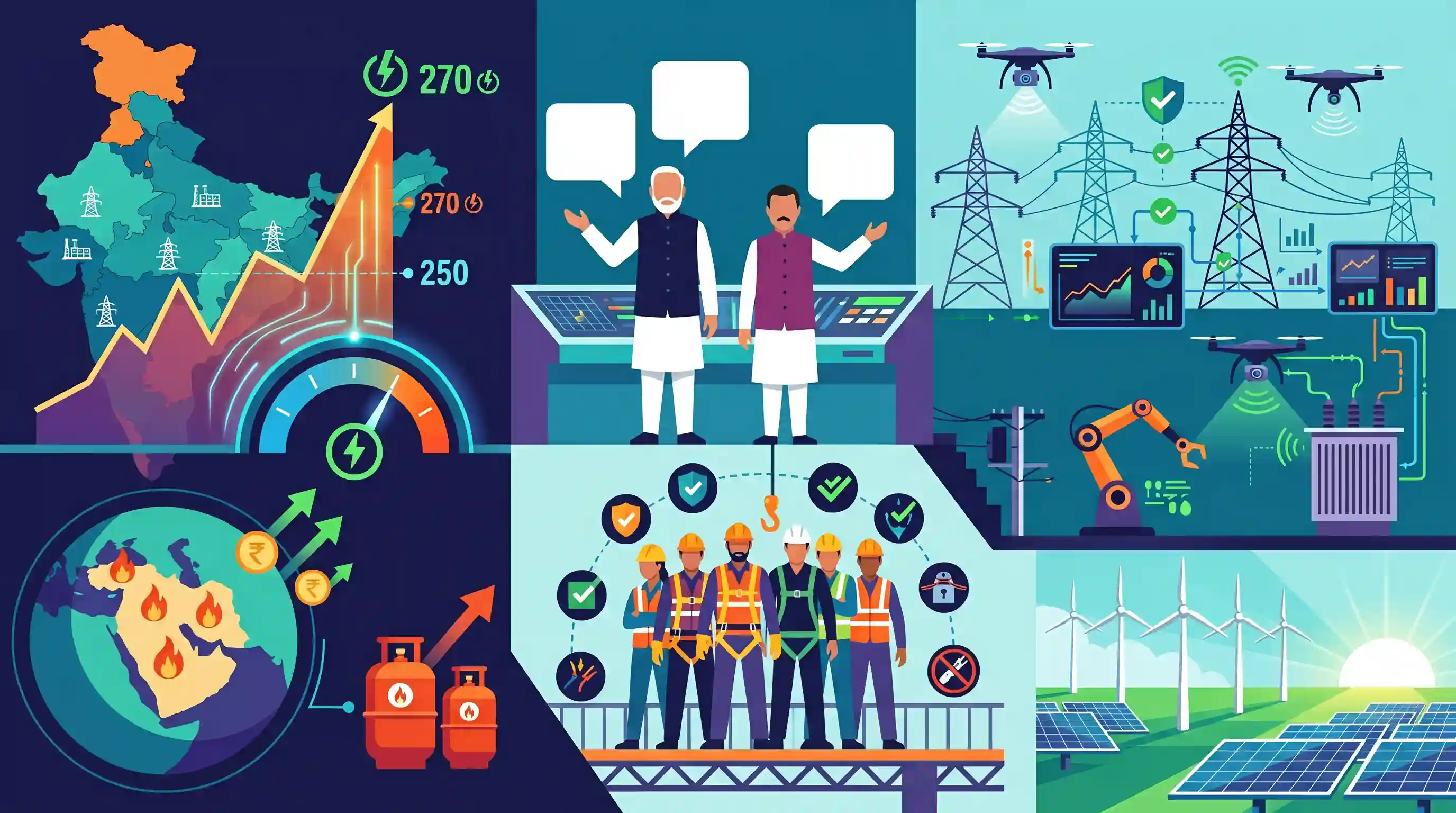
The rising peak power demand reflects India's economic expansion and climate vulnerabilities. The article connects geopolitical events in West Asia directly to domestic energy inflation (LPG prices) while underscoring the critical role of emerging tech (AI, drones) in modernizing infrastructure and ensuring the occupational safety of frontline workers.
Summary
India's peak power demand is projected to touch 270 GW this summer, higher than the previous record of 250 GW in May 2024. MoS for Power Shripad Yesso Naik and Minister Hardeep Puri assured that while the West Asia crisis has driven up global energy rates—causing a ₹60 increase in domestic LPG prices—the country's electricity supply will not be disrupted. Speaking at 'Lineman Diwas', the ministers emphasized the need to embed occupational safety into the work culture of the power sector. Upgrading to smart grids and deploying AI-based predictive maintenance, drones, and data analytics were highlighted as vital steps to improve infrastructure resilience, minimize hazards, and ensure safety as India shifts toward modern and renewable energy grids.
Key Points
- India's peak power demand is projected to reach 270 GW this summer, surpassing the previous all-time high of about 250 GW recorded in May 2024.
- The ongoing West Asia crisis has led to a spike in global energy rates, resulting in a ₹60 hike in domestic LPG cylinder prices, though the power supply remains unaffected.
- Occupational safety in the power sector was highlighted during 'Lineman Diwas', emphasizing the shift from rule-bound safety to a broader safety work culture.
- Future power systems are urged to integrate smart grids, AI-based predictive maintenance, drone inspections, and sensor-based fault detection to enhance reliability and safety.
- The modernization of grid infrastructure, especially with renewable energy, must be accompanied by upgraded safety practices to minimize human error and hazardous tasks.
Important Terms
Central Electricity Authority (CEA)

A statutory body under the Electricity Act, 2003, acting as a technical advisor to the government on national electricity policy, grid standards, and infrastructure safety.
UPSC context
GS Paper III: Infrastructure (Energy). Tests knowledge of statutory regulatory bodies and technical planning in the power sector.
Ministry of Power
The nodal central agency responsible for policy formulation, perspective planning, and monitoring of India's electrical energy generation, transmission, and distribution.
UPSC context
GS Paper II: Governance and Paper III: Infrastructure. Tests understanding of governmental oversight in the energy sector.
Ministry of New and Renewable Energy (MNRE)
The nodal ministry for all matters relating to new and renewable energy, focused on developing green energy to ensure national energy self-reliance.
UPSC context
GS Paper III: Energy and Environment. Crucial for topics on climate change commitments (Panchamrit) and energy transition.
Smart Grid
An advanced electrical network using digital technology and two-way communication to manage power flows efficiently, improve reliability, and integrate renewable energy sources.
UPSC context
GS Paper III: Science and Technology and Infrastructure. Tests awareness of modern technological solutions for grid stability and loss reduction.
Energy Security
The reliable and affordable availability of energy sources, often challenged by geopolitical volatility (like the West Asia crisis) and import dependencies.
UPSC context
GS Paper II: International Relations and GS Paper III: Security. Examines how global geopolitics affect domestic economic stability.
Peak Power Demand
The maximum electrical load required by the grid at any given time, serving as a critical indicator for infrastructure capacity planning and resource management.
UPSC context
GS Paper III: Infrastructure. Relevant for understanding demand-supply dynamics and the resilience of the national power grid.
Prelims Trap
The West Asia crisis threatens India's electricity supply due to high reliance on imported fuel for power generation.
India's power generation relies predominantly on domestic coal and renewables, insulating the electricity grid from West Asian oil/LPG price shocks.
Static Concepts Connected
What distinguishes a Smart Grid from a traditional power grid?
- Two-way communication: Enables real-time digital data exchange between utilities and consumers, optimizing demand-supply management.
- Self-healing capability: Uses IoT sensors and AI-based predictive maintenance for automated fault detection and rapid restoration.
- Renewable integration: Seamlessly balances and absorbs intermittent decentralized renewable energy sources (like rooftop solar) into the baseload.
What is the framework of the Occupational Safety, Health and Working Conditions (OSH) Code, 2020?
- Consolidation: Subsumes 13 central labour enactments (like the Factories Act and Mines Act) into a single comprehensive framework.
- Uniform standards: Mandates uniform safety standards across industries, aiming to institutionalize a proactive safety culture rather than mere rule-compliance.
Cross-Topic Patterns
Energy Security vs. Grid Stability
As India shifts from imported oil/LPG to electricity-based transport and cooking, maintaining grid stability during the 270 GW summer peaks becomes the new frontline of national energy security.
Emerging Tech in Core Infrastructure
AI, drones, and IoT are moving from pure IT syllabus topics to core infrastructure, acting as critical enablers for occupational safety and grid modernization.

Expect a 2026 prelims question contrasting India's heavy LPG/oil import dependency with its largely insulated, coal-reliant power grid.
Linked PYQs · 5
Linked PYQs · 5
- 2022MainsGS3
Do you think India will meet 50 percent of its energy needs from renewable energy by 2030 ? Justify your answer. How will the shift of subsidies from fossil fuels to renewables help achieve the above objective ? Explain.
- 2021MainsGS3
Explain the purpose of the Green Grid Initiative launched at World Leaders Summit of the COP26 UN Climate Change Conference in Glasgow in November, 2021. When was this idea first floated in the International Solar Alliance (ISA)?
- 2023MainsGS3
What is oil pollution? What are its impacts on the marine ecosystem? In what way is oil pollution particularly harmful for a country like India?
- 2024MainsGS3
What is the technology being employed for electronic toll collection on highways? What are its advantages and limitations? What are the proposed changes that will make this process seamless? Would this transition carry any potential hazards?
- 2023MainsGS3
Introduce the concept of Artificial Intelligence (AI). How does Al help clinical diagnosis? Do you perceive any threat to privacy of the individual in the use of Al in healthcare?
