Defence Minister Emphasizes Indigenization and Strategic Readiness
Source:The Hindu ↗
Why It Matters
This highlights a significant policy shift in India's defence sector—viewing defence expenditure as an economic growth driver rather than a sunk cost. The push for indigenization (Make in India), private sector participation, and the new ₹1 lakh crore RDI scheme are highly relevant for GS-3 questions on self-reliance in technology and defense economics.
Summary
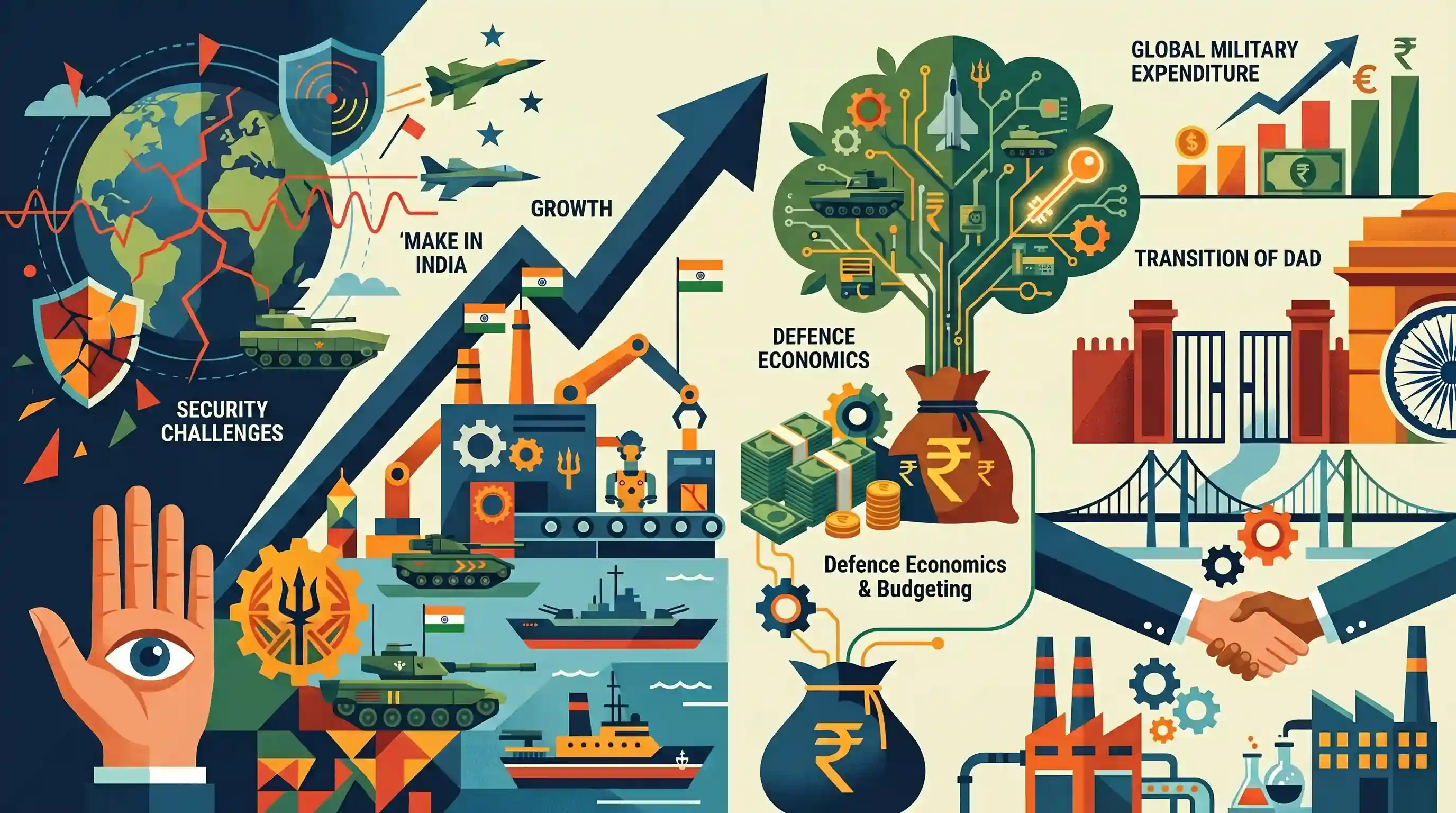
Addressing the Controllers' Conference 2025 hosted by the Defence Accounts Department (DAD), Defence Minister Rajnath Singh stated that peacetime is an "illusion" and emphasized continuous readiness for uncertainty. He highlighted India's growing stature in defence manufacturing, spurred by the success of Operation Sindoor, and noted that global military expenditure—reaching $2.7 trillion in 2024 according to SIPRI—opens massive opportunities for Indian industries. Singh urged the DAD to transition from a "controller" to a "facilitator" to support private sector participation in defence. He also emphasized that defence budgets are now viewed as growth drivers, supported by initiatives like the ₹1 lakh crore Research, Development and Innovation (RDI) Scheme for high-end technology procurement.
Key Points
- Defence Minister Rajnath Singh stated that "peace time is nothing but an illusion," urging the Armed Forces to be continuously prepared for uncertainty.
- Following the success of Operation Sindoor, there has been a significant surge in global demand for Indian-manufactured defence equipment.
- With growing private sector participation in defence, the Defence Accounts Department (DAD) was urged to evolve from a regulatory 'controller' to a supportive 'facilitator'.
- Global military expenditure reached $2.7 trillion in 2024 (according to SIPRI), opening new export opportunities for India's indigenous defence industries.
- The government has introduced a ₹1 lakh crore Research, Development and Innovation (RDI) Scheme to prioritize defence innovation and high-end tech procurement.
- Defence budgets are increasingly being viewed as economic growth drivers rather than mere expenditures, promoting a "defence economics" approach.
Important Terms
Operation Sindoor

A 2025 multidomain military operation launched in response to terror attacks; it serves as a landmark validation of indigenous defence systems like BrahMos and Akash in active combat.
UPSC context
GS Paper III (Internal Security); tests knowledge of indigenous defence capabilities and the 'Make in India' impact on operational success.
Research, Development and Innovation (RDI) Scheme
A ₹1 lakh crore government initiative providing long-term, low-interest financing to catalyze private sector R&D in strategic domains like defence, AI, and space technology.
UPSC context
GS Paper III (Indigenization of Technology); relevant for topics on industrial growth, self-reliance, and public-private partnership in research.
Defence Accounts Department (DAD)
The financial arm of the Ministry of Defence responsible for auditing, accounting, and providing financial advice for the Indian Armed Forces and related organizations.
UPSC context
GS Paper II/III (Governance/Security); relevant for understanding the fiscal management of the defence budget and institutional reforms in procurement.
Stockholm International Peace Research Institute (SIPRI)
A Sweden-based independent international institute that provides data and analysis on global military expenditure, arms transfers, and disarmament.
UPSC context
GS Paper II/III (International Relations/Security); used to cite trends in global militarization, India's spending rank, and regional security.
Controller General of Defence Accounts (CGDA)
The administrative head of the Defence Accounts Department and principal accounting officer for the Ministry of Defence, overseeing audit and financial advice for the services.
UPSC context
GS Paper II (Regulatory Bodies); important for governance structures within the Ministry of Defence and ensuring financial transparency.
Prelims Trap
"SIPRI is a specialized UN agency tracking global military expenditure."
SIPRI is an independent international institute based in Stockholm, Sweden. It is not affiliated with the United Nations. UPSC frequently traps aspirants on report publishers' parentage.
Static Concepts Connected
What is the highest priority category under the Defence Acquisition Procedure (DAP)?
- Buy (Indian-IDDM): Indigenously Designed, Developed and Manufactured (IDDM) is the most preferred category, generally requiring a minimum of 50% indigenous content.
- Positive Indigenisation Lists: MoD periodically notifies lists of weapons and platforms subjected to staggered import embargoes to force domestic manufacturing.
- iDEX Initiative: Innovations for Defence Excellence (iDEX) provides grants to MSMEs and startups to foster innovation and tech development in Defence and Aerospace.
How does "Defence Economics" shift expenditure from 'sunk cost' to 'growth driver'?
- Dual-use tech: Military R&D heavily subsidized by the state often creates spin-off technologies applicable to civilian sectors, spurring broader commercial markets.
- MSME ecosystem: Initiatives like Defence Industrial Corridors (UP and Tamil Nadu) integrate regional MSMEs into high-value domestic and global supply chains.
- Forex savings: Replacing imported capital defense platforms with domestic ones structurally reduces the national import bill and current account deficit.
Cross-Topic Patterns
Defence diplomacy & Act East
Surging defence demand connects to India's foreign policy, using weapons exports (e.g., BrahMos, Pinaka) to build strategic leverage in ASEAN (Act East) and the Caucasus.
Budget's ₹1 Lakh Cr R&D Corpus
This links MoD's deep-tech procurement with the Interim Budget 2024-25 announcement offering 50-year interest-free loans to spur private sector innovation across various sectors.

Expect a multi-statement Prelims question mixing SIPRI report trends, India's defence export targets, and DAP 2020 indigenisation rules.
Linked PYQs · 3
Linked PYQs · 3
- 2014MainsGS3
Foreign Direct Investment (FDI) in the defence sector is now set to be liberalized. What influence this is expected to have on Indian defence and economy in the short and long run?
- 2019MainsGS3
The public expenditure management is a challenge to the Government of India in the context of budget making during the post-liberalization period. Clarify it.
- 2023MainsGS3
Faster economic growth requires increased share of the manufacturing sector in GDP, particularly of MSMEs. Comment on the present policies of the Government in this regard.
