Impact of India United States Trade Deal on Kashmir Apple Industry
Source:The Hindu ↗
Why It Matters
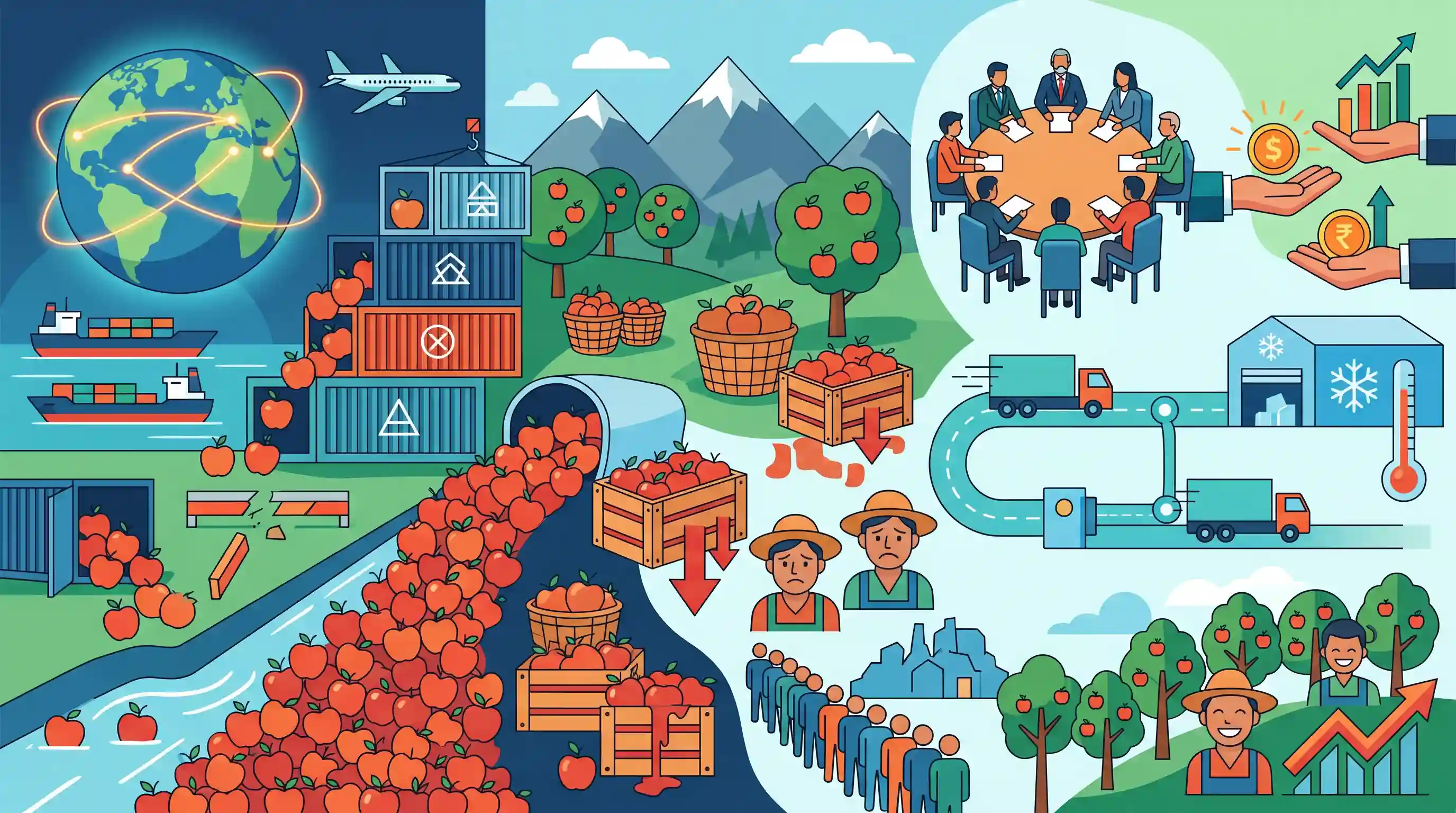
Illustrates the real-world, localized economic impacts of macroeconomic policies like International Free Trade Agreements (FTAs) on domestic agricultural sectors. It highlights the vulnerability of regional economies to global trade dynamics and underscores the critical need for robust post-harvest infrastructure (cold storage, dry ports) to build resilience among farmers.
Summary
The Peoples Democratic Party (PDP) has urged the Jammu and Kashmir government to convene an all-party meeting regarding the negative impact of recent Free Trade Agreements (FTAs), specifically the India-U.S. trade deal, on the region's apple industry. PDP leader Waheed-ur-Rehmaan Parra highlighted that tax-free apple imports from the U.S. and other countries have sparked an agricultural crisis in Kashmir, jeopardizing the livelihoods of nearly 7 million people dependent on horticulture. To mitigate the damage, political leaders are advocating for interest-free loans under the Holistic Agriculture Development Programme (HADP), significant expansion of cold storage infrastructure, and improved supply chain management to prevent distress sales. Chief Minister Omar Abdullah also acknowledged the severe threat posed by the trade pact to J&K’s local economy.
Key Points
- The Peoples Democratic Party (PDP) has demanded an all-party meeting in J&K to address the adverse impacts of the India-U.S. trade deal on local apple growers.
- The removal of tariffs on U.S. apples has triggered an agricultural crisis in Kashmir, where the horticulture sector is the economic backbone supporting around 7 million people.
- PDP leaders called for interest-free loans and subsidies under the Holistic Agriculture Development Programme (HADP) to protect farmers from financial ruin.
- Expanding cold storage, controlled atmosphere facilities, and supply chain infrastructure is emphasized to prevent distress sales of perishable produce.
- There is a push to revisit a dry port project to facilitate better export logistics for J&K's horticulture products.
Important Terms
India-U.S. Trade Agreement (2023)

A 2023 trade arrangement where India reduced the basic customs duty on U.S. apples from 50% to 25%, sparking domestic concerns over cheaper imports undercutting local prices.
UPSC context
GS Paper III (Economy). Tests understanding of bilateral trade's impact on domestic primary sectors and rural livelihoods.
Minimum Import Price (MIP)
A floor price (e.g., ₹80/kg for apples) set by the government below which a product cannot be imported, serving as a non-tariff barrier to protect domestic farmers from dumping.
UPSC context
GS Paper III (Agriculture). Relevant for studying market intervention mechanisms and protectionist trade policies.
Holistic Agriculture Development Programme (HADP)
A ₹5,013 crore J&K government initiative comprising 29 projects aimed at doubling agricultural output, enhancing value chains, and providing 90% loan financing to orchardists.
UPSC context
GS Paper III (Agriculture). Focuses on regional policy interventions for productivity and technology-led agricultural transformation.
Free Trade Agreements (FTAs)
Pacts between nations to reduce or eliminate trade barriers like tariffs and quotas. They aim to enhance market access while requiring a balance with domestic economic protections.
UPSC context
GS Paper III (Economy). Crucial for topics on international trade, globalization, and the impact of external competition on local industries.
J&K Horticulture Sector
The economic backbone of J&K, contributing ~8% to GSDP and supporting 7 million people; the region accounts for over 70% of India’s total apple production.
UPSC context
GS Paper III (Economic Geography/Agriculture). Important for studying regional economic dependencies and supply chain challenges.
Jammu and Kashmir Legislative Assembly
The 90-member unicameral legislature of the Union Territory, reconstituted in 2024 to debate regional policy and address socio-economic issues like trade impacts on local industry.
UPSC context
GS Paper II (Polity). Relevant for understanding the political structure of UTs with legislatures and regional democratic governance.
Prelims Trap
Free Trade Agreements (FTAs) affecting state subjects like agriculture must be formally ratified by Parliament to take effect.
In India, the Union Executive holds exclusive power to sign and ratify international treaties (Article 73). Parliamentary approval isn't mandatory unless domestic laws require amendment.
Static Concepts Connected
Who holds the power to sign and ratify international treaties in India?
- Union Executive: Under Article 73, the executive power of the Union allows the Cabinet to sign and ratify international treaties without prior parliamentary approval.
- Parliamentary Implementation: Under Article 253, Parliament has the exclusive power to enact legislation to implement any treaty or agreement, even if the subject falls under the State List.
What is Controlled Atmosphere (CA) storage in the horticulture supply chain?
- Atmospheric Regulation: CA storage alters natural atmospheric concentrations (reducing oxygen, increasing CO2) alongside strict temperature and humidity controls to significantly slow down the respiration and ripening of fruits.
- Preventing Distress Sales: It extends the shelf life of highly perishable crops like apples by several months, stabilizing off-season supply and protecting farmers from distress sales during harvest gluts.
Cross-Topic Patterns
Federalism vs. Foreign Policy
J&K's political mobilization against a Union-negotiated FTA mirrors past state-level resistance (e.g., Kerala on ASEAN FTA), highlighting the growing demand for institutionalizing states' voices in international trade negotiations.
FTAs and Agricultural Safeguards
The influx of low-duty foreign apples triggering domestic distress perfectly illustrates why India historically resisted sweeping agricultural market access in mega-regional agreements like RCEP and at the WTO.

A GS2/GS3 Mains question on federal frictions and the lack of state consultation in India's treaty-making powers (Art 73) is highly likely.
Linked PYQs · 4
Linked PYQs · 4
- 2018MainsGS3
Assess the role of National Horticulture Mission (NHM) in boosting the production, productivity and income of horticulture farms. How far has it succeeded in increasing the income of farmers?
- 2025MainsGS3
Elaborate the scope and significance of supply chain management of agricultural commodities in India.
- 2024MainsGS3
Elucidate the importance of buffer stocks for stabilizing agricultural prices in India. What are the challenges associated with the storage of buffer stock? Discuss.
- 2018PrelimsGS1
Consider the following countries: 1. Australia 2. Canada 3. China 4. India 5. Japan 6. USA Which of the above are among the 'free-trade partners' of ASEAN?
