PCMC Showcases Sustainable Urban Planning Model
Source:Indian Express ↗
Why It Matters
This article provides a compelling case study of Urban Local Bodies (ULBs) successfully addressing the challenges of urbanization through inclusive infrastructure and innovative financial empowerment (Green Bonds). It is highly relevant for GS2 (devolution of powers and finances to local bodies) and GS1 (urbanization and its remedies), offering concrete examples for Mains answers on sustainable cities, municipal finance, and inter-state knowledge sharing.
Summary
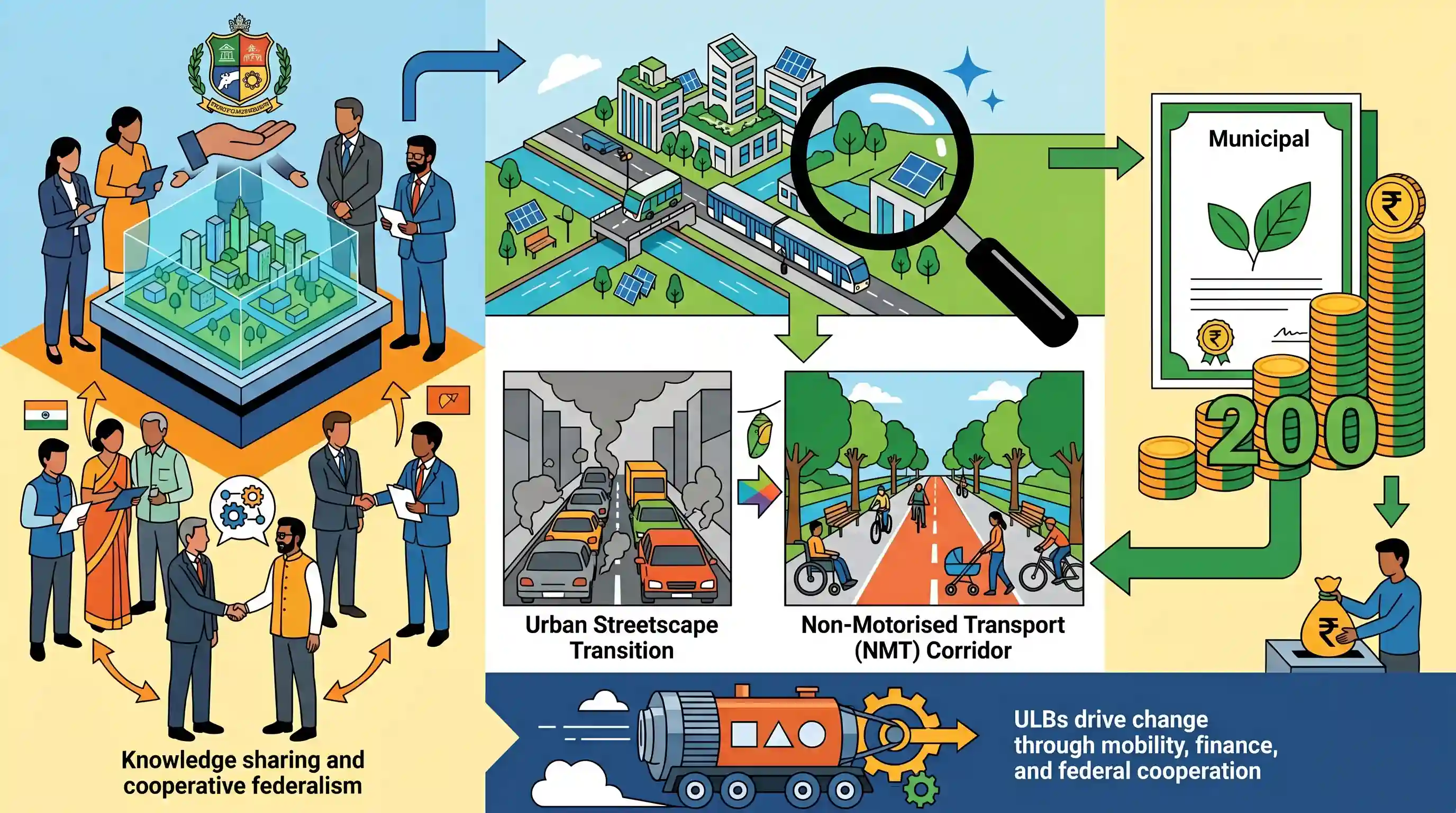
The Pimpri-Chinchwad Municipal Corporation (PCMC) hosted a delegation of civic officials from Uttar Pradesh and Maharashtra to share its successful model for inclusive and sustainable urban development. PCMC showcased its transition from vehicle-centric roads to equitable public spaces through initiatives like the 'Harit Setu' and 'Urban Streetscape' programs, which prioritize pedestrians, cyclists, and vulnerable groups via non-motorised transport (NMT) corridors. Notably, the corporation demonstrated financial innovation by issuing Maharashtra's first municipal Green Bond to raise Rs 200 crore for these sustainable projects. The inter-state exchange underscores the critical role of Urban Local Bodies (ULBs) in driving sustainable urban mobility, innovative financing, and cooperative federalism.
Key Points
- PCMC hosted a knowledge-sharing session for civic officials from Uttar Pradesh and Maharashtra to showcase its inclusive and sustainable urban planning model.
- The corporation highlighted initiatives like the 'Harit Setu' and 'Urban Streetscape' programs, which prioritize non-motorised transport (NMT) corridors and low emission zones.
- Infrastructure design at PCMC shifts priority from motorized vehicles to pedestrians, cyclists, children, senior citizens, and people with disabilities (PwDs), aiming to reclaim roads as equitable public spaces.
- To fund its sustainable mobility projects, PCMC pioneered urban financing by issuing Maharashtra's first municipal Green Bond, successfully raising Rs 200 crore.
- The knowledge exchange included demonstrations of an Integrated Command and Control Centre and discussions on financial models, illustrating inter-state capacity building for Urban Local Bodies (ULBs).
Important Terms
Municipal Green Bonds

Debt instruments issued by Urban Local Bodies (ULBs) to fund climate-friendly projects like clean transport or renewable energy, adhering to SEBI’s green debt framework.
UPSC context
GS2 (Local Governance) and GS3 (Economy/Infrastructure); vital for municipal financial autonomy and sustainable urban development.
PCMC Green Bond
Maharashtra’s first green municipal bond, a Rs 200 crore issue (listed 2025) oversubscribed 5.13 times to fund sustainable mobility and the 'Harit Setu' project.
UPSC context
GS3 (Infrastructure); a landmark case study for innovative municipal financing and investor confidence in local bodies.
Harit Setu
A 12-year master plan by PCMC to transform urban roads into an integrated network of green corridors, cycle tracks, and pedestrian-friendly walkways.
UPSC context
GS1 (Urbanization); illustrates the shift from vehicle-centric to people-centric urban planning and "active mobility."
Urban Streetscape program
A city-wide initiative to redesign streets as equitable public spaces, featuring wider footpaths, junction safety upgrades, and improved lighting following Indian Roads Congress standards.
UPSC context
GS3 (Infrastructure); exemplifies "Complete Streets" design and inclusive urban mobility for vulnerable groups.
Non-Motorised Transport (NMT)
Human-powered transportation modes, primarily walking and cycling, prioritized in sustainable urban transport policies to reduce congestion, pollution, and carbon emissions.
UPSC context
GS3 (Environment); central to the National Urban Transport Policy (NUTP) and climate-resilient urban infrastructure.
Cooperative Federalism
A governance principle where central, state, and local governments work collaboratively; demonstrated through inter-state knowledge sharing of successful urban models.
UPSC context
GS2 (Polity); tested via mechanisms of inter-state coordination and the diffusion of best practices in governance.
Prelims Trap
Only the Central Government or RBI can authorize Green Bonds, and ULBs are barred from direct market borrowing.
ULBs can issue Municipal Green Bonds to raise funds directly from capital markets. They are regulated by SEBI's ILDM Regulations, not the RBI, provided the ULB meets net-worth and non-default criteria.
Static Concepts Connected
What are the SEBI conditions for Urban Local Bodies to issue Municipal Bonds?
- No Default: The municipality must not have defaulted on any loan or debt instrument in the last one year.
- Positive Net Worth: The ULB must have maintained a positive net worth in all three preceding financial years.
- Accounting Standards: The municipality must prepare its accounts in accordance with the National Municipal Accounting Manual (NMAM).
What defines a 'Green Bond' in the Indian regulatory framework?
- End-use Restriction: Proceeds must strictly fund 'green' projects like renewable energy, clean mass transport (e.g., NMT corridors), or sustainable water management.
- SEBI Compliance: Under SEBI guidelines, issuers must provide a green debt security framework and undergo an independent third-party review or certification.
Cross-Topic Patterns
Municipal Finance + 74th Amendment constraints
The chronic underfunding of ULBs makes market borrowings like Muni Bonds crucial, directly linking to the 15th Finance Commission's push for property tax reforms and audited municipal accounts.
Smart Cities + Climate Action goals
Non-Motorised Transport (NMT) corridors align local urban mobility with India's Net Zero by 2070 target, merging GS1 urbanization themes with GS3 climate action and infrastructure goals.

Expect a multi-statement Prelims question testing SEBI's municipal bond issuance criteria alongside the definition of Green Debt.
Linked PYQs · 4
Linked PYQs · 4
- 2024MainsGS2
Analyse the role of local bodies in providing good governance at local level and bring out the pros and cons merging the rural local bodies with the urban local bodies.
- 2023MainsGS2
“The states in India seem reluctant to empower urban local bodies both functionally as well as financially.” Comment.
- 2025MainsGS1
How does smart city in India, address the issues of urban poverty and distributive justice?
- 2019MainsGS1
How is efficient and affordable urban mass transport key to the rapid economic development of India?
