Local Governance Lapses in Solid Waste Management in Kerala
Source:The Hindu ↗
Why It Matters
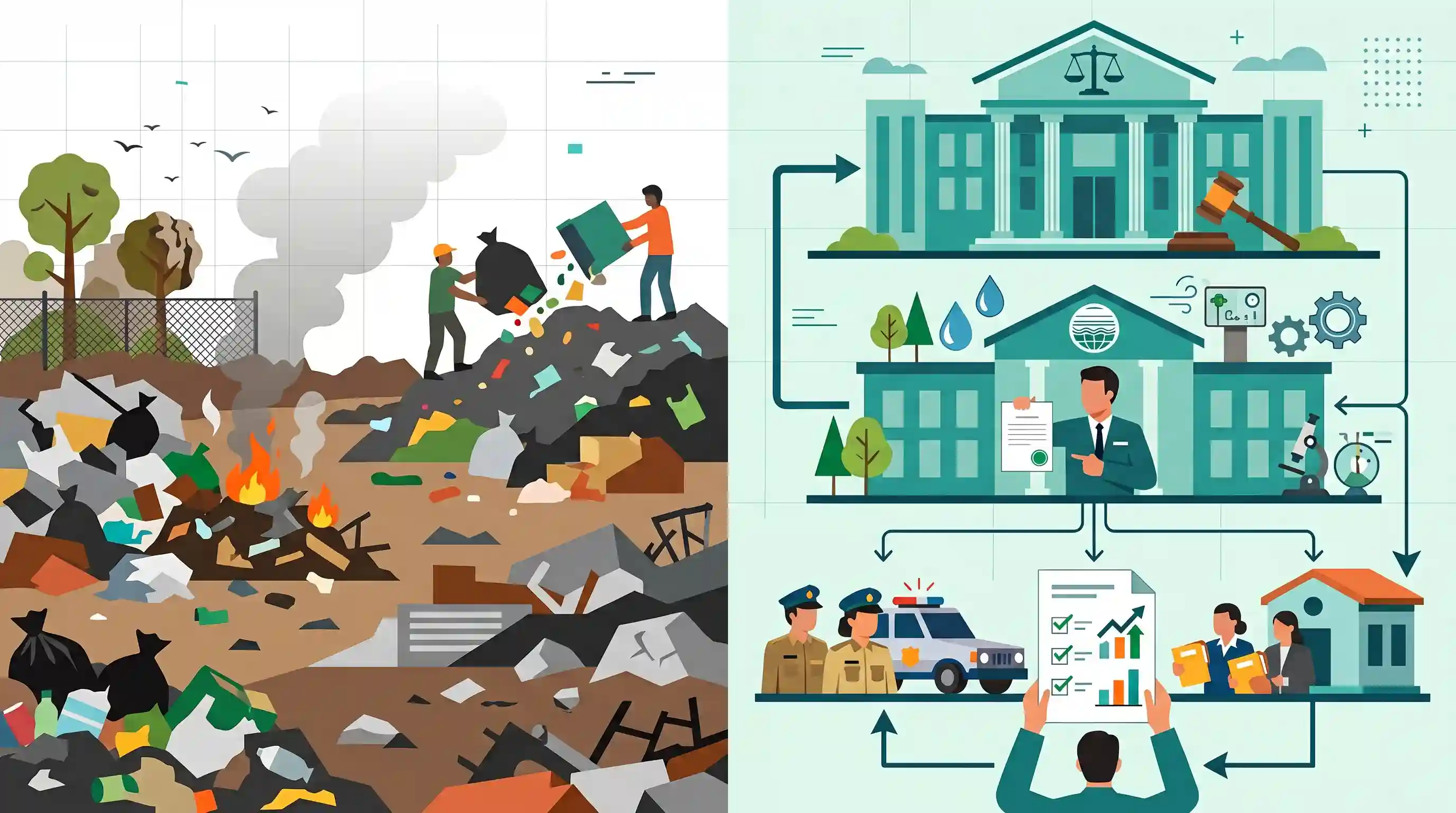
It illustrates the practical difficulties in managing urban and semi-urban solid waste, emphasizing the role of local self-governments (panchayats) and the necessary enforcement mechanisms by statutory bodies like the PCB and NGT. This connects directly to GS3 (Environment) and GS2 (Local Governance).
Summary
The Kerala State Pollution Control Board has ordered the Vadavucode-Puthecruz panchayat and local police to submit an action-taken report regarding illegal waste dumping on private land in Brahmapuram. The intervention follows suo motu cognizance by the National Green Tribunal after a previous fire incident linked to illegally dumped plastic and construction debris. This highlights the governance challenges in solid waste management and the oversight role of environmental bodies over local panchayats.
Key Points
- The Kerala PCB directed the Vadavucode-Puthecruz panchayat and local police to submit reports on actions taken against illegal waste dumping at Brahmapuram.
- The dumped materials included plastic as well as construction and demolition waste, which pose severe environmental and fire hazards.
- The NGT had previously taken suo motu notice of the issue following a fire incident originating from the illegally dumped garbage.
- The incident highlights ongoing challenges in enforcing solid waste management rules at the local self-government level.
Important Terms
National Green Tribunal (NGT)

A statutory judicial body established under the NGT Act, 2010, for the specialized and expeditious disposal of cases related to environmental protection and forest conservation.
UPSC context
GS II (Statutory Bodies) & GS III (Environment); crucial for understanding environmental jurisprudence and judicial activism.
State Pollution Control Board (SPCB)
Statutory bodies constituted under the Water Act, 1974, responsible for enforcing environmental laws, monitoring pollution standards, and overseeing waste management at the state level.
UPSC context
GS III (Environment) & GS II (Governance); highlights the decentralized implementation of environmental regulations and federal oversight.
Solid Waste Management Rules, 2016
National regulations mandating the segregation of waste into biodegradable, dry, and domestic hazardous categories, placing primary implementation responsibility on local bodies.
UPSC context
GS III (Waste Management); focuses on technical standards, source segregation, and the 'polluter pays' principle.
Suo Motu Cognizance
A legal power allowing courts or tribunals to initiate proceedings on their own initiative (without a formal petition), often triggered by media reports or environmental emergencies.
UPSC context
GS II (Judiciary); tests knowledge of judicial activism and the NGT’s unique role as a proactive environmental watchdog.
Legacy Waste
Old, untreated municipal solid waste that has accumulated in landfills or open dumpsites over many years, posing fire and leachate risks.
UPSC context
GS III (Environment/Pollution); relevant for discussing landfill management, remediation techniques, and urban environmental hazards.
Biomining
The scientific process of clearing legacy waste by excavating and separating materials using trommels or screens into compost, recyclables, and inert soil.
UPSC context
GS III (Science & Technology/Environment); an essential technological solution for sustainable waste management and urban land reclamation.
Local Self-Government (LSG)
The 73rd and 74th Constitutional Amendments empowered these bodies (Panchayats/Municipalities) with the mandate for public health, sanitation, and waste management.
UPSC context
GS II (Governance/Panchayati Raj); focuses on the bottom-up accountability of local bodies in executing national environmental mandates.
Prelims Trap
"The National Green Tribunal (NGT) cannot take suo motu cognizance as it is a statutory tribunal, not a constitutional court."
Aspirants assume statutory tribunals only act on petitions. The Supreme Court has explicitly affirmed NGT's suo motu powers to safeguard the fundamental right to a healthy environment.
Static Concepts Connected
What are the obligations of local bodies under Solid Waste Management Rules, 2016?
- Infrastructure mandate: Mandated to set up facilities for the segregation, collection, and scientific processing of municipal solid waste.
- Fees and fines: Empowered to levy user fees on waste generators and impose spot fines for non-compliance or littering.
- Informal sector integration: Directed to integrate informal sector workers like ragpickers, waste pickers, and kabadiwalas into the formal waste management system.
What is the statutory backing and enforcement mandate of State Pollution Control Boards?
- Legislative origin: Established under the Water (Prevention and Control of Pollution) Act, 1974, and later entrusted with powers under the Air Act and EPA.
- Enforcement power: Possess statutory authority to monitor local bodies and levy 'environmental compensation' (penalties) for failing to comply with waste management norms.
Cross-Topic Patterns
Panchayats as frontline climate actors
Unsegregated dumping causes anaerobic decomposition, releasing highly flammable methane. This transforms local panchayats from mere administrative units into critical frontline actors in India's greenhouse gas mitigation strategy.
Local dumping & EPR compliance gaps
The dumping of plastic and construction waste directly highlights poor Extended Producer Responsibility (EPR) enforcement, linking local panchayat implementation failures to broader corporate compliance gaps in GS3.

Expect a multi-statement Prelims 2026 question mapping NGT's suo motu powers against the statutory duties of local bodies in waste rules.
Linked PYQs · 3
Linked PYQs · 3
- 2018MainsGS3
What are the impediments in disposing the huge quantities of discarded solid wastes which are continuously being generated? How do we remove safely the toxic wastes that have been accumulating in our habitable environment?
- 2024MainsGS2
Analyse the role of local bodies in providing good governance at local level and bring out the pros and cons merging the rural local bodies with the urban local bodies.
- 2018PrelimsGS1
How is the National Green Tribunal (NGT) different from the Central Pollution Control Board (CPCB)? 1. The NGT has been established by an Act whereas the CPCB has been created by an executive order of the Government. 2. The NGT provides environmental justice and helps reduce the burden of litigation in the higher courts whereas the CPCB promotes cleanliness of streams and wells, and aims to improve the quality of air in the country. Which of the statements given above is/are correct?
