Carbon Pricing and Climate Compensation Debates in Global South
Source:The Hindu ↗
Why It Matters
The article highlights the tension between market-based economic mechanisms (carbon pricing) and international climate equity principles (Loss and Damage, CBDR), which are central to global climate negotiations and India's developmental stance.
Summary
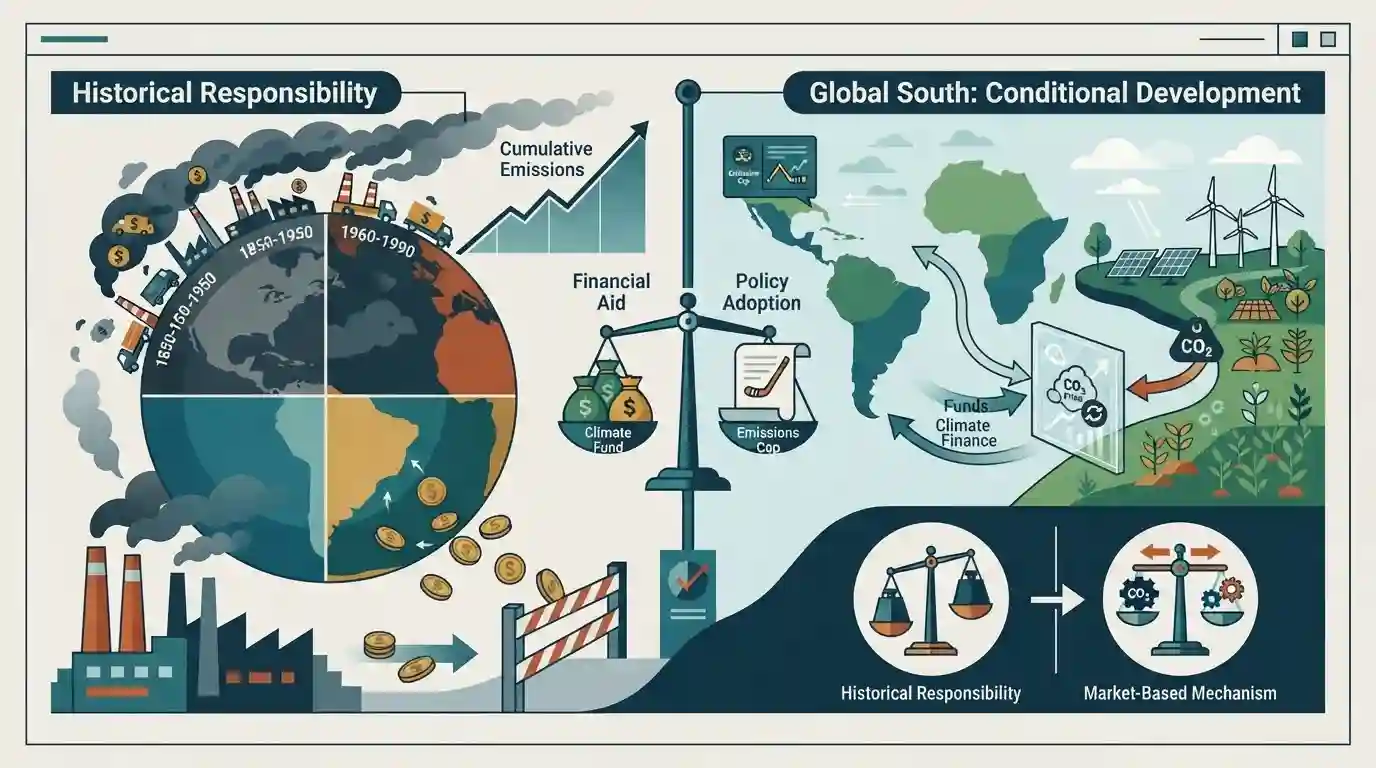
Economist Michael Greenstone argues that financial flows for climate damage to the Global South should be conditional upon these nations adopting carbon pricing policies. The perspective opens up critical discussions on market-based environmental instruments versus the principle of historical climate responsibility.
Key Points
- Renowned economist Michael Greenstone argues that financial compensation for climate damage should be tied to developing nations implementing carbon pricing mechanisms.
- The proposal sparks debate on climate equity, pitting the principle of historical responsibility and CBDR (Common But Differentiated Responsibilities) against conditional market-based climate policies.
- Carbon pricing (such as carbon taxes or emissions trading systems) is highlighted as an efficient tool to internalize environmental costs, though its implementation in the Global South raises equity and development concerns.
Important Terms
Loss and Damage Fund

An international funding mechanism established under UN climate talks to provide financial assistance to developing countries suffering from unavoidable economic and non-economic losses due to climate change impacts.
UPSC context
UPSC Prelims/Mains (Environment & Climate Change): Important for UNFCCC negotiations, climate equity, and financial mechanisms for developing nations.
Global South
A broad socioeconomic and political grouping referring to low- and middle-income countries across Asia, Africa, and Latin America that face disproportionate vulnerabilities to historical emissions from industrialized nations.
UPSC context
UPSC Mains (GS Paper II/III): Key for international relations, global climate justice, and North-South policy negotiations.
Carbon Pricing
An economic policy instrument like carbon taxes or emission trading systems that assigns a monetary cost to greenhouse gas emissions to internalize environmental damage costs.
UPSC context
UPSC Prelims/Mains (Economy & Environment): Important for market-based environmental regulations, domestic carbon markets, and green growth strategies.
Static Concepts Connected
What is the principle of CBDR-RC under the UNFCCC framework?
- Historical Responsibility: Acknowledges historical emissions of developed nations and differing capabilities of developing countries.
- Differentiation: Basis for differentiation in climate action and financial/technological flows (e.g., Kyoto Protocol, Paris Agreement).
Cross-Topic Patterns
Carbon pricing vs. CBDR principle in climate negotiations
Market-based environmental instruments like carbon pricing interact directly with WTO border adjustments (CBAM) and UNFCCC equity principles.

CBDR-RC principle vs market-based conditionality (carbon pricing) is a prime candidate for UPSC GS Paper 3 mains debate.
Linked PYQs · 1
Linked PYQs · 1
- 2020MainsGS3
Explain intra-generational and inter-generational issues of equity from the perspective of inclusive growth and sustainable development.
