Biennial Elections to Bihar Legislative Council Vidhan Parishad
Source:dailypioneer ↗
Why It Matters
The development highlights core constitutional concepts tested in the BPSC Prelims, specifically the structure, history, and constitutional provisions of the Bihar Legislative Council (Articles 169 & 171), as well as the mandate requiring ministers to secure legislative membership within six months of appointment (Article 164(4)).
Summary
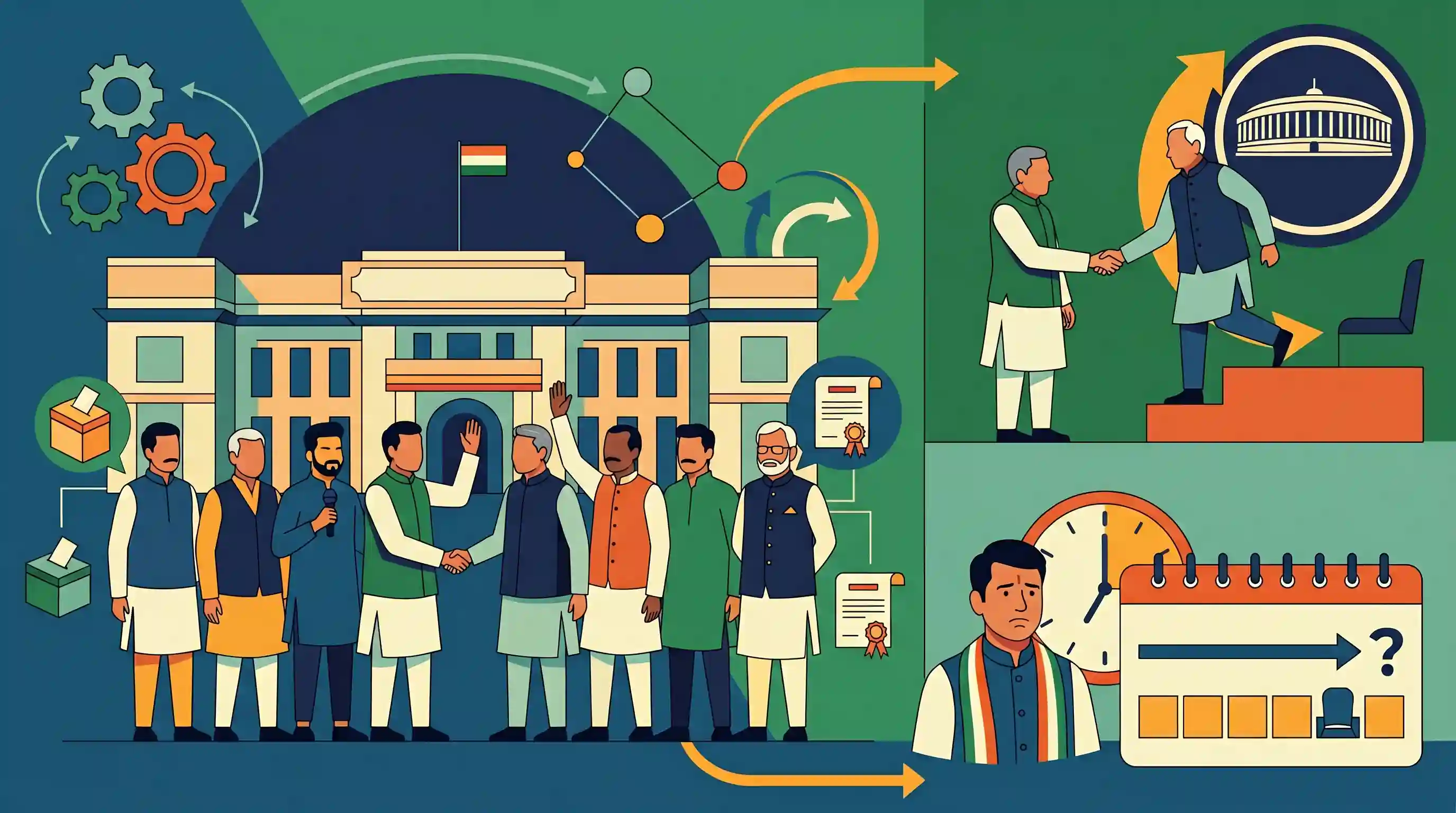
In June 2026, nine candidates were elected unopposed to the Bihar Legislative Council (Vidhan Parishad) in the biennial elections, along with JD(U)'s Lalan Saraf winning a by-election seat vacated by Rajya Sabha MP Nitish Kumar. The newly elected members include Bihar Health Minister Nishant Kumar and Bhojpuri star Pawan Singh. This election brings focus to constitutional mandates like Article 164(4) for non-legislator ministers (e.g., Deepak Prakash) and the evolution of Bihar's bicameral state legislature.
Key Points
- Nine candidates, including Bhojpuri actor Pawan Singh, Bihar Health Minister Nishant Kumar, and BJP's Sanjay Mayukh, were elected unopposed to the Bihar Legislative Council (Vidhan Parishad) in the June 2026 biennial elections.
- JD(U) candidate Lalan Saraf won a separate by-election unopposed for the council seat vacated by former Chief Minister Nitish Kumar, who resigned after being elected as a Rajya Sabha MP.
- Ashraf Ansari was elected as the first-ever Legislative Council member from the Lok Janshakti Party (Ram Vilas) since its inception five years ago.
- Party-wise Seat Breakdown: BJP secured 4 seats (Pawan Singh, Sanjay Mayukh, Anil Thakur, Sheela Pandit); JD(U) won 3 seats (Nishant Kumar, Bharti Mehta, Shivrani Devi Prajapati); LJP(RV) won 1 seat (Ashraf Ansari); and RJD won 1 seat (Sunil Kumar Singh).
- Constitutional Necessity: The election highlights the situation of Minister Deepak Prakash (son of RLM chief Upendra Kushwaha), who is currently not a member of either house. Under Article 164(4) of the Constitution, a minister must become a member of the State Legislature within six consecutive months or lose office.
- Political Controversy: Opposition RJD leader Tejashwi Yadav targeted the educational credentials of newly elected MLC and Health Minister Nishant Kumar, whose election affidavit revealed he had completed only 5 out of 8 semesters of his engineering degree at BIT Mesra.
Important Terms
Bihar Legislative Council (Vidhan Parishad)

The upper house of Bihar’s bicameral state legislature, comprising 75 members who serve six-year terms, with one-third retiring every two years as a permanent, non-dissoluble body.
UPSC context
GS Paper II: State Legislature. Tests understanding of the structure, constitutional status, and powers of state upper houses.
Article 164(4) of the Constitution of India
A constitutional provision mandating that a Minister who is not a member of the State Legislature for six consecutive months must vacate office upon the expiration of that period.
UPSC context
GS Paper II: State Executive. Tests appointment rules, qualifications of non-legislator ministers, and constitutional checks on executive power.
Article 169 of the Constitution of India
A constitutional provision empowering Parliament to create or abolish a state’s Legislative Council if the state’s Legislative Assembly passes a resolution with a special majority.
UPSC context
GS Paper II: State Legislature. Tests the constitutional mechanisms, federal balance, and parliamentary control over state bicameralism.
Article 171 of the Constitution of India
An article governing the composition of state Legislative Councils, limiting their strength to one-third of the Assembly and outlining indirect election and nomination methods.
UPSC context
GS Paper II: State Legislature. Tests details of the composition, electoral college, and membership limits of state upper houses.
Government of India Act 1935
A landmark British act that introduced provincial autonomy, abolished provincial dyarchy, and established bicameral legislatures in six provinces, including Bihar.
UPSC context
GS Paper I: Modern History. Tests key historical legislation, constitutional evolution, and the origins of provincial legislative frameworks.
Government of India Act 1919
A British-era legislation that introduced dyarchy in the provinces, established central bicameralism, and initiated the early evolution towards bicameral structures in Indian states.
UPSC context
GS Paper I: Modern History. Tests early constitutional developments, administrative devolution, and British-era legislative reforms.
Prelims Trap
Parliament must pass a constitutional amendment under Article 368 to create or abolish a State Legislative Council.
Article 169(3) explicitly states that any law passed by Parliament to create or abolish a Council is not to be deemed an amendment of the Constitution under Article 368, requiring only a simple majority.
Static Concepts Connected
How is a Legislative Council created or abolished, and what is its composition?
- Creation and Abolition: Parliament can create or abolish a Council if the State Assembly passes a resolution by a special majority (majority of total membership and >= 2/3 of members present and voting).
- Size Constraints: The total strength must not exceed one-third of the Legislative Assembly's strength, and cannot be fewer than 40 members.
- Electorate Breakdown: 1/3 elected by local bodies, 1/12 by graduates, 1/12 by teachers, 1/3 by MLAs, and the remaining 1/6 nominated by the Governor for achievements in literature, science, art, cooperative movement, or social service.
What limitations apply to the appointment of non-legislator Ministers under Article 164(4)?
- Six-Month Window: A Minister who is not a member of the State Legislature for six consecutive months must vacate office; this is a strict accountability limit, not an open-ended loophole.
- No Re-appointment Trick: In S.R. Chaudhuri v. State of Punjab (2001), the SC ruled a non-legislator minister who fails to get elected within 6 months cannot be immediately re-appointed as a Minister.
- Disqualification Bar: In B.R. Kapur v. State of TN (2001), the SC held that a person disqualified from contesting elections under the RPA 1951 cannot be appointed as a Minister.
Cross-Topic Patterns
Asymmetric Bicameralism: Council vs Rajya Sabha
Unlike the Rajya Sabha, Legislative Councils are weak second chambers. They cannot block ordinary bills permanently, only delay them for a maximum of 4 months, showcasing asymmetric bicameralism.
Provincial Autonomy and Historical Bicameralism
The Government of India Act 1935 established bicameralism in six provinces, including Bihar. This historical blueprint shaped the constituent assembly's debate on the utility of state upper houses.

Statements testing the S.R. Chaudhuri case (no back-to-back non-legislator appointments) and Article 169 criteria will feature in 2026.
Linked PYQs · 2
Linked PYQs · 2
- 2024-IBPSC_PRELIMSGS1
Which of the following Acts converted Unicameral Legislature of Bihar into Bicameral : Bihar Legislative Assembly and Bihar Legislative Council?
- 2024-IBPSC_PRELIMSGS1
Under the Government of India Act 1935, who was the first elected Chairman of Bihar Legislative Council ?
