Chandragiri Elephant Movement Monitoring and Mitigation Measures
Source:thehindu ↗
Why It Matters
Human-wildlife conflict is a recurring theme in state civil service exams. Questions often focus on the geography of such conflicts (e.g., Seshachalam biosphere reserve), state-specific initiatives (H.A.N.U.M.A.N. teams), and the legal framework for protected areas and compensation (Wildlife Protection Act, Indian Forest Act).
Summary
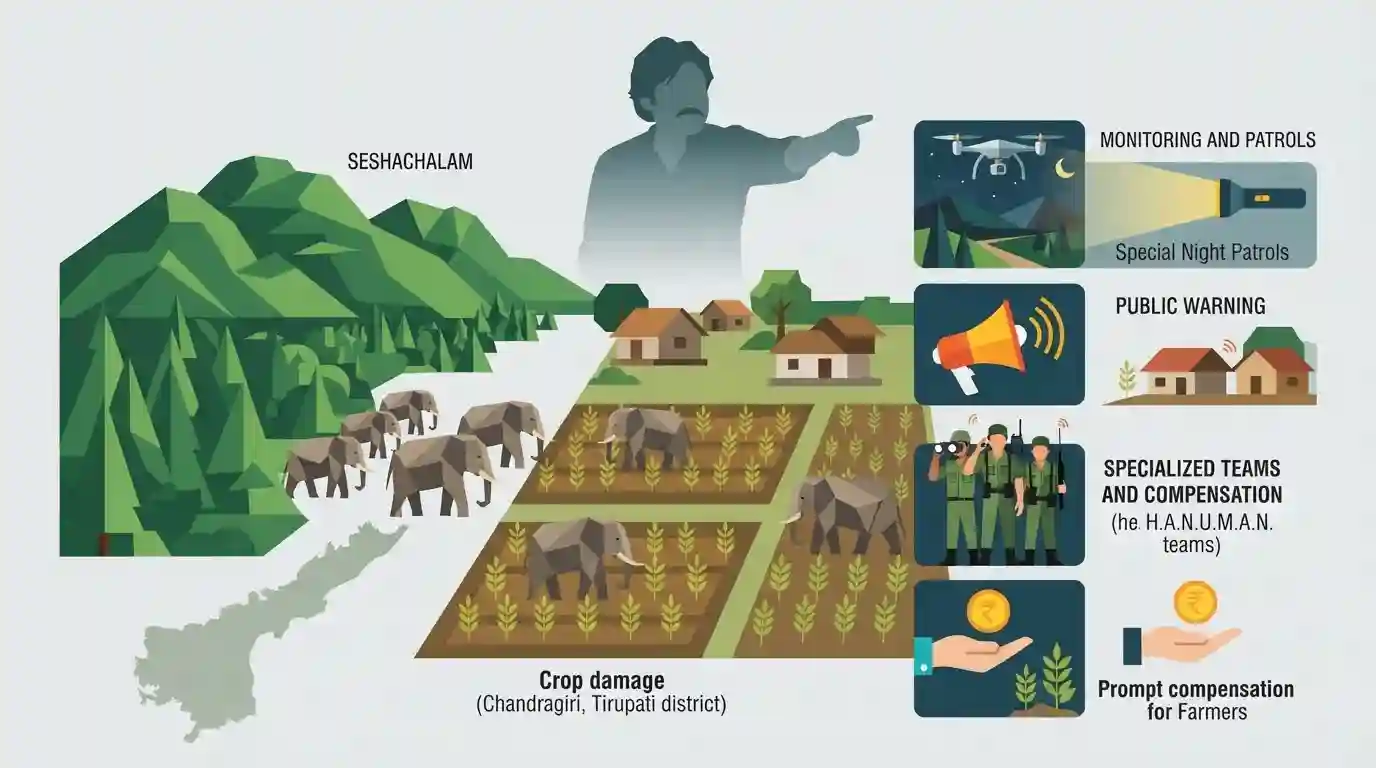
Andhra Pradesh Deputy Chief Minister and Minister for Environment and Forests, Pawan Kalyan, issued an alert regarding the movement of a herd of elephants in the Chandragiri area of Tirupati district. The elephants emerged from the Seshachalam forests, causing damage to local crops. To mitigate this human-wildlife conflict, the Minister directed forest officials to implement continuous monitoring, conduct special night patrols, and use public address systems to warn residents. He also mandated the deployment of specialized H.A.N.U.M.A.N. teams and ensured that prompt compensation is paid to farmers for any crop losses to prevent retaliatory measures.
Key Points
- A herd of wild elephants migrated from the Seshachalam forests into human settlements in the Chandragiri area of Tirupati district, causing crop damage.
- Deputy Chief Minister Pawan Kalyan directed forest officials to initiate continuous monitoring, special night patrols, and public awareness campaigns.
- Specialized wildlife management units known as H.A.N.U.M.A.N. teams are to be deployed as necessary to mitigate the conflict.
- The state government ordered the prompt disbursement of compensation to affected farmers to prevent economic distress and retaliation against wildlife.
Important Terms
H.A.N.U.M.A.N. teams

Healing and Nurturing Units for Monitoring, Aid and Nursing of Wildlife; dedicated rapid response teams in Andhra Pradesh equipped to handle human-wildlife conflicts, rescue, and treat injured animals.
UPSC context
GS Paper II & III: Governance and Environment; tests state initiatives for mitigating man-animal conflicts and wildlife conservation.
Seshachalam Hills Biosphere Reserve
Declared in 2010 as Andhra Pradesh's first biosphere reserve in the Eastern Ghats. It spans Chittoor and Kadapa districts, protecting rich endemic biodiversity, red sanders, and crucial wildlife corridors.
UPSC context
GS Paper I & III: Geography of AP and Biodiversity; tests knowledge of key protected areas, physical features, and ecology of Andhra Pradesh.
Wildlife Protection Act, 1972
A landmark Indian act providing a legal framework for protecting wild animal and plant species, managing habitats, and regulating trade in wildlife products through schedules of varying protection levels.
UPSC context
GS Paper III: Environment and Disaster Management; tests legal mechanisms, conservation strategies, and regulatory bodies established for biodiversity protection in India.
Indian Forest Act, 1927
A pre-independence central legislation that defines forest categories (Reserved, Protected, Village), regulates timber movement, and consolidates laws relating to forest transit, duty, and forest-related offenses.
UPSC context
GS Paper III: Environmental Legislations; tests understanding of colonial-era forest administration, community rights, and state-owned forest classifications.
Andhra Pradesh Forest Department
The state government agency responsible for conserving forests, protecting wildlife, managing biosphere reserves, and implementing state and national environmental policies within Andhra Pradesh.
UPSC context
GS Paper II & III: AP State Administration and Environment; tests state executive structures managing biodiversity and implementing conflict-mitigation initiatives.
Prelims Trap
Seshachalam Hills Biosphere Reserve is Andhra Pradesh's only designated elephant sanctuary.
While Seshachalam is AP's first Biosphere Reserve and sees frequent elephant transit, Kaundinya Wildlife Sanctuary in Chittoor is the state's only designated elephant sanctuary.
Static Concepts Connected
What are the ecological features of the Seshachalam Hills Biosphere Reserve?
- Status and Location: Designated in 2010 as India's 17th Biosphere Reserve and the first in Andhra Pradesh, covering Tirupati, Chittoor, and Kadapa/Annamayya districts.
- Flora and Fauna: Famous for harboring the highly prized endemic Red Sanders (Pterocarpus santalinus) and endangered fauna like the Golden Gecko.
What is the status of elephant conservation and Kumki deployment in Andhra Pradesh?
- Kaundinya Sanctuary: Located in Chittoor district, it is the only sanctuary in Andhra Pradesh that harbors a continuous population of Asian Elephants.
- Kumki Elephants: Specially trained captive elephants deployed by the forest department to safely herd, capture, or rescue wild elephant groups causing conflict.
Cross-Topic Patterns
AI in governance and forest management
Integrating Project H.A.N.U.M.A.N.'s AI tracking with the state's e-governance framework showcases how technology bridges wildlife conservation and rural security.
Agrarian economics and wildlife compensation
Timely disbursement of the enhanced ₹10 lakh ex-gratia prevents crop-loss-induced farmer distress, connecting wildlife policy directly to rural agrarian economics.

APPSC is likely to test Project H.A.N.U.M.A.N.'s key objectives alongside the geographical features of Seshachalam Biosphere Reserve.
Linked PYQs · 3
Linked PYQs · 3
- 2024APPSC_PRELIMSGS1
Match the following : | List-I (Wildlife Sanctuary in Andhra Pradesh) | List-II (Region) | |---|---| | A. Coringa | I. Kurnool | | B. Gundla Brahmeswaram | II. Kadapa | | C. Rollapadu | III. East Godavari | | D. Sri Lankamalleswara | IV. Kurnool and Prakasam | Choose the correct answer using the codes given below : Code: A B C D
- 2023APPSC_PRELIMSGS1
According to the Indian Forest Act, 1927, which of the following is the most appropriate sequence which shows the degree of protection between different forest types ?
- 2023APPSC_PRELIMSGS1
Naupada Coastal and Marine Biodiversity Area (ICMBA) is located in the district of
