Kumki Elephants Deployed to Mitigate Human Wildlife Conflict
Source:timesofindia ↗
ఇది ఎందుకు ముఖ్యం
APPSC Prelims frequently test local geography, environmental measures, and wildlife sanctuaries (e.g., matching sanctuaries with districts). The use of Kumki elephants represents a prominent conflict mitigation strategy in the Eastern Ghats border regions (AP-Odisha), mapping directly to AP geography and environmental conservation topics.
సారాంశం
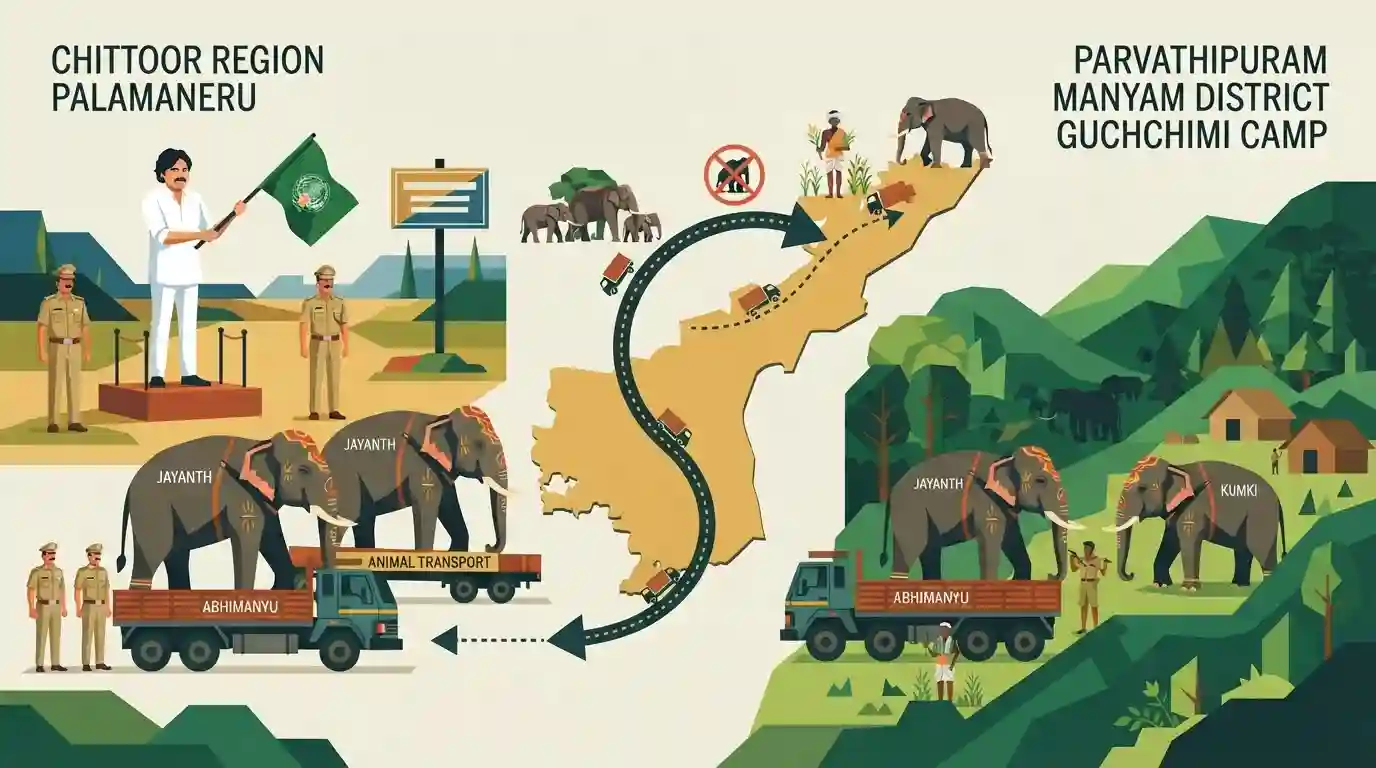
Deputy Chief Minister K Pawan Kalyan flagged off two trained 'Kumki' elephants, Jayanth and Abhimanyu, from Palamaneru in the Chittoor region to the Guchchimi Elephant Camp in Parvathipuram Manyam district. This translocation aims to protect local tribal farmers and their crops from wild elephant herds straying across the Odisha-Andhra Pradesh border, mitigating human-animal conflict without harming the wild pachyderms.
ముఖ్య అంశాలు
- Two trained 'Kumki' elephants, Jayanth and Abhimanyu, were translocated from Musalamadugu Elephant Camp in Palamaneru to Guchchimi Elephant Camp in Parvathipuram Manyam district.
- Deputy Chief Minister and Forest Minister K Pawan Kalyan flagged off their transit to address severe human-animal conflicts in the AP-Odisha border regions.
- Kumki elephants are trained captive elephants used to drive away wild elephant herds safely, protecting tribal farmers' crops and lives without harming the wild pachyderms.
- The initiative highlights localized strategies by the Andhra Pradesh government to mitigate human-elephant conflict, particularly in the northern border regions near Odisha.
ముఖ్యమైన పదాలు
Kumki Elephants

Trained captive Asian elephants in India utilized to guide, calm, herd, capture, or rescue wild elephants, as well as mitigate human-wildlife conflicts near agricultural areas and human settlements.
UPSC context
GS Paper III (Ecology and Biodiversity); tests mitigation strategies for human-wildlife conflict and wildlife management interventions.
Human-Animal Conflict
Situations arising when wildlife ecological needs overlap with human activities, resulting in crop damage, property destruction, injuries, or loss of life for both people and animals.
UPSC context
GS Paper III (Environment & Biodiversity); tests ecological impacts, policy interventions, and socioeconomic aspects of cohabitation.
Asian Elephant
A keystone species (Elephas maximus) listed as Endangered on the IUCN Red List and Schedule I under India's Wildlife (Protection) Act, 1972, representing the country's National Heritage Animal.
UPSC context
GS Paper III (Ecology & Conservation); tests species distribution, IUCN status, and conservation frameworks.
Project Elephant
A centrally sponsored scheme launched by India's MoEFCC in 1992 to protect elephants, their habitats, and migratory corridors, and to address human-elephant conflict.
UPSC context
GS Paper III (Government Schemes & Conservation); tests national ecological initiatives and habitat preservation policies.
Wildlife Management
The practice of balancing the needs of wildlife populations with those of human societies using scientific methods, habitat manipulation, animal translocation, and conflict resolution techniques.
UPSC context
GS Paper III (Environmental Protection); tests administrative strategies, scientific methodologies, and institutional frameworks in conservation.
ప్రిలిమ్స్ ఉచ్చు
"Captive elephants hold a lower protection status than wild elephants under the Wildlife Protection Act."
Both captive and wild Asian elephants belong to the same species and receive absolute, identical protection under Schedule I of the Wildlife Protection Act, 1972.
అనుసంధానమైన స్థిర భావనలు
What is the conservation status of the Asian Elephant?
- WPA 1972: Placed in Schedule I, granting absolute legal protection against hunting and commercial exploitation.
- IUCN Red List: Classified globally as 'Endangered' due to habitat fragmentation, poaching, and human-wildlife conflict.
- Global Conventions: Listed in Appendix I of both CITES and the Convention on Migratory Species (CMS).
What are the primary mandates of Project Elephant?
- Centrally Sponsored Scheme: Launched in 1992 by the MoEFCC to provide financial and technical support to elephant range states.
- Triple Focus: Aims to protect wild elephants and their corridors, mitigate human-animal conflict, and ensure the welfare of captive elephants.
- MIKE Programme: Executes the 'Monitoring of Illegal Killing of Elephants' (MIKE) mandate introduced by CITES to track poaching trends.
అంతర-అంశ నమూనాలు
Captive Elephant Transport Rules 2024
The 2022 WPA amendment and subsequent 2024 rules introduced strict conditions for the inter-state transfer of captive elephants, transferring key oversight to the Chief Wildlife Warden.
Eastern Ghats habitat fragmentation
Shrinking forests and mining in the Eastern Ghats (Odisha-AP border) force elephant herds into agricultural lands, directly linking geographic habitat degradation to human-animal conflict.

Expect a multi-statement Prelims question testing the legal status of captive elephants vs wild ones and the 2024 WPA Transport Rules.
అనుసంధాన PYQలు · 2
అనుసంధాన PYQలు · 2
- 2024APPSC_PRELIMSGS1
Match the following : | List-I (Wildlife Sanctuary in Andhra Pradesh) | List-II (Region) | |---|---| | A. Coringa | I. Kurnool | | B. Gundla Brahmeswaram | II. Kadapa | | C. Rollapadu | III. East Godavari | | D. Sri Lankamalleswara | IV. Kurnool and Prakasam | Choose the correct answer using the codes given below : Code: A B C D
- 2023APPSC_PRELIMSGS1
According to the Indian Forest Act, 1927, which of the following is the most appropriate sequence which shows the degree of protection between different forest types ?
