Indian Army Stance on Ongoing Ceasefire with Pakistan
Source:The Hindu ↗
Why It Matters
This is highly relevant to GS-2 (India and its neighborhood relations) and GS-3 (Security challenges and border management). Understanding the mechanisms of de-escalation (like DGMO talks) and the strategic implications of surgical strikes ('Operation Sindoor') forms core components of Mains questions on internal security and bilateral relations.
Summary
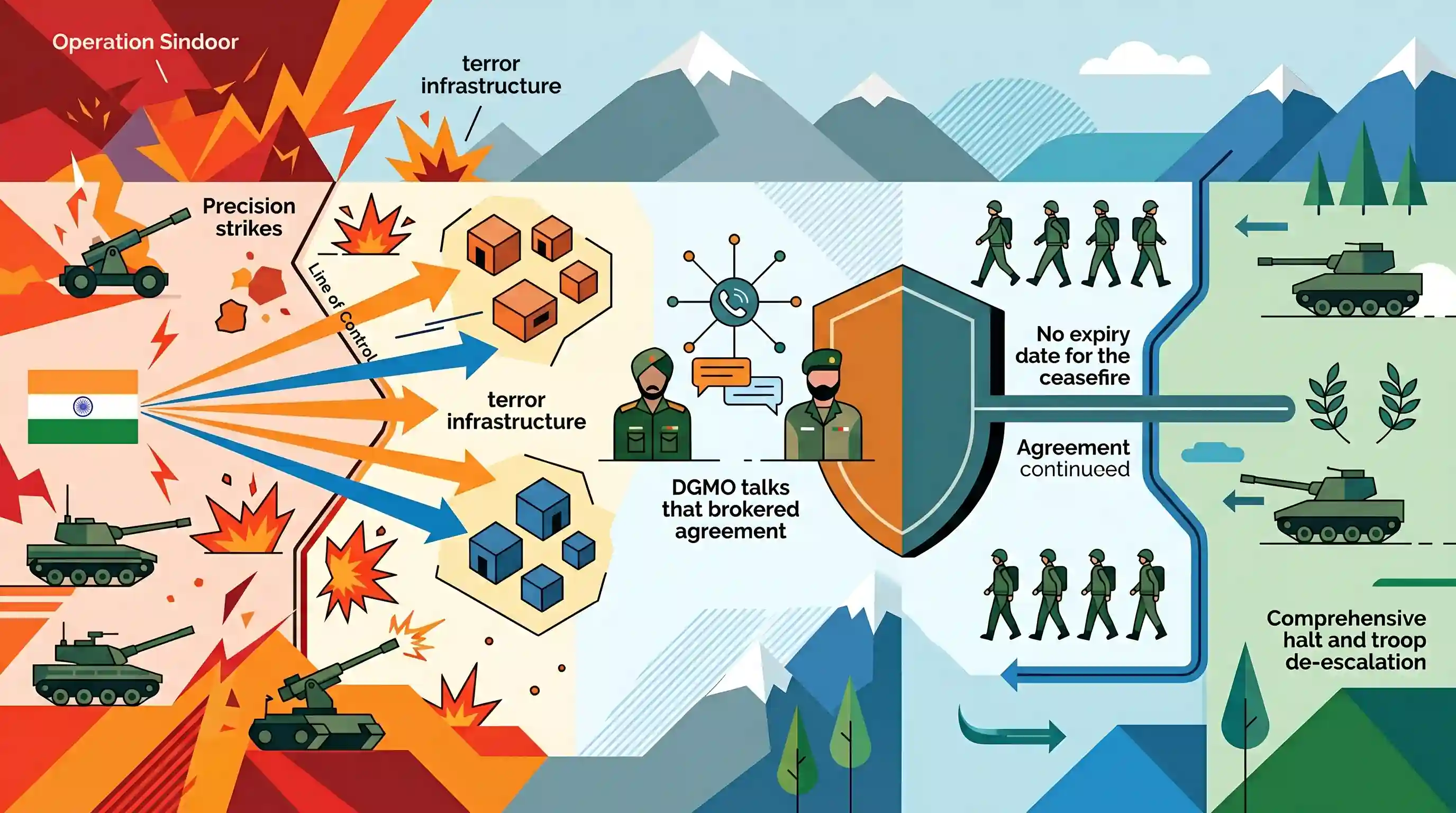
The Indian Army has clarified that the recent agreement to pause hostilities with Pakistan does not have an expiry date, dismissing earlier Pakistani suggestions of a temporary halt. The cessation follows intense military escalation sparked by India's 'Operation Sindoor'—precision strikes against terror infrastructure in Pakistan and PoK. The agreement, brokered through talks between the Directors General of Military Operations (DGMOs), involves a comprehensive halt to military actions and potential reciprocal troop de-escalation along the borders.
Key Points
- The Indian Army announced that the cessation of hostilities with Pakistan has no expiry date, contradicting claims of a May 18 deadline.
- The pause follows a four-day military confrontation triggered by India's Operation Sindoor, involving precision strikes on terror infrastructure in Pakistan and PoK on May 6-7.
- The DGMOs of both nations engaged in talks on May 10 and 12, agreeing to halt firing and military action across land, air, and sea.
- Both sides are also considering immediate reciprocal measures to reduce troop levels at the borders and forward areas.
Important Terms
Operation Sindoor

A series of precision air and missile strikes launched by India on May 7, 2025, targeting nine terror infrastructure sites in Pakistan and PoK in response to the Pahalgam terror attack.
UPSC context
GS Paper II/III: Strategic posture, surgical strikes, and India's 'right to respond' against state-sponsored terrorism.
Directors General of Military Operations (DGMOs)
High-ranking military officers (Lieutenant General rank in India) responsible for directing military operations and maintaining the hotline communication channel between the Indian and Pakistani armies to manage border tensions.
UPSC context
GS Paper II: Bilateral institutional mechanisms and crisis management in India-Pakistan relations.
Cross-border Terrorism
Terrorism originating from one country (Pakistan) and targeting another (India), often involving state or non-state actors using the Line of Control (LoC) or International Border for infiltration and attacks.
UPSC context
GS Paper III: Internal security challenges and the nexus between state sponsorship and militant groups like LeT/JeM/TRF.
Line of Control (LoC)
The de facto border between India and Pakistan in the region of Jammu and Kashmir, established after the 1971 war, which remains a primary site for military standoffs and ceasefire violations.
UPSC context
GS Paper III: Border management and security forces' role in safeguarding sovereign territory.
Confidence Building Measures (CBMs)
Planned measures (like the DGMO hotline or ceasefire agreements) intended to reduce tensions, prevent unintended escalation, and build trust between adversarial nations like India and Pakistan.
UPSC context
GS Paper II: Diplomatic and military tools for regional stability and conflict resolution.
Prelims Trap
The recent pause in hostilities establishes a new, time-bound border treaty superseding the 2003 Ceasefire Agreement.
Aspirants confuse DGMO-level tactical pauses with formal bilateral treaties. The recent open-ended pause enforces the existing 2003 Ceasefire Agreement; it does not replace it.
Static Concepts Connected
How does the DGMO hotline mechanism function between India and Pakistan?
- Origin: Established following the 1971 Indo-Pak war to facilitate direct, secure military-to-military communication.
- Primary Function: Serves as the main bilateral crisis management tool to de-escalate border tensions, negotiate ceasefires, and prevent accidental warfare.
- Routine Operation: While historically used for scheduled weekly calls on Tuesdays, it is immediately activated during active military confrontations or escalations.
What are the key Military Confidence Building Measures (CBMs) between India and Pakistan?
- Nuclear Facilities: The 1988 Non-Nuclear Aggression Agreement (enforced 1991) mandates the annual exchange of lists of nuclear installations to prevent mutual attacks.
- Airspace Violations: A 1991 agreement prevents combat aircraft from flying within specified distances of the international border and the Line of Control.
- Advance Notification: A binding mechanism requires prior notice regarding large-scale military exercises and troop movements near the borders to avoid miscalculation.
Cross-Topic Patterns
Drones & Asymmetric Border Warfare
The integration of UAVs and loitering munitions in operations like Sindoor shifts border management focus from physical fencing (CIBMS) to advanced anti-drone systems and airspace monitoring.
Conventional strikes under the nuclear overhang
Recent precision strikes challenge the traditional 'nuclear flashpoint' theory, illustrating India's proactive doctrine to utilize conventional force thresholds below the level of full-scale retaliation.

Expect a 2026 GS3 question evaluating India's shift to proactive cross-border doctrines (like Operation Sindoor) despite nuclear risks.
Linked PYQs · 4
Linked PYQs · 4
- 2015MainsGS2
Terrorist activities and mutual distrust have clouded India-Pakistan relations. To what extent the use of soft power like sports and cultural exchanges could help generate goodwill between the two countries? Discuss with suitable examples.
- 2016MainsGS3
The terms 'Hot Pursuit' and 'Surgical Strikes' are often used in connection with armed action against terrorist attacks. Discuss the strategic impact of such actions.
- 2024MainsGS3
India has a long and troubled border with China and Pakistan fraught with contentious issues. Examine the conflicting issues and security challenges along the border. Also give out the development being undertaken in these areas under the Border Area Development Programme (BADP) and Border Infrastructure and Management (BIM) Scheme.
- 2016MainsGS3
Border management is a complex task due to difficult terrain and hostile relations with some countries. Elucidate the challenges and strategies for effective border management.
