Satyendra Narayan Sinha Legacy and Role in Bihar Politics
Source:ani-news ↗
Why It Matters
Satyendra Narayan Sinha is a crucial figure in Bihar's political history, bridging the pre-independence freedom struggle (where his father Anugraha Narayan Sinha, 'Bihar Vibhuti', was also prominent) and the post-independence era (specifically the JP Movement and regional leadership). BPSC frequently asks questions on state-specific leaders, their titles, and their contributions to movements like the JP Movement and provincial governance.
Summary
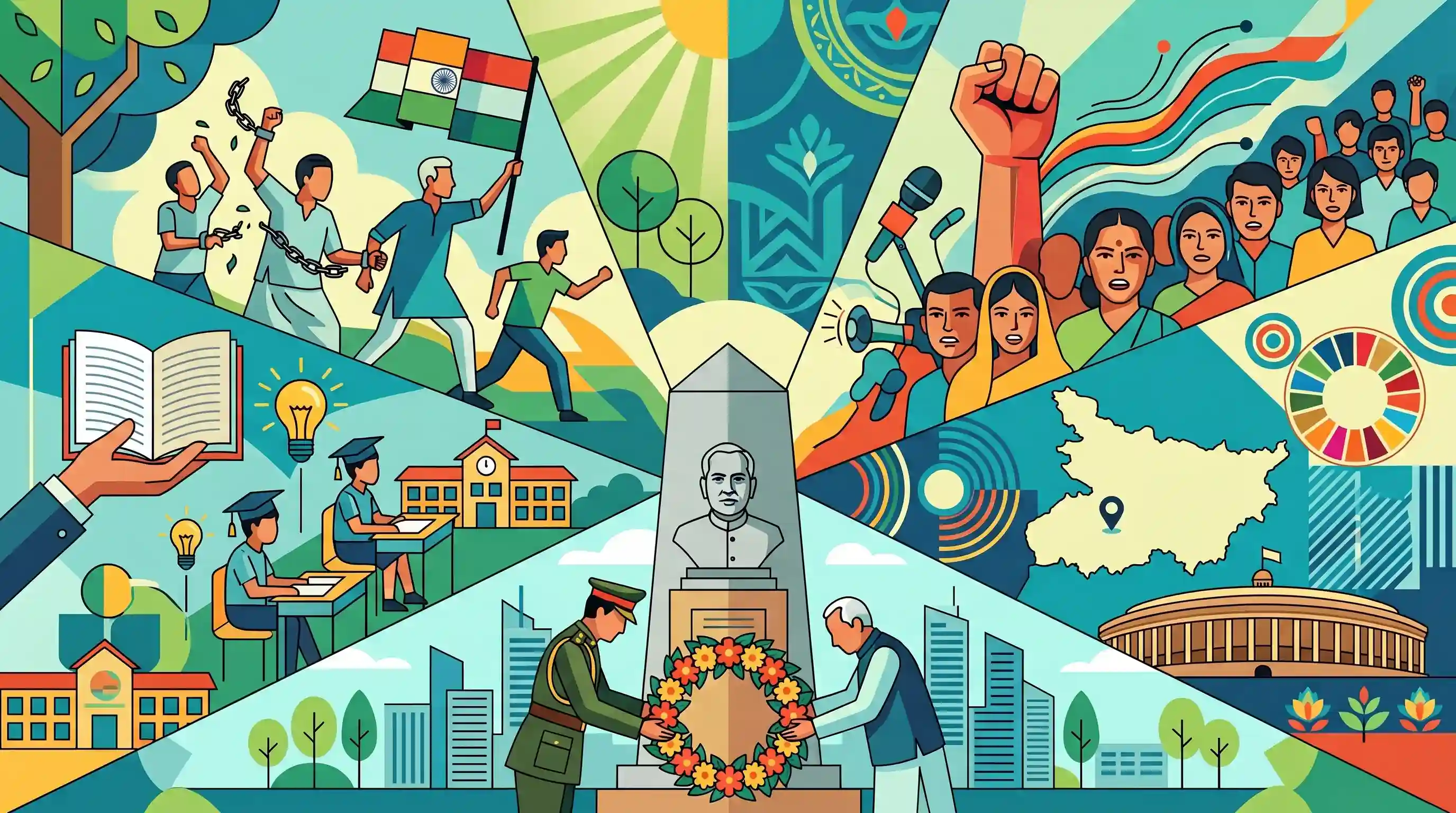
Bihar Governor Lt. Gen. Syed Ata Hasnain (Retd) and Chief Minister Samrat Choudhary paid tribute to the former 19th Chief Minister of Bihar, Satyendra Narayan Sinha, on his birth anniversary in Patna. Known affectionately as 'Chhote Saheb', Sinha was a freedom fighter, six-term Lok Sabha MP from Aurangabad, a former state Education Minister who revolutionized the local educational system, and a prominent leader of the JP-led Total Revolution (Sampoorna Kranti) movement against the Emergency.
Key Points
- Bihar Governor Lt. Gen. Syed Ata Hasnain (Retd) and Chief Minister Samrat Choudhary participated in a state-organized event at Shree Krishnapuri Park, Patna, to mark the birth anniversary of former Chief Minister Satyendra Narayan Sinha.
- Satyendra Narayan Sinha served as the 19th Chief Minister of Bihar and was affectionately known as 'Chhote Saheb'.
- During the pre-independence era, he actively participated as a freedom fighter and organized legal aid for political prisoners.
- As Bihar's Education Minister in the early 1960s, he is credited with pioneering educational reforms and streamlining the state's education system.
- He was elected to the Lok Sabha from the Aurangabad constituency in Bihar six times, starting with the first general elections in 1952.
- He strongly opposed the Emergency (1975–77) and was a leading figure in Jayaprakash Narayan's 'Sampoorna Kranti' (Total Revolution) movement.
Important Terms
Total Revolution (Sampoorna Kranti)

A holistic, non-violent movement launched in 1974 by Jayaprakash Narayan, aiming for comprehensive social, economic, political, cultural, educational, ideological, and spiritual transformation.
UPSC context
GS Paper I (Post-Independence India) & GS Paper II (Polity); tests understanding of democratic protest movements.
Janata Party
An amalgam of political parties formed in 1977 to oppose the Emergency, which went on to form India's first non-Congress central government under Morarji Desai.
UPSC context
GS Paper I (Post-Independence Consolidation); tests knowledge of party system evolution and political alignments.
National Democratic Alliance
A major centre-right political coalition in India, formed in 1998 and led by the Bharatiya Janata Party, representing a significant phase in India's coalition politics.
UPSC context
GS Paper II (Polity and Governance); tests understanding of multi-party systems and coalition governance.
Satyendra Narayan Sinha
A prominent freedom fighter, political leader, former state Education Minister, and the 19th Chief Minister of Bihar, known for his key role in the Total Revolution movement.
UPSC context
BPSC & GS Paper I (Post-Independence); tests knowledge of regional leaders and state-level developments.
Emergency (1975–1977)
A 21-month period (1975-1977) of suspended fundamental rights and centralized power declared by President Fakhruddin Ali Ahmed under Article 352 on PM Indira Gandhi's advice.
UPSC context
GS Paper II (Polity); tests understanding of constitutional crisis, emergency provisions, and democratic resilience.
Prelims Trap
Shri Krishna Sinha formed the very first provincial ministry in Bihar immediately following the 1937 elections.
Historically, Muhammad Yunus of the Muslim Independent Party formed the first interim ministry in Bihar in April 1937. Shri Krishna Sinha led the Congress ministry later in July 1937.
Static Concepts Connected
What was the significance of the 1937 Provincial Elections in Bihar under the GoI Act 1935?
- Provincial Autonomy: The Act of 1935 granted provincial autonomy, replacing diarchy with responsible provincial governments elected by an expanded (though still restricted) franchise.
- Ministry Formation: Muhammad Yunus formed a brief interim government before Shri Krishna Sinha led the majority Congress ministry in July 1937.
- Key Policies: The Bihar ministry implemented progressive tenancy reforms, lifted bans on national publications, and released political dissidents before resigning in late 1939.
What were the core objectives of Jayaprakash Narayan's 'Total Revolution'?
- Catalyst: Launched in Bihar in 1974, it began as a student agitation against corruption, high inflation, and unemployment before targeting the central government.
- Seven Dimensions: JP conceptualized a non-violent transformation involving seven dimensions: social, economic, political, cultural, ideological, educational, and spiritual.
- Political Legacy: It successfully united disparate opposition groups, leading to the formation of India's first non-Congress central government in 1977.
Cross-Topic Patterns
Decentralization and the 'Congress System'
The shift of leaders like S.N. Sinha from Congress to JP's movement marks the structural breakdown of the 'Congress System' into early regional coalition politics.
Agrarian relations and political elites
The social composition of Bihar's early legislative leadership directly influenced the legislative implementation—and political compromises—of post-independence land reform and tenancy acts.

The 1937 provincial ministries and key regional actors in the JP Movement are highly likely to feature in multi-statement MCQ options.
Linked PYQs · 5
Linked PYQs · 5
- 2025BPSC_PRELIMSGS1
Who became Chief Minister of Bihar in March 1939?
- 2018BPSC_PRELIMSGS1
Who among the following was the leader of the first Congress Ministry in Bihar?
- 2023BPSC_PRELIMSGS1
The Quit India Movement in 1942 witnessed significant contributions from leaders of Bihar. Which prominent Bihar leader was known as the ‘Bihar Kesari’ and actively participated in the Quit India Movement?
- 2024-EBPSC_PRELIMSGS1
Who presented the Bihar Budget 2024-25 in the State Assembly?
- 2022BPSC_PRELIMSGS1
Who had formed the Bihar Socialist Party in 1931 AD?
