Patna High Court Ruling on Section 319 CrPC Trial Summons
Source:courtbook ↗
Why It Matters
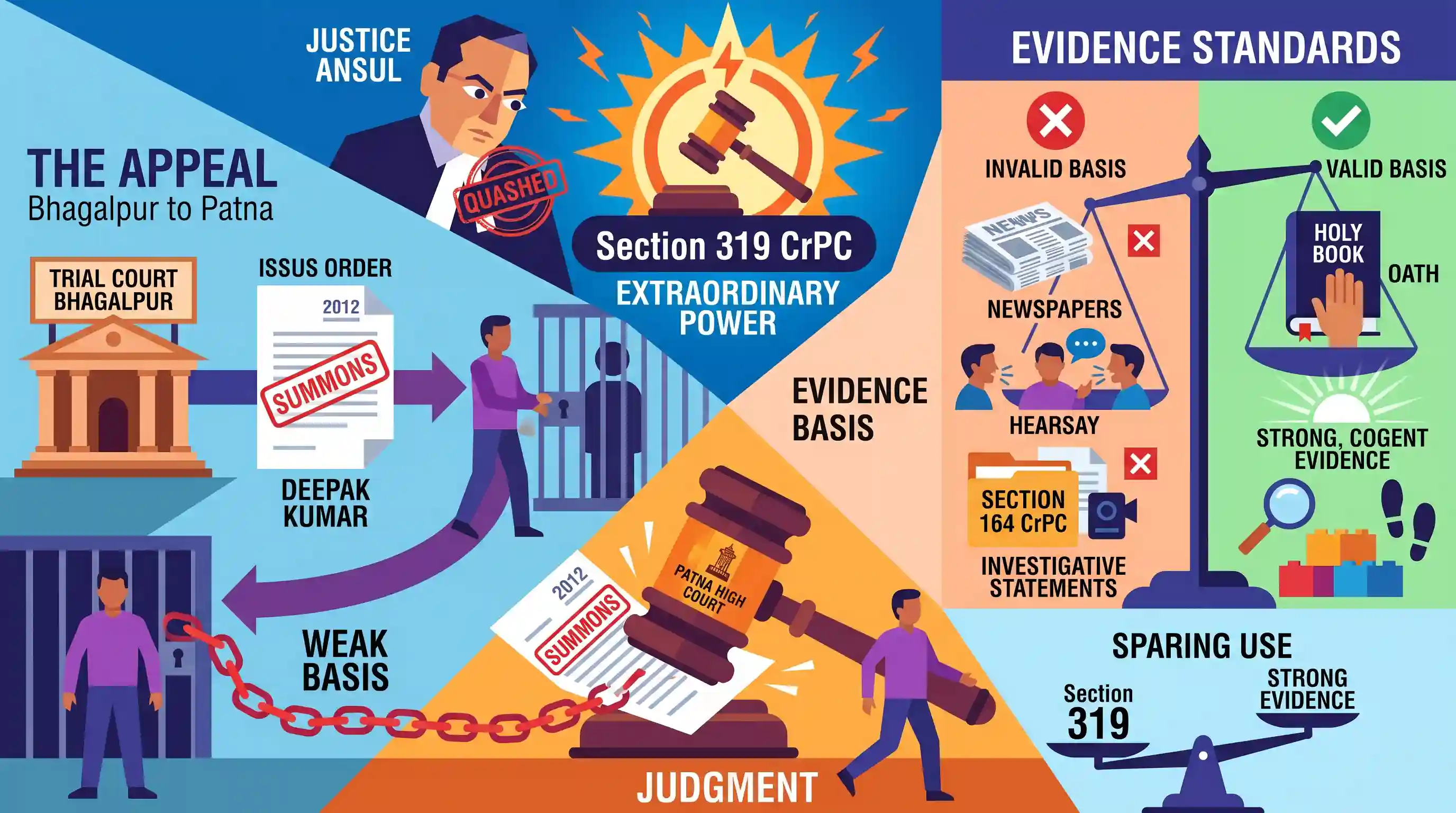
This ruling reinforces judicial safeguards against the arbitrary addition of accused individuals during trials, establishing that hearsay and investigative (Section 164) statements lack the substantive character required for trial court summons under Section 319 CrPC.
Summary
The Patna High Court, in the case of Deepak Kumar @ Deepak Sah v. State of Bihar, set aside a trial court order from Bhagalpur that summoned the petitioner as an accused under Section 319 CrPC in a 2012 murder trial. Justice Ansul ruled that Section 319 CrPC powers are extraordinary and require strong, cogent evidence on oath, clarifying that hearsay (like newspaper reports) and Section 164 CrPC investigative statements cannot serve as the sole basis for such a summons.
Key Points
- The Patna High Court quashed a trial court's order summoning Deepak Kumar @ Deepak Sah as an accused under Section 319 of the Code of Criminal Procedure (CrPC) in a 2012 murder case.
- Justice Ansul emphasized that the power under Section 319 CrPC is extraordinary and must be exercised sparingly, requiring 'strong and cogent' evidence produced on oath during the trial.
- The judgment clarified that statements recorded under Section 164 CrPC during investigations are not substantive evidence and cannot form the sole basis for summoning a person under Section 319.
- The High Court found that the trial court erred by relying on the testimony of the victim's mother, whose claims against the petitioner were based entirely on a newspaper report (hearsay) rather than personal knowledge.
Important Terms
Code of Criminal Procedure (CrPC)

The primary procedural legislation in India that outlines the mechanism for the investigation, arrest, bail, trial, and punishment of criminal offences.
UPSC context
GS Paper II (Polity & Governance). Tests understanding of procedural justice, fundamental rights, and the criminal justice system.
Section 319 of CrPC
A legal provision enabling a trial court to summon and try any additional person, not originally accused, if evidence emerges showing their involvement in the offence.
UPSC context
GS Paper II (Polity & Judicial Reforms). Tests knowledge of court powers, procedural safeguards, and judicial discretion during trials.
Section 164 of CrPC
A provision empowering a Judicial or Metropolitan Magistrate to record voluntary confessions of an accused or statements of a witness during an active criminal investigation.
UPSC context
GS Paper II (Polity & Criminal Justice). Tests grasp of procedural safeguards, evidentiary value, and rights of the accused.
Patna High Court
The highest judicial court in Bihar, established in 1916, which exercises original, appellate, and supervisory jurisdiction over all subordinate courts in the state.
UPSC context
GS Paper II (Polity & Judiciary). Tests knowledge of the structure, jurisdiction, and role of State High Courts.
District and Sessions Court
The apex subordinate judicial body at the district level in India, presiding over civil matters as a District Court and criminal trials as a Sessions Court.
UPSC context
GS Paper II (Subordinate Judiciary). Tests understanding of the hierarchical judicial structure, powers, and administrative control in districts.
Prelims Trap
Statements recorded by a Magistrate under Section 164 CrPC (Section 183 BNSS) constitute substantive evidence sufficient on their own for conviction.
Statements recorded under Section 164 CrPC/S. 183 BNSS are only meant for corroboration or contradiction. They are not substantive evidence and cannot solely support a conviction or a Section 319/358 summons.
Static Concepts Connected
What is the evidentiary status of statements recorded under Section 164 CrPC (Section 183 BNSS)?
- Non-substantive nature: These statements are not substantive evidence and cannot serve as the sole foundation for a conviction or summoning an additional accused.
- Corroborative purpose: They are primarily used in trials to corroborate or contradict the testimonies of witnesses under the law of evidence.
- Judicial safeguards: The Magistrate must ensure and record that any confession made is completely voluntary and free from police pressure.
What is the scope of Section 319 CrPC (Section 358 BNSS) in criminal trials?
- Extraordinary power: It allows a trial court to summon any person not originally named as an accused if evidence during the trial reveals their involvement.
- Hardeep Singh benchmark: The standard of evidence required to summon is higher than a simple prima facie case (used during charge framing) but lower than what is needed for conviction.
- Judicial philosophy: It is anchored in the maxim "Judex damnatur cum nocens absolvitur," asserting that a judge is compromised if the actual guilty party escapes trial.
Cross-Topic Patterns
BNSS transition and judicial discretion
The structural transition from CrPC to BNSS tests how constitutional courts interpret newly digitized procedural safeguards without diluting established fair-trial jurisprudence.
Media trials versus judicial evidence
Relying on hearsay like newspaper reports highlights the conflict between public media trials and the rigorous requirements of "procedure established by law" under Article 21.

Expect a 2026 question testing BNSS/CrPC procedural standards, specifically distinguishing "prima facie" charges from "strong and cogent" summons.
Linked PYQs · 1
Linked PYQs · 1
- 2025BPSC_PRELIMSGS1
Which one of the following subjects fall within the jurisdiction of both High Court and Supreme Court?
