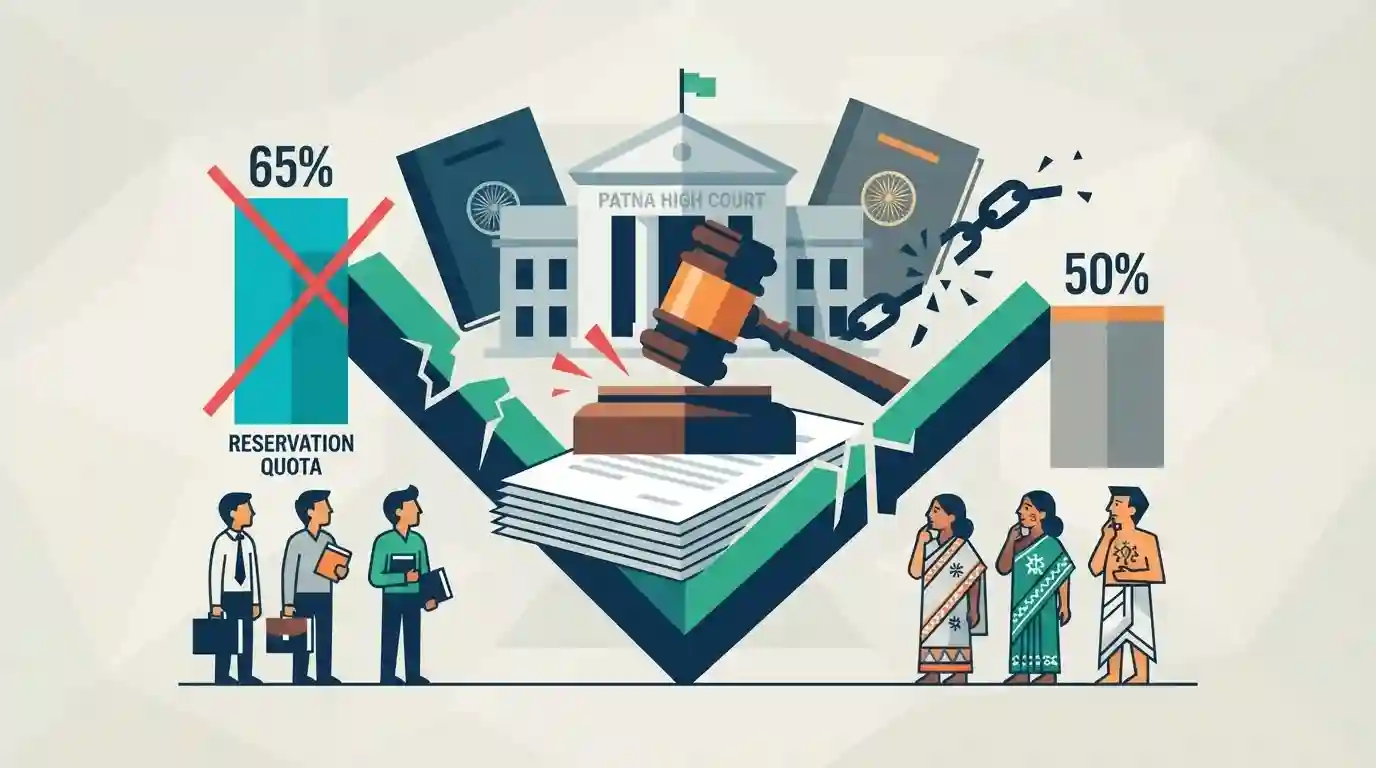
Patna High Court Strikes Down Reservation Quota Hike
Source:drishtiias ↗
Why It Matters
This judicial decision directly impacts Bihar's socio-political landscape, public employment policy, and state legislature's legislative powers concerning affirmative action, making it a critical topic for state civil services examinations.
Summary
The Patna High Court has struck down the Bihar government's legislation aimed at enhancing reservations in educational institutions and state government jobs from 50% to 65% for backward classes, SCs, and STs, declaring it unconstitutional and violative of the right to equality.
Key Points
- The Patna High Court nullified the Bihar government's decision to increase reservations for Scheduled Castes (SCs), Scheduled Tribes (STs), and Other Backward Classes (OBCs) / Extremely Backward Classes (EBCs) from 50% to 65%.
- The court ruled that the enhanced quota violated the fundamental right to equality enshrined under Articles 14 and 16 of the Constitution and exceeded the 50% ceiling limit set by the Supreme Court.
- The ruling deals a significant blow to the state's social welfare framework and caste-based affirmative action policies following the Bihar Caste-based Survey.
Important Terms
Patna High Court

The highest judicial authority in Bihar, which struck down the state government's 2023 legislation enhancing reservations from 50% to 65% for being violative of the right to equality and the 50% ceiling.
UPSC context
Crucial for BPSC GS Paper II (Indian Polity, Judiciary, and Judicial Review), testing the scope of High Court writ jurisdiction and constitutional validity.
Bihar Government
The executive authority that passed legislative amendments in November 2023 to increase overall reservations to 65% (75% with EWS) based on caste survey data.
UPSC context
Essential for Bihar-specific current affairs and GS Paper II (Polity and Governance, reservation policy implementation).
Indra Sawhney Case
The landmark 1992 Supreme Court ruling that established a 50% cap on reservations in public employment and education, which formed the basis for striking down Bihar's quota enhancement.
UPSC context
Important for BPSC/UPSC GS Paper II (Basic Structure, Fundamental Rights, and Affirmative Action jurisprudence).
Prelims Trap
the 50% reservation ceiling is an absolute limit written into the text of the Constitution of India
Aspirants often assume the 50% reservation ceiling is a rigid constitutional provision rather than a judicial limit established by the Supreme Court that can be breached only under extraordinary circumstances.
Static Concepts Connected
What are the key constitutional provisions and judicial benchmarks governing reservation in India?
- Articles 14 & 16: Guarantee equality of opportunity in matters of public employment and prohibit discrimination on grounds of religion, race, caste, sex, or place of birth.
- Indra Sawhney (1992): Established the 50% ceiling limit on reservations, subject to exceptional circumstances for far-flung or marginalized communities.
- 103rd Amendment Act: Enabled a 10% reservation for Economically Weaker Sections (EWS), breaching the traditional 50% threshold constitutionally.
Cross-Topic Patterns
Caste Census Data vs. Judicial Review
The Bihar Caste-based Survey data directly triggered legislative quota changes, creating a governance test between administrative data collection and judicial review under Article 14/16.

Indra Sawhney 50% rule + Articles 14/16 + 103rd Amendment (EWS) often feature in multi-statement BPSC Polity mains/prelims questions.
Linked PYQs · 2
Linked PYQs · 2
- 2024-EBPSC_PRELIMSGS1
Size of Council of Ministers has been restricted to 15 percent of membership of Lok Sabha by which Constitutional Amendment?
- 2025BPSC_PRELIMSGS1
The constitution of India provides for reasonable restrictions on Fundamental Rights but reasonableness must keep in mind that: 1. The restrictions must be necessary for the protection of the rights of others. 2. The restrictions must be proportionate to the end sought. 3. The restrictions must be reasonable in the light of the circumstances. 4. The restrictions must be in the public interest.
