Patna High Court Directives on Noise Pollution and Motor Vehicles
Source:The Hindu ↗
Why It Matters
This is highly relevant for the BPSC Prelims and Mains (GS Paper 2 - Polity/Governance and GS Paper 3 - Environment) as it highlights the intersection of judicial activism, environmental regulation, and statutory enforcement by state authorities. It tests knowledge of specific acts like the Noise Pollution Rules, 2000, and the Motor Vehicles Act, 1988, along with the responsibilities of bodies like the State Pollution Control Boards.
Summary
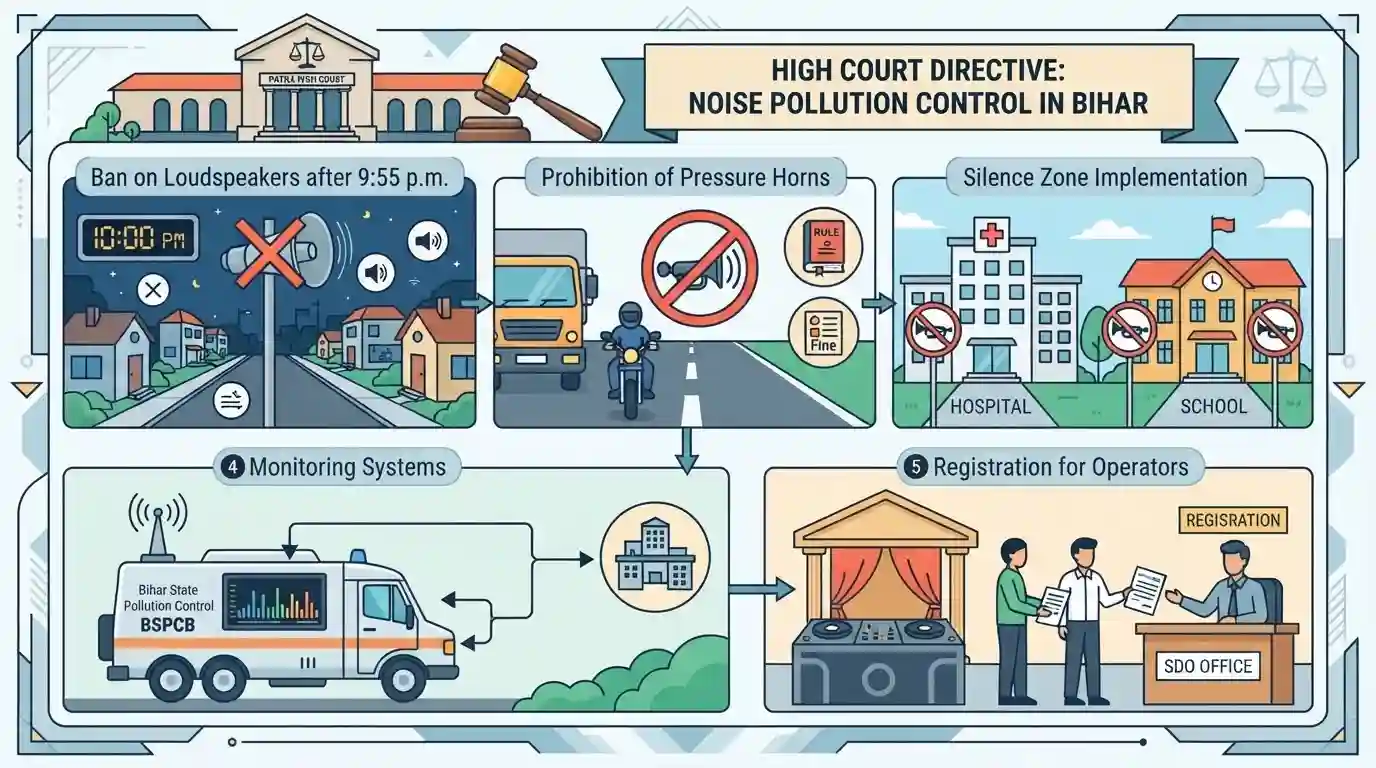
The Patna High Court, through a single-judge bench of Justice Rajiv Roy, has issued strict directives to curb noise pollution in Bihar. The court ordered complete compliance with the Noise Pollution (Regulation and Control) Rules, 2000, and the Motor Vehicles Act, 1988. Key measures include banning loudspeakers after 9:55 p.m., prohibiting pressure horns (punishable under Section 190(2) of the MV Act), mandatory installation of 'Silence Zone' boards near sensitive areas like hospitals and schools, and the establishment of sound monitoring systems by the Bihar State Pollution Control Board. Additionally, DJ operators and marriage hall owners must register with the local SDO.
Key Points
- The Patna High Court ordered strict enforcement of the Noise Pollution (Regulation and Control) Rules, 2000 across Bihar, including a complete ban on loudspeakers after 9:55 p.m.
- Police officials are directed to issue challans for the use of pressure horns under Section 190(2) of the Motor Vehicles Act, 1988.
- Cities in Bihar must be categorized into industrial, commercial, residential, and silence zones, with mandatory 'Silence Zone' signboards near hospitals and educational institutions.
- The Bihar State Pollution Control Board has been instructed to install sound monitoring systems to measure ambient noise levels.
- Registration has been made compulsory for DJ operators, marriage hall owners, and sound system operators with the local Sub-Divisional Officer (SDO).
Important Terms
Noise Pollution (Regulation and Control) Rules, 2000

Issued under the Environment (Protection) Act, 1986, these rules set ambient noise standards by zone. In Bihar, the Patna High Court mandated strict compliance, including a complete loudspeaker ban after 9:55 PM.
UPSC context
Tests BPSC GS Paper 2 (Polity/Environment) knowledge of statutory frameworks for environmental governance and the fundamental Right to Health.
Motor Vehicles Act, 1988
A central act governing road transport in India. The Patna High Court directed authorities to invoke Section 190(2) to strictly penalize vehicles using pressure horns for violating mandatory noise standards.
UPSC context
BPSC Prelims & Mains GS 2 (Governance); highlights statutory tools available to police and civil administration for controlling public nuisance.
Silence Zone
Legally demarcated areas within 100 meters of hospitals, educational institutions, and courts. Permissible limits are strict (50 dB day / 40 dB night), with complete bans on horns and loudspeakers.
UPSC context
Relevant for BPSC Prelims (environmental standards) and Mains GS 2 (public health policy implementation and civic administration).
Bihar State Pollution Control Board (BSPCB)
A state statutory body enforcing environmental regulations. The Patna High Court mandated the BSPCB to install sound-monitoring systems and digital display boards in public places to raise noise pollution awareness.
UPSC context
Crucial for Bihar-specific BPSC Prelims and GS Paper 2, testing the roles of state regulatory bodies in environmental management.
Environment (Protection) Act, 1986
An umbrella legislation empowering the government to protect environmental quality. It serves as the parent act for the Noise Pollution Rules, legally treating excessive noise as an actionable environmental pollutant.
UPSC context
Core topic for BPSC Prelims and GS Paper 2 (Environment); tests foundational knowledge of India's legal mechanisms for environmental protection.
Prelims Trap
The Noise Pollution (Regulation and Control) Rules, 2000 were formulated under the Air Act, 1981.
While noise was added as an air pollutant under the Air Act in 1987, the specific Noise Pollution Rules 2000 were promulgated under the Environment (Protection) Act, 1986.
Static Concepts Connected
What is the statutory framework governing Noise Pollution in India?
- Parent Act: The Noise Pollution (Regulation and Control) Rules, 2000 were enacted by the Centre under the Environment (Protection) Act, 1986.
- Air Act Link: Noise was officially recognized as an air pollutant via a 1987 amendment to the Air (Prevention and Control of Pollution) Act, 1981.
- Ambient Limits: Prescribes day/night decibel limits for Industrial (75/70 dB), Commercial (65/55), Residential (55/45), and Silence (50/40) zones.
What powers do Executive Magistrates have over local public nuisance?
- Magisterial Powers: Section 133 of the CrPC/BNSS empowers Sub-Divisional Magistrates (SDOs) to pass conditional orders for the removal of public nuisances, including excessive noise.
- Licensing Authority: SDOs act as the designated local authority for registering, licensing, and regulating event operators, DJs, and marriage halls to maintain public order.
Cross-Topic Patterns
Judicial Activism in Environment Enforcement
The Patna HC's intervention to mandate SDO registrations and MV Act challans highlights the judiciary continually filling executive enforcement gaps in local civic and environmental administration.
Public Nuisance & Local Administration
Connects environmental regulations (EPA 1986) directly with ground-level civic administration tools (CrPC public nuisance powers, SDO event licensing) and municipal zoning policies.

A multi-statement question testing the Noise Rules' parent Act (EPA 1986) vs the Air Act, along with zone-wise decibel limits, is likely.
