High Court Orders Removal of Deepfake Video under Privacy Rights
Source:The Hindu ↗
Why It Matters
This development is crucial for UPSC aspirants as it sits at the intersection of Polity (Fundamental Rights, Judiciary), Governance (Elections), and Technology (AI deepfakes, Intermediary Guidelines). It sets a legal precedent on addressing AI-generated misinformation while protecting the right to privacy and dignity, a recurring theme in recent GS2 and GS3 papers.
Summary
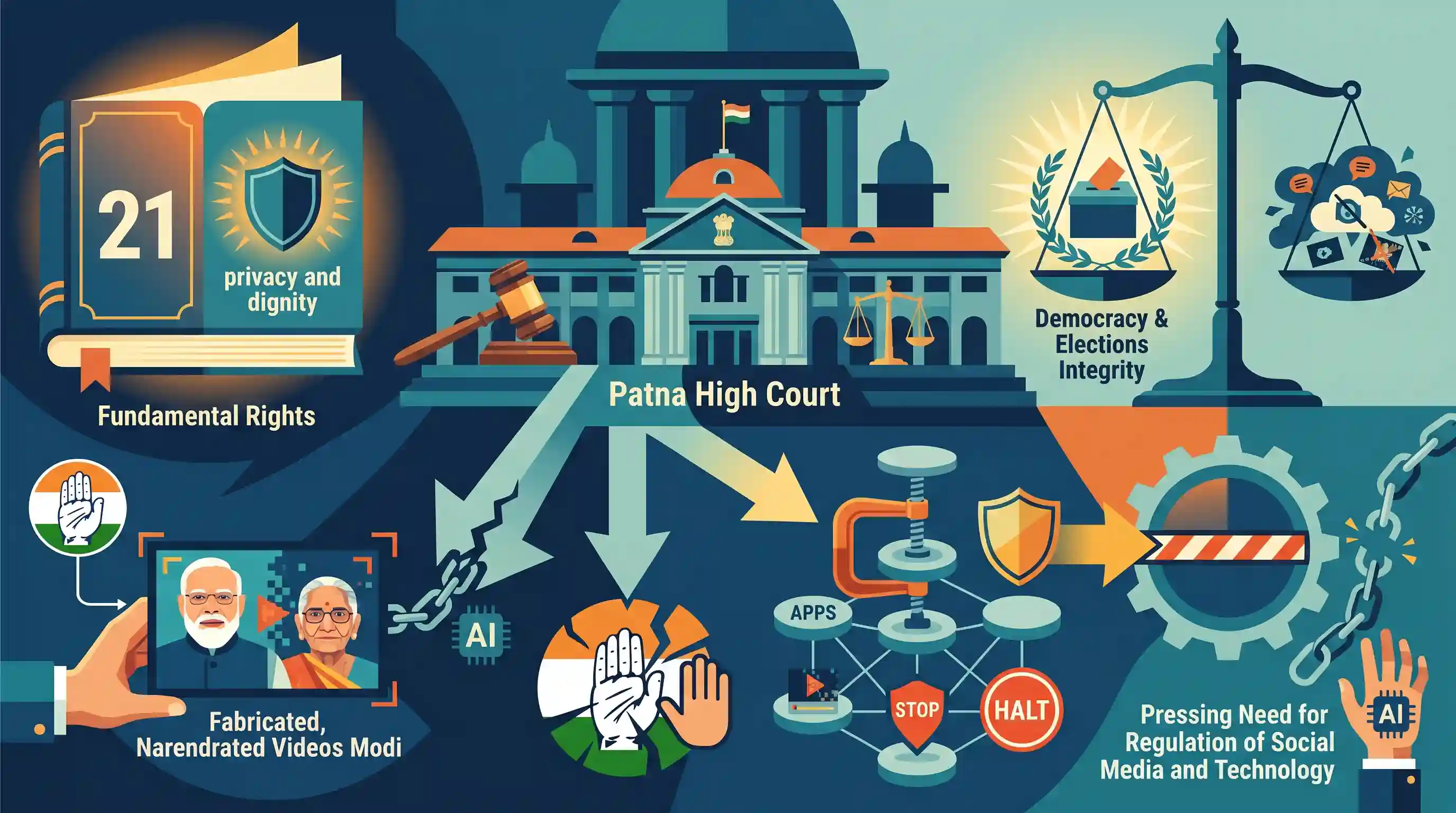
The Patna High Court has directed the Congress to remove an AI-generated video of PM Modi and his late mother from its social media accounts, citing a violation of the fundamental rights to privacy and dignity. The court also instructed social media intermediaries to halt the video's circulation, emphasizing adherence to Supreme Court guidelines. This judicial intervention underscores the growing threat of AI-driven misinformation and deepfakes in political campaigns, highlighting the pressing need to regulate technology and social media platforms to ensure ethical political discourse and election integrity.
Key Points
- The Patna High Court ordered the Congress party to remove an AI-generated deepfake video featuring PM Modi and his late mother from its social media platforms.
- The court ruled that the video infringes upon the fundamental rights to privacy and dignity, violating established Supreme Court guidelines.
- Social media intermediaries have been directed to curb the circulation of the video, highlighting their accountability in content regulation.
- The case raises critical concerns about the malicious use of artificial intelligence and deepfakes in electoral politics and the need for stringent regulatory mechanisms.
Important Terms
Fundamental Rights

Enshrined in Part III of the Indian Constitution, these are basic human rights guaranteed to all citizens. They are justiciable and serve as a check on state power.
UPSC context
GS Paper II: Polity. Focuses on Article 12-35, judicial review, and the balance between individual liberty and reasonable restrictions.
Right to Privacy
Declared a fundamental right under Article 21 in the KS Puttaswamy judgment (2017), it protects individual autonomy over personal data and digital likeness.
UPSC context
GS Paper II: Constitution. Tests landmark judgments and their impact on emerging technologies like AI and deepfakes.
Deepfakes
Synthetic media where AI is used to create realistic but fabricated images, audio, or video. In elections, they are used for disinformation and character assassination.
UPSC context
GS Paper III: Science & Technology/Security. Concerns cybercrime, misinformation, and the ethical use of Generative AI in democracy.
Social Media Intermediaries
Platforms like X or Facebook that facilitate online interaction. Under IT Rules 2021, they must follow "due diligence" to remove illegal or deceptive content once flagged.
UPSC context
GS Paper II: Governance/IT Rules. Focuses on the "Safe Harbour" doctrine and regulatory challenges in digital space.
Article 21
The constitutional guarantee that "no person shall be deprived of his life or personal liberty except according to procedure established by law."
UPSC context
GS Paper II: Fundamental Rights. Broadly interpreted by courts to include rights to dignity, clean environment, and privacy.
Representation of the People Act
The primary legislation (1950 and 1951 Acts) governing the conduct of elections, voter registration, and qualifications of representatives in India.
UPSC context
GS Paper II: Election Management. Essential for understanding corrupt practices and disqualification during political campaigns.
Judicial Intervention
The judiciary's active role in protecting constitutional rights or addressing governance gaps, often through Public Interest Litigations (PILs).
UPSC context
GS Paper II: Separation of Powers. Tests the limits of judicial activism vs. executive overreach in tech regulation.
Prelims Trap
"Social media platforms enjoy absolute 'safe harbour' immunity for third-party deepfakes."
Safe harbour (Sec 79, IT Act) is conditional. It vanishes if platforms fail to remove flagged content expeditiously after a court/govt directive.
Static Concepts Connected
What is 'Safe Harbour' under Section 79 of the IT Act?
- Conditional Immunity: Protects social media intermediaries from legal liability for third-party content posted on their platforms.
- Due Diligence: Platforms must observe specific IT Rules, including establishing grievance redressal mechanisms and publishing privacy policies.
- Takedown Obligation: Immunity is lost if platforms fail to remove unlawful content after receiving actual knowledge via a court or government order.
How does Article 21 protect citizens against deepfakes?
- Puttaswamy Judgment: Recognized the Right to Privacy as intrinsic to Article 21, explicitly covering informational privacy, data protection, and digital autonomy.
- Right to Dignity: Deepfakes that morph, misrepresent, or defame individuals violate the core fundamental right to live with human dignity.
Cross-Topic Patterns
ECI powers vs. Statutory IT Rules
While ECI invokes Article 324 for election integrity, enforcing deepfake takedowns technically relies on the IT Act, blending constitutional powers with statutory mechanisms.
Personality Rights via Article 21
Deepfakes merge intellectual property (personality rights of public figures) with fundamental rights (privacy/dignity), creating a novel constitutional jurisprudence area for Mains.

Expect a 2026 Prelims question testing the conditional nature of 'Safe Harbour' under the IT Act alongside Article 21's Right to Privacy.
Linked PYQs · 4
Linked PYQs · 4
- 2024MainsGS3
Social media and encrypting messaging services pose a serious security challenge. What measures have been adopted at various levels to address the security implications of social media? Also suggest any other remedies to address the problem.
- 2024PrelimsGS1
Under which of the following Articles of the Constitution of India, has the Supreme Court of India placed the Right to Privacy ?
- 2021PrelimsGS1
'Right to Privacy' is protected under which Article of the Constitution of India?
- 2023MainsGS3
Introduce the concept of Artificial Intelligence (AI). How does Al help clinical diagnosis? Do you perceive any threat to privacy of the individual in the use of Al in healthcare?
