Patna high court orders CBI probe into custodial disappearance case
Source:daily-pioneer ↗
Why It Matters
The incident serves as an important case study for BPSC aspirants regarding the enforcement of fundamental rights (Article 21, Habeas Corpus) and the writ jurisdiction of High Courts (Article 226) to ensure fair investigations by transferring cases to the CBI.
Summary
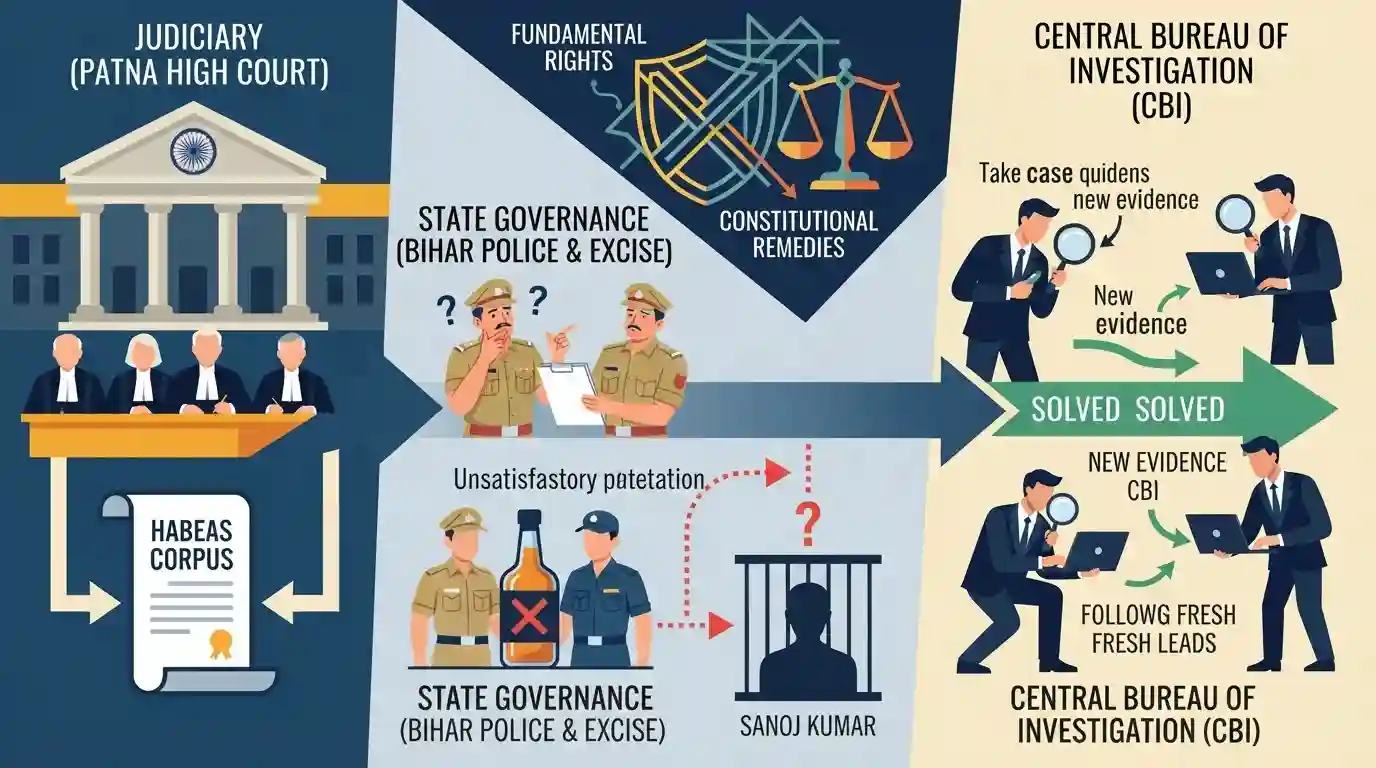
The Patna High Court has transferred the investigation of a missing person's case to the Central Bureau of Investigation (CBI), citing extreme dissatisfaction with the Bihar Police's probe. The case involves Sanoj Kumar, who disappeared after being detained by Excise Police in Bhojpur district for allegedly violating the state's liquor ban. Acting on a habeas corpus petition, a division bench noted the state police's failure to conduct a fair and impartial inquiry and protect the fundamental rights of the citizen against illegal detention.
Key Points
- The Patna High Court directed the CBI to investigate the disappearance of Sanoj Kumar, who went missing after being detained by Excise Police in Bhojpur district.
- The court issued the order on a habeas corpus petition filed by the victim's brother, expressing dissatisfaction with the state police's biased and incomplete investigation.
- The case highlights allegations of illegal detention and violation of fundamental rights by state authorities enforcing the Bihar Prohibition and Excise Act.
- The ruling underscores the power of constitutional courts (under Article 226/32) to transfer criminal investigations to central agencies like the CBI when state machinery is found compromised.
Important Terms
Central Bureau of Investigation (CBI)

India's premier investigative agency operating under the Ministry of Personnel. It handles high-profile corruption, economic offenses, and cases referred by constitutional courts where state police probes are deemed insufficient or biased.
UPSC context
GS-2 (Statutory Bodies). Tests the agency's mandate, federal tensions over general consent, and its role in ensuring impartial investigations.
Bihar Prohibition and Excise Act
A stringent 2016 state law enforcing a total ban on the manufacture, trade, transport, and consumption of liquor in Bihar. It aims to fulfill constitutional directives but faces criticism for severe enforcement challenges and clogging courts.
UPSC context
GS-2 (State Policies/DPSP). Tests issues related to Article 47 (public health), governance challenges, and the judicial burden of mass arrests.
Habeas Corpus
A fundamental legal writ meaning "to have the body." Issued under Articles 32 and 226, it directs authorities to present a detained person before the court to verify if their confinement violates the right to personal liberty.
UPSC context
GS-2 (Constitutional Remedies). Tests mechanisms for enforcing fundamental rights (Article 21), judicial review powers, and protections against illegal state detention.
Patna High Court
The highest judicial authority in Bihar. Under Article 226 of the Constitution, it possesses broad writ jurisdiction to protect citizens' fundamental rights, oversee lower courts, and direct independent probes into alleged state machinery failures.
UPSC context
GS-2 (Judiciary). Tests the constitutional role of High Courts, their writ jurisdictions compared to the Supreme Court, and judicial activism.
Prelims Trap
High Courts cannot order a CBI investigation without the prior consent of the respective State Government.
Both the Supreme Court (Article 32) and High Courts (Article 226) can constitutionally transfer investigations to the CBI without state consent, overriding the DSPE Act.
Static Concepts Connected
Against whom can the writ of Habeas Corpus be issued?
- Public authorities: It can be issued against state agencies (police, jail authorities) to produce a person detained arbitrarily or without legal justification.
- Private individuals: Unlike Mandamus or Certiorari, Habeas Corpus can also be issued against private individuals holding someone captive illegally.
- Exceptions: It is not issued if detention is lawful, for contempt of court/legislature, or if the person is outside the court's territorial jurisdiction.
How does the CBI acquire jurisdiction to investigate cases within a state?
- Statutory requirement: Under Section 6 of the DSPE Act, the CBI generally needs the state government's consent (general or specific) to investigate crimes within state borders.
- Judicial override: The Supreme Court and High Courts can bypass this statutory requirement and directly order a CBI probe to ensure a fair investigation.
- Union Territories: The CBI can suo motu take up investigation of offenses committed only in Union Territories or related to Central Government employees/departments.
Cross-Topic Patterns
Custodial rights & D.K. Basu guidelines
Cases of disappearances from custody invoke Article 21 and 22 safeguards. Expect linkages between habeas corpus petitions and the mandatory arrest safeguards dictated by the Supreme Court's D.K. Basu guidelines.
Liquor bans & judicial pendency
Strict state policies like the Bihar Prohibition Act often lead to mass incarcerations and alleged illegal detentions, clogging High Courts and triggering debates on the necessity of legislative impact assessments.

Questions on Habeas Corpus will likely merge Article 21, D.K. Basu arrest guidelines, and HC powers to bypass state consent for CBI probes.
Linked PYQs · 2
Linked PYQs · 2
- 2025BPSC_PRELIMSGS1
Which one of the following subjects fall within the jurisdiction of both High Court and Supreme Court?
- 2025BPSC_PRELIMSGS1
The constitution of India provides for reasonable restrictions on Fundamental Rights but reasonableness must keep in mind that: 1. The restrictions must be necessary for the protection of the rights of others. 2. The restrictions must be proportionate to the end sought. 3. The restrictions must be reasonable in the light of the circumstances. 4. The restrictions must be in the public interest.
