Patna High Court Orders CBI Probe in Custodial Disappearance Case
Source:hindustantimes ↗
Why It Matters
This article illustrates the practical application of writ jurisdiction (Habeas Corpus under Article 226) by High Courts to protect citizens' fundamental right to life and personal liberty. It is highly relevant for BPSC Prelims as it involves the jurisdiction of constitutional courts, the role of central agencies (CBI) in ensuring fair investigations, and the administrative consequences of state policies like the Bihar liquor prohibition.
Summary
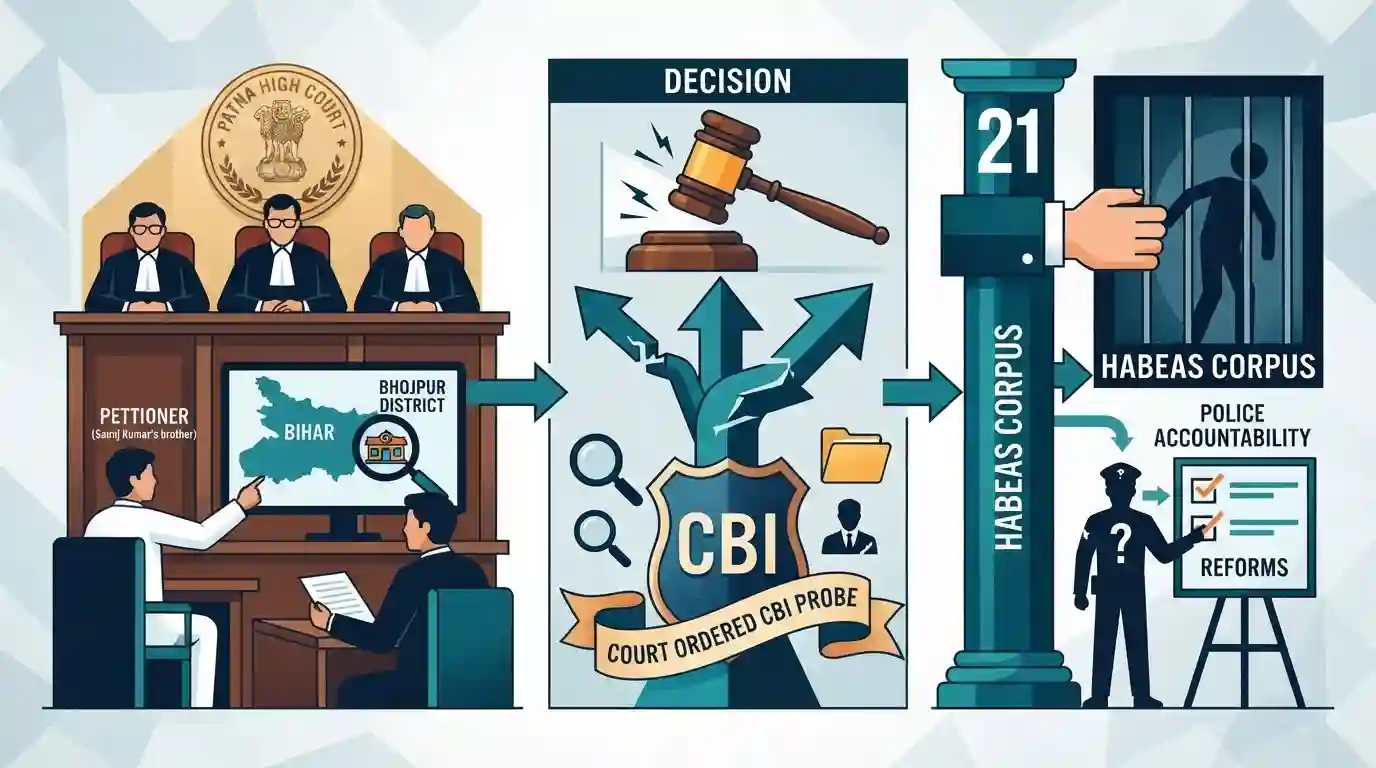
The Patna High Court has ordered the Central Bureau of Investigation (CBI) to probe the disappearance of a man, Sanoj Kumar, from police detention in Bihar's Bhojpur district. Kumar was allegedly detained by the excise police for consuming alcohol. While hearing a habeas corpus petition filed by his brother, the High Court concluded that the investigation conducted by the state police was biased and failed to yield the truth. The ruling emphasizes the judiciary's role in safeguarding fundamental rights (Article 21) and holding law enforcement accountable, especially in cases of suspected custodial atrocities and illegal detention under the Bihar Prohibition and Excise Act.
Key Points
- The Patna High Court directed the CBI to take over the investigation of a man who disappeared while in police custody in Bihar's Bhojpur district.
- The court was hearing a habeas corpus petition, which raised serious concerns about the protection of life and personal liberty (Article 21).
- The individual was initially detained by the excise police on suspicion of consuming alcohol under the state's strict prohibition laws.
- The High Court noted that the state police investigation was likely biased and sought an independent probe to uncover the truth and ensure police accountability.
Important Terms
Habeas Corpus

A prerogative writ that directs law enforcement officials to bring a detained person before the court to determine the legality of their detention.
UPSC context
Highly relevant for GS Paper 2 (Indian Polity); tests fundamental rights enforcement and constitutional remedies under Articles 32 and 226.
Article 21
A fundamental constitutional right guaranteeing that no person shall be deprived of their life or personal liberty except according to procedure established by law.
UPSC context
Crucial for GS Paper 2 (Polity); frequently tests judicial interpretations of the right to life, particularly against custodial violence and illegal detention.
Central Bureau of Investigation (CBI)
The premier federal investigating agency of India, operating under the DoPT, often ordered by constitutional courts to investigate compromised or sensitive state-level cases.
UPSC context
Core GS Paper 2 topic; tests federal dynamics, accountability, and the investigative jurisdictions of specialized law enforcement bodies.
Bihar Prohibition and Excise Act
A state legislation enforcing a total ban on the manufacture, trade, and consumption of liquor in Bihar, granting specialized detention powers to state authorities.
UPSC context
Relevant for GS Paper 2 (State Policies); tests the enforcement mechanisms, potential for police overreach, and socioeconomic impacts of prohibition laws.
Excise Police
A specialized law enforcement wing functioning under a state's excise department, specifically tasked with preventing illegal liquor consumption, trade, and contraband smuggling.
UPSC context
Maps to GS Papers 2 and 3; highlights parallel law enforcement structures, custodial accountability, and the prevention of administrative overreach.
Prelims Trap
"A High Court cannot order a CBI investigation into a state police matter without the explicit consent of the State Government."
The Supreme Court and High Courts have extraordinary constitutional powers to order a CBI probe directly, overriding the DSPE Act's requirement for prior state consent.
Static Concepts Connected
How does the CBI derive its jurisdiction across Indian states?
- DSPE Act 1946: The CBI is not a statutory body; it derives its investigative powers from the Delhi Special Police Establishment (DSPE) Act, 1946.
- State Consent: Section 6 of the DSPE Act requires the consent of the respective State Government (either general or specific) for the CBI to investigate within its territory.
- Judicial Override: Constitutional courts (Supreme Court and High Courts) can direct the CBI to investigate a cognizable offence anywhere in India, completely bypassing the need for state consent.
What are the core limitations of the Writ of Habeas Corpus?
- Lawful Detention: It cannot be issued if the detention is lawful, such as a legal remand or execution of a valid court sentence.
- Contempt rulings: The writ is not applicable if the detention is for contempt of a legislature or a competent court.
- Territorial limits: The writ will generally not be granted if the person or authority detaining the individual falls entirely outside the territorial jurisdiction of the issuing court.
Cross-Topic Patterns
DPSP implementation vs. Judicial Pendency
Bihar's strict liquor ban (Article 47) demonstrates how rigid statutory enforcement of Directive Principles can inadvertently flood High Courts with bail and Habeas Corpus petitions.
Custodial Violence & Police Reforms
Police detention disappearances repeatedly underscore the lack of independent oversight bodies (Prakash Singh directives) and India's pending ratification of the UN Convention Against Torture.

Expect a 2026 prelims statement testing whether High Courts can bypass state consent for CBI probes in Habeas Corpus matters.
Linked PYQs · 1
Linked PYQs · 1
- 2025BPSC_PRELIMSGS1
Which one of the following subjects fall within the jurisdiction of both High Court and Supreme Court?
