Patna College legacy and higher education in colonial Bihar
Source:patna-press ↗
Why It Matters
Patna College is a critical focal point for BPSC Prelims in the context of Bihar's modern history. Questions directly targeting its establishment year (1863), the history of Western education, the Dutch colonial presence in Patna, and its notable alumni (like Shri Krishna Singh) have repeatedly appeared in past examinations.
Summary
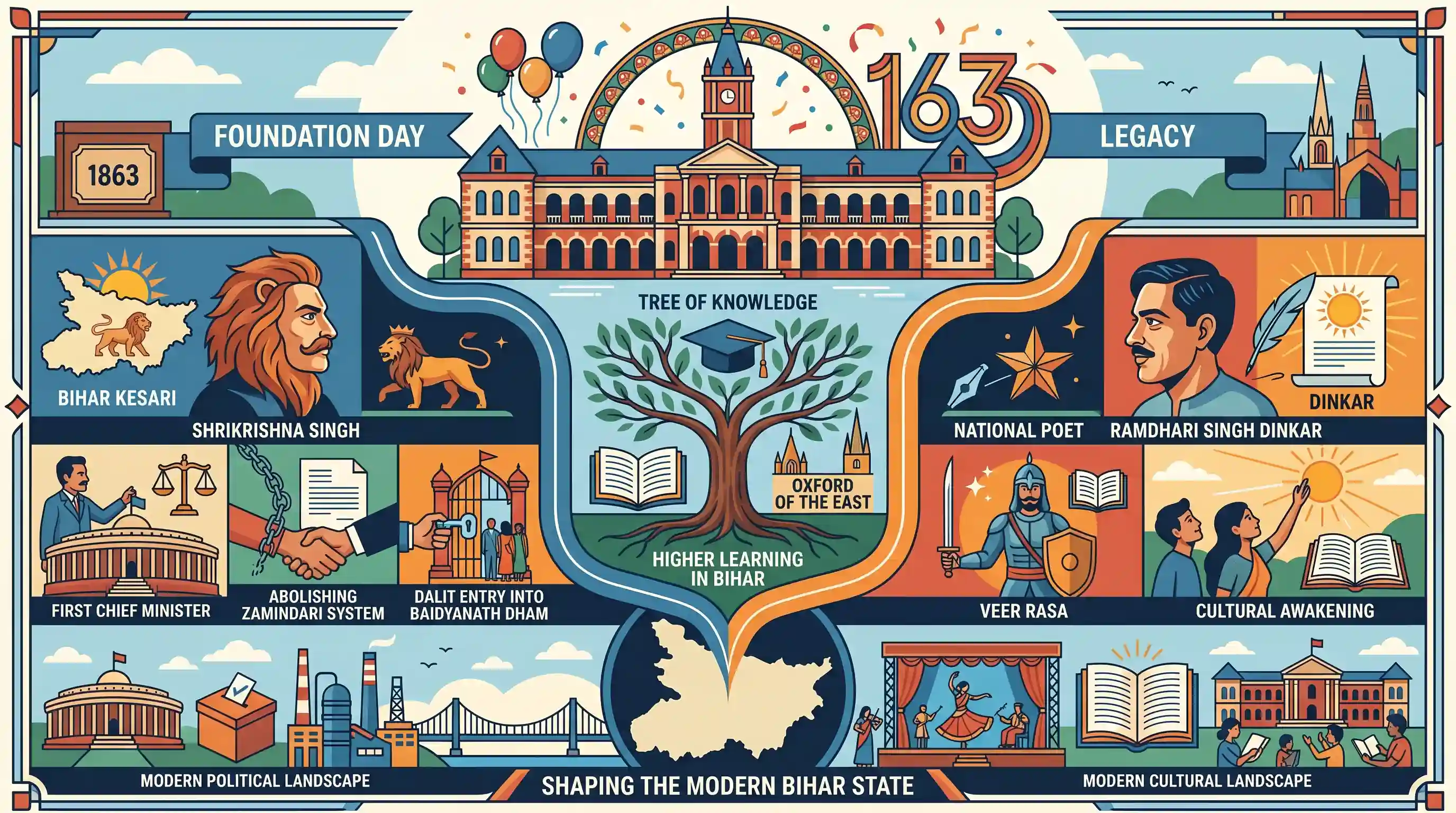
Patna College marked its 163rd Foundation Day, highlighting its legacy as the oldest institution for higher learning in Bihar. Known as the 'Oxford of the East', the college was established in 1863 and features prominent Dutch architecture. The event celebrated its rich history of producing eminent personalities, including Bihar's first Chief Minister Shrikrishna Singh and poet Ramdhari Singh Dinkar, who shaped the state's modern political and cultural landscape.
Key Points
- Patna College, historically referred to as the 'Oxford of the East', celebrated its 163rd Foundation Day.
- Established in 1863, the institution predates Patna University and remains a cornerstone of Western education in Bihar.
- The main building exhibits distinctive Dutch architectural features, serving as a reminder of European colonial settlements in Patna.
- Its illustrious alumni include Bihar's first Chief Minister Shrikrishna Singh, Dr. Anugrah Narayan Singh, and national poet Ramdhari Singh Dinkar.
Important Terms
Patna College

Established in 1863, it is Bihar's oldest institution of higher learning. Once termed the 'Oxford of the East,' its campus features historic Dutch colonial architecture and has produced many of the state's pioneering political and cultural leaders.
UPSC context
GS Paper I (Modern Indian History, Education under British Rule) and Bihar-specific state service examinations.
Patna University
Founded in 1917, it is Bihar's first university and the seventh oldest in the Indian subcontinent. It served as a major center for intellectual and political activity during the Indian independence movement.
UPSC context
GS Paper I (Modern History) and regional developments in Western education.
Shrikrishna Singh
The first Chief Minister of Bihar (1946–1961), known as 'Bihar Kesari'. He was a prominent freedom fighter and the first leader in India to legally abolish the Zamindari system.
UPSC context
GS Paper I (Modern History/Personalities) and Post-Independence consolidation and reorganization within the country.
Ramdhari Singh Dinkar
A legendary nationalist Hindi poet known as 'Rashtrakavi'. His heroic poetry (Veer Rasa) and works like 'Sanskriti ke Chaar Adhyaye' were instrumental in shaping India's national consciousness and cultural identity.
UPSC context
GS Paper I (Modern History, Cultural contributions) and useful for Ethics and Essay papers.
Dutch Architecture in Bihar
A rare colonial style in Bihar, best exemplified by Patna College's 17th-century administrative block (formerly a Dutch opium factory). It signifies Patna's history as a global riverine trade hub for European companies.
UPSC context
GS Paper I (Indian Heritage and Culture, Art Forms, Literature and Architecture from ancient to modern times).
Prelims Trap
"Patna College was established by the Dutch in 1632 to promote Western education in Eastern India."
Aspirants often assume the Dutch built the college. While the building was a Dutch factory built in 1632, the British established the actual educational institution in 1863.
Static Concepts Connected
When and why did the Dutch establish settlements in Patna?
- Trade Interests: Established primarily to procure saltpetre (crucial for gunpowder manufacturing), opium, and cotton textiles from the region.
- Establishment Timeline: The Dutch East India Company established their factory in Patna in 1632, whose main building now houses Patna College.
- Eventual Decline: Dutch influence collapsed after their defeat by the British at the Battle of Bedara (1759) in Bengal.
How did Wood's Despatch (1854) influence higher education in India?
- Magna Carta: Termed the 'Magna Carta' of English education in India, it laid the comprehensive foundation for the modern educational system.
- University Setup: It led to the immediate establishment of universities in Calcutta, Bombay, and Madras in 1857 based on the London University model.
- Provincial Expansion: It mandated the creation of Public Instruction departments in provinces, paving the way for regional colleges like Patna College (1863).
Cross-Topic Patterns
Adaptive Reuse of Colonial Architecture
Tracing how European trade factories were repurposed into administrative and educational hubs under later British rule (e.g., Dutch factory to Patna College) is a recurring sub-theme in colonial cultural history.
Vernacular Literature and Nationalism
Ramdhari Singh Dinkar's 'Veer Rasa' poetry highlights how vernacular literature fueled the Indian freedom struggle, linking cultural expression directly to political mass movements.

Expect a chronological arrangement question in Prelims 2026 mixing Dutch/English factory establishments with key educational milestones.
Linked PYQs · 4
Linked PYQs · 4
- 2024-IBPSC_PRELIMSGS1
When was the Patna College established?
- 2025BPSC_PRELIMSGS1
Who became Chief Minister of Bihar in March 1939?
- 2018BPSC_PRELIMSGS1
Who among the following was the leader of the first Congress Ministry in Bihar?
- 2020BPSC_PRELIMSGS1
Which company established its factory in 1632 at Patna, Bihar?
