Bihar to receive central tax share in fiscal year
Source:jagran ↗
Why It Matters
Important for understanding Bihar's state budget, central tax devolution, and resource mobilization under Finance Commission recommendations.
Summary
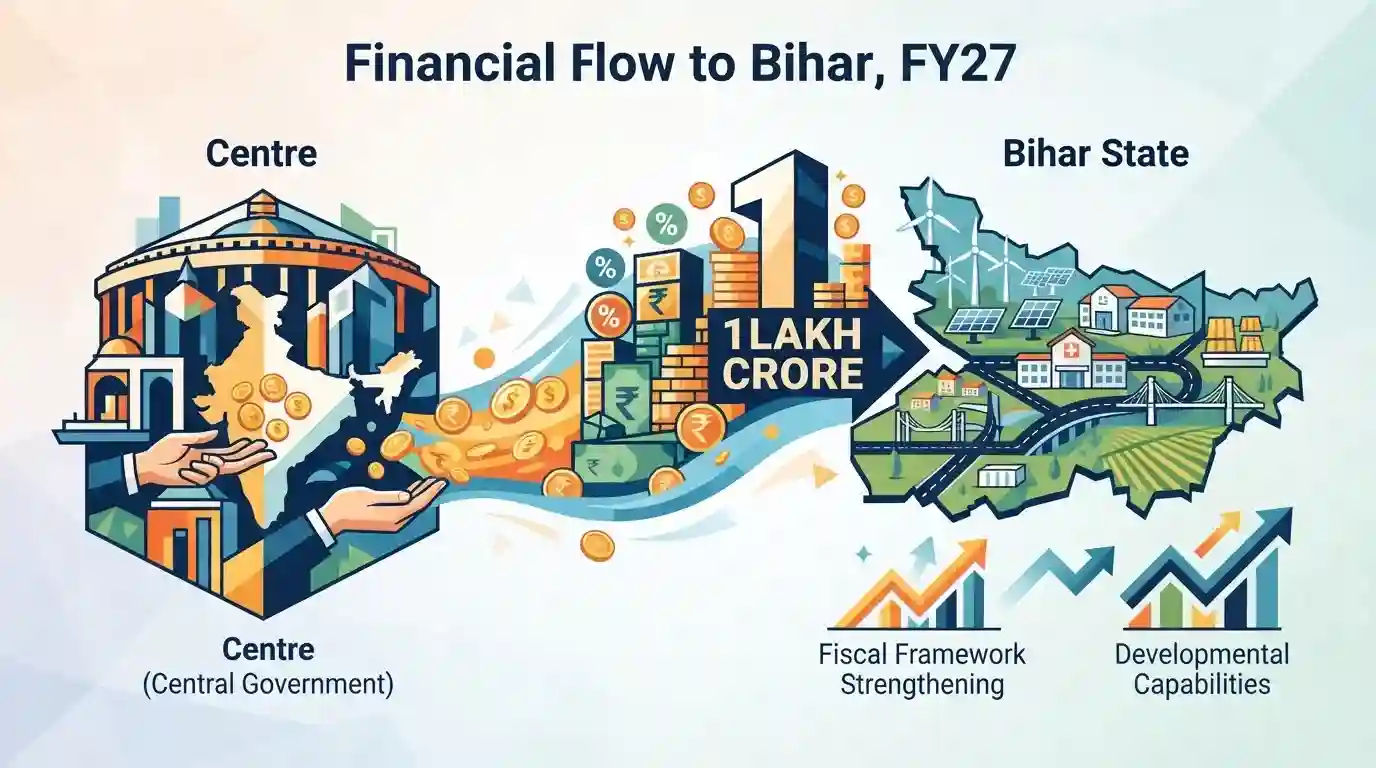
The article highlights that Bihar is set to receive approximately Rs 1 lakh crore as its share of central taxes in the financial year 2027 (FY27), strengthening the state's fiscal framework and developmental capabilities.
Key Points
- Bihar is projected to receive around Rs 1 lakh crore as its share from central taxes in the financial year 2027 (FY27).
- This devolution of central taxes is a major component of Bihar's financial resources, aiding state budgetary planning and development infrastructure.
- Such fiscal allocations underline the importance of the Finance Commission's recommendations regarding the vertical and horizontal tax devolution for states like Bihar.
Important Terms
Central Tax Devolution

The distribution of a portion of central tax collections from the divisible pool to state governments, determined by the Finance Commission's horizontal and vertical devolution formulas.
UPSC context
Important for BPSC Economics/Polity (Centre-State financial relations, fiscal federalism, and Bihar's fiscal resources).
Finance Commission
A constitutional body established under Article 280 of the Indian Constitution to recommend the vertical and horizontal distribution of tax revenues between the Centre and states.
UPSC context
Essential for BPSC Prelims and Mains (Indian Polity, Constitutional bodies, and federal fiscal governance).
Central Government
The federal tier of administration in India responsible for nation-wide macroeconomic policies, levying national taxes, and distributing divisible tax pools to state governments.
UPSC context
Tested in BPSC General Studies regarding federal structure, governance, and central budgetary allocations to Bihar.
Prelims Trap
Central tax share is a discretionary grant given by the Union government to Bihar
Central tax devolution is a statutory constitutional right under Article 270 (divisible pool), not discretionary grants or loans provided by the Union.
Static Concepts Connected
What are the constitutional provisions governing Centre-State financial relations and tax devolution in India?
- Article 270: Article 270 provides for taxes levied and collected by the Union and distributed between the Union and the States.
- Article 280: Article 280 establishes the Finance Commission every five years to recommend the vertical and horizontal distribution of taxes.
- Articles 266 & 275: The Consolidated Fund of India (Article 266) and grants-in-aid (Article 275) form the backbone of fiscal transfers.
Cross-Topic Patterns
Finance Commission Devolution & State Budgets
Bihar's heavy reliance on central tax devolution links state budgetary planning with the macro-fiscal recommendations of successive Finance Commissions under Article 280.

Expect statement-based questions on Finance Commission criteria weights (income distance, population, forest cover) affecting Bihar.
Linked PYQs · 1
Linked PYQs · 1
- 2022BPSC_PRELIMSGS1
According to the 15th Finance Commission's recommendations, how much share will Bihar receive in divisible pool of Central taxes from 2021-26?
