Patanjali research on Chyawanprash published in international journal
Source:pioneeredge ↗
Why It Matters
This development is significant for questions on the integration of traditional Indian medicine systems (AYUSH) with modern scientific research, validating indigenous knowledge on global platforms, and understanding cellular biology concepts related to aging and stress.
Summary
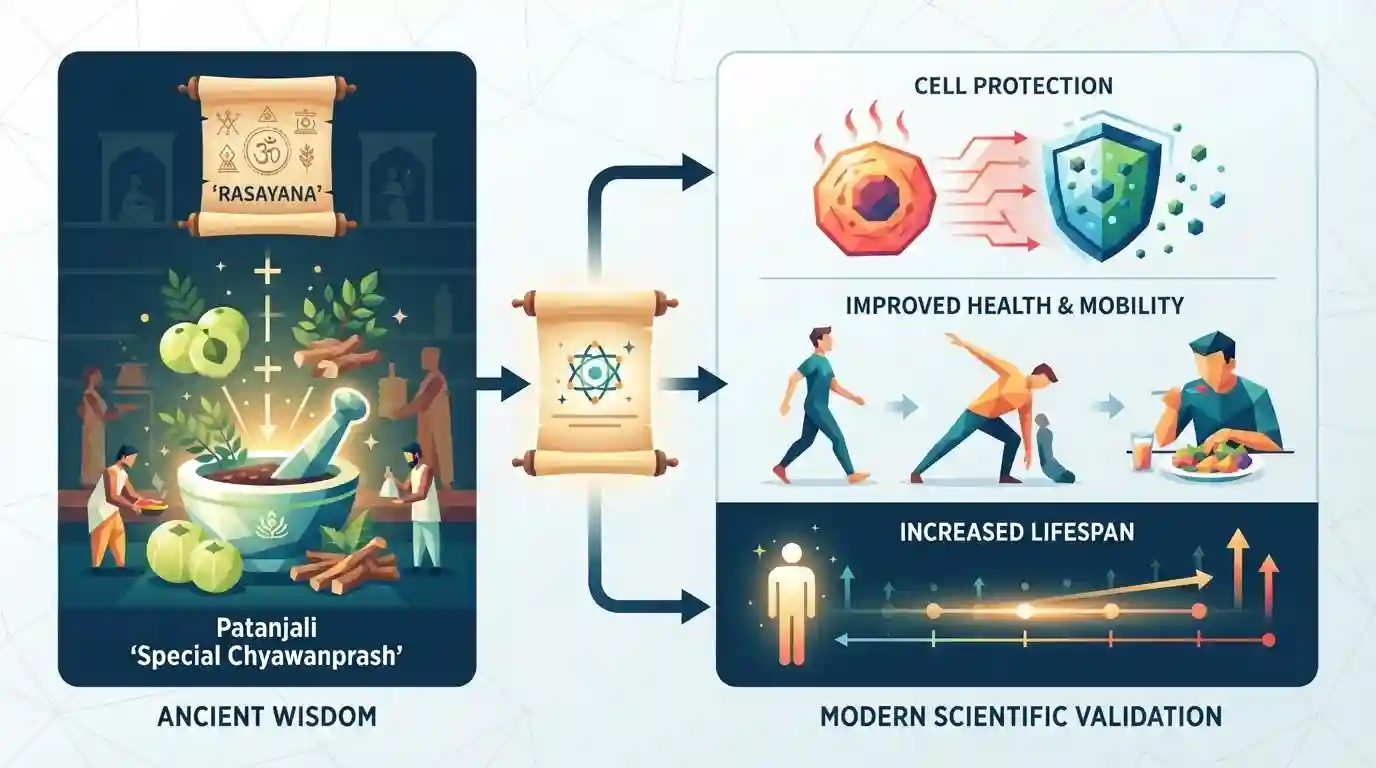
Research conducted by Patanjali on its 'Special Chyawanprash' has been published in the peer-reviewed international journal 'Experimental Gerontology'. The study demonstrates the formulation's ability to protect cells from heat-stress-induced damage, improve feeding behavior and muscle mobility, and increase lifespan. Described in classical Ayurvedic texts as a 'Rasayana' (rejuvenation therapy), this scientific validation supports efforts to establish Ayurveda as an evidence-based medicine system on a global platform.
Key Points
- Patanjali's research on 'Special Chyawanprash' has been published in the international journal 'Experimental Gerontology'.
- The study scientifically validates the traditional Ayurvedic claim of Chyawanprash being a 'Rasayana' or rejuvenation formulation.
- The research demonstrated that Special Chyawanprash helps reduce heat-stress-induced cellular damage, preserves muscle function, and enhances longevity.
- This marks a significant step towards establishing Ayurveda as an evidence-based medical system recognized globally.
Important Terms
Patanjali

An Indian consumer goods and research enterprise known for scientifically investigating and validating traditional Ayurvedic formulations like Chyawanprash using modern methodologies.
UPSC context
Relevant for GS-3 (Science & Tech) regarding the commercialization and modern scientific validation of traditional Indian knowledge systems.
Chyawanprash
An ancient Ayurvedic dietary supplement and superfood made from various herbs, traditionally valued for its antioxidant, immunity-boosting, and anti-aging properties.
UPSC context
Important for GS-2 (Health) topics covering AYUSH interventions, public nutrition, and the global promotion of indigenous healthcare products.
Experimental Gerontology
A peer-reviewed international scientific journal that publishes research specifically focused on the biological mechanisms of aging, longevity, and age-related diseases.
UPSC context
Useful for GS-3 (Biotechnology/Health), highlighting platforms where Indian scientific research and traditional medicine validation gain global peer-reviewed recognition.
Rasayana
One of the eight branches of Ayurveda focusing on rejuvenation therapy. It uses specific herbs, diets, and practices to nourish tissues, prevent aging, and prolong life.
UPSC context
Critical for GS-1 (Indian Heritage/Culture) and GS-2 (Health). Tests understanding of classical Ayurvedic systems and holistic healthcare philosophies.
Evidence-based medicine
A clinical decision-making approach that integrates the best available, rigorously tested scientific research with clinical expertise to evaluate and optimize patient treatments.
UPSC context
Key for GS-2 (Health Policy) and GS-3 (Science), especially concerning the need to rigorously validate alternative therapies like Ayurveda.
Prelims Trap
In Ashtanga Ayurveda, 'Rasayana' refers exclusively to the pharmaceutical preparation of heavy metals and mercury formulations.
Aspirants often confuse Rasayana (rejuvenation/geriatrics) with Rasashastra (the specialized branch of Ayurveda dealing with metals, minerals, and iatrochemistry).
Static Concepts Connected
What are the key branches of Ashtanga Ayurveda relevant to modern healthcare?
- Rasayana Tantra: Focuses on rejuvenation, longevity, cellular health, and geriatric care to prevent premature aging.
- Kayachikitsa: Deals with internal medicine, diagnostics, and systemic therapies for holistic bodily healing.
- Shalya Tantra: Covers ancient surgical techniques, instrumentation, and the removal of foreign objects.
What is the WHO Global Centre for Traditional Medicine (WHO-GCTM)?
- Establishment: Located in Jamnagar, Gujarat, India, marking the first global outposted centre for traditional medicine.
- Primary Mandate: Aims to build a solid evidence base for traditional medicine, standardizing clinical trials and data collection.
- Inter-sectoral Linkage: Collaborates closely with the Ministry of AYUSH to integrate traditional practices with modern science.
Cross-Topic Patterns
AYUSH validation + IPR defense
Scientific validation of traditional formulations directly supports India's Traditional Knowledge Digital Library (TKDL) in preventing bio-piracy and unauthorized international patenting.
Geriatric care + Pluralistic health
Integrating evidence-based Rasayana therapies into the National Programme for Health Care of the Elderly (NPHCE) bridges traditional medicine with public healthcare systems.

AYUSH research initiatives like SMART and WHO-GCTM standardisation frameworks are highly likely targets for GS-3 health sector questions.
Linked PYQs · 1
Linked PYQs · 1
- 2025UKPSC_PRELIMSGS1
Transformation of normal cells into cancerous neoplastic cells may be induced by physical, chemical or biological agents are called :
