Passkeys and Cyber Security Evolution in Digital Authentication
Source:The Hindu ↗
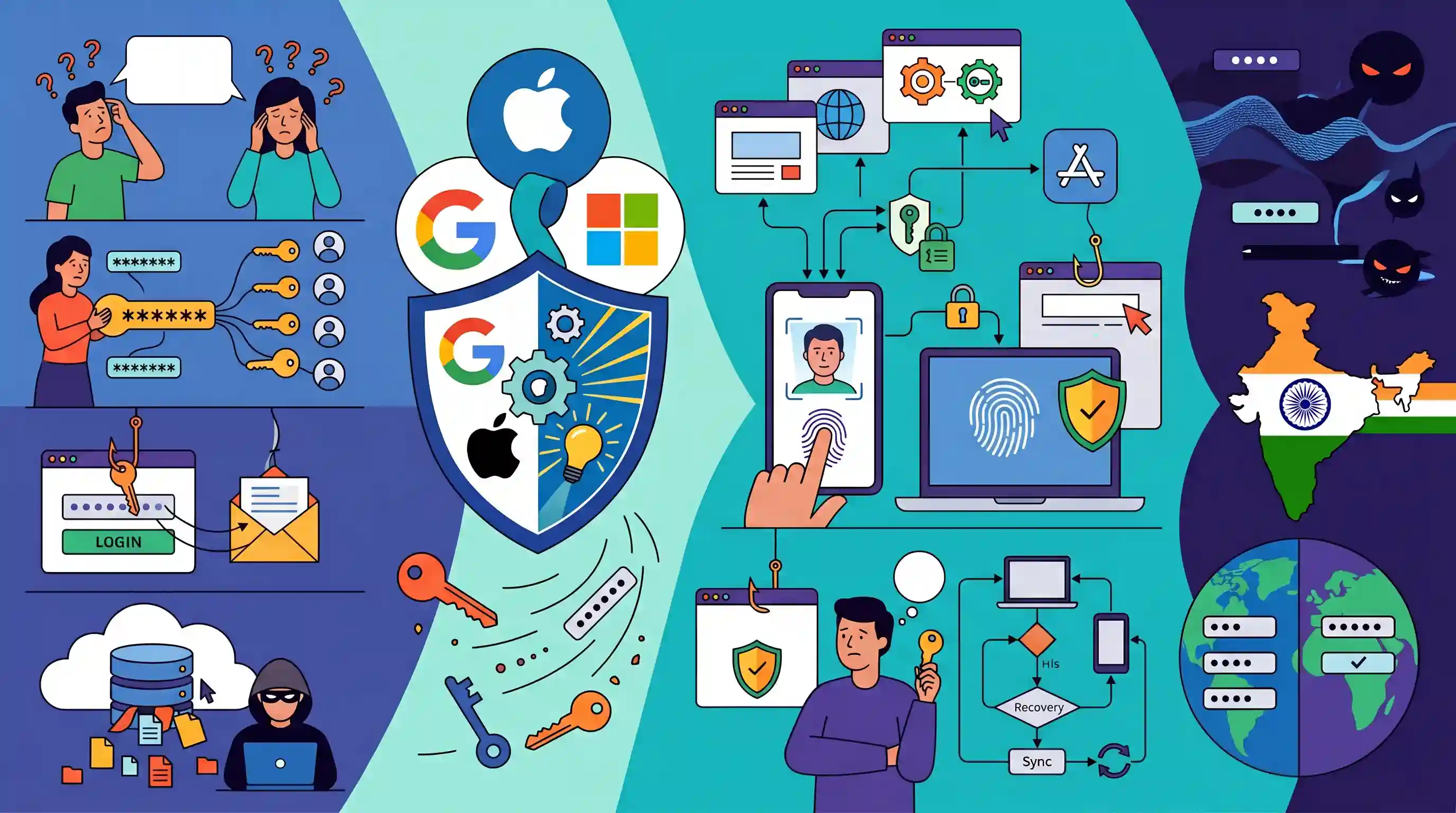
Why It Matters
Understanding the evolution of digital authentication (from passwords to passkeys and Public Key Infrastructure) is crucial for the Cyber Security component of GS Paper 3. It highlights the mechanisms of cyber vulnerabilities like phishing and data breaches, and the technological interventions designed to secure digital infrastructure and user privacy.
Summary
The article discusses the cybersecurity industry's strategic shift from traditional passwords to 'passkeys', a movement spearheaded by the Fast Identity Online Alliance (FIDO) which includes major tech corporations. Passwords have become a significant security liability due to widespread reuse and vulnerability to phishing and massive data breaches. Passkeys aim to solve this by binding user authentication to a physical device using biometric verification or PIN codes, effectively neutralizing phishing threats. However, the transition faces challenges such as user habituation, the complexity of device recovery, and the continued reliance on passwords across many platforms. This development is highly relevant to India's digital security infrastructure and the ongoing battle against cyber threats.
Key Points
- Tech giants are driving a transition away from traditional passwords to passwordless authentication methods, citing vulnerabilities to phishing, data leaks, and brute-force hacking.
- The Fast Identity Online Alliance (FIDO), comprising companies like Apple, Google, Microsoft, and Amazon, is popularizing 'passkeys' that rely on device-based cryptographic authorization.
- Passkeys authenticate users via biometric inputs (fingerprints, facial recognition) or device PINs, making it impossible for users to accidentally surrender credentials to phishing sites.
- Despite their security benefits, passkeys face adoption hurdles due to user unfamiliarity, complex recovery processes for lost devices, and the enduring ubiquity of legacy password systems.
Important Terms
Fast Identity Online Alliance (FIDO)

An open industry association founded in 2013 to develop and promote authentication standards that reduce global reliance on passwords through secure, interoperable methods like passkeys.
UPSC context
GS Paper 3: IT and Cyber Security. Tests knowledge of international standards for digital infrastructure and authentication.
A tech giant and FIDO board member that led the massive rollout of passkeys across Android and Chrome to mitigate phishing risks.
UPSC context
GS Paper 3: Information Technology. Tests understanding of the role of Big Tech in digital security standards.
Apple
A key FIDO member that pioneered biometric-backed "Passkeys" within its ecosystem (FaceID/TouchID), ensuring secure, device-bound cryptographic authentication.
UPSC context
GS Paper 3: Awareness in IT. Relevant to discussions on user privacy and secure hardware-software integration.
Microsoft
A leader in the "passwordless" movement through its Windows Hello and FIDO2 integration, targeting a shift from credentials to device-based security.
UPSC context
GS Paper 3: Cyber Security. Tests knowledge of enterprise-level security and operating system vulnerabilities.
OpenAI
An AI research organization whose models are increasingly analyzed for their dual-use potential in both creating (offensive) and patching (defensive) cybersecurity vulnerabilities.
UPSC context
GS Paper 3: Emerging Technologies. Tests impact of Artificial Intelligence on internal security and cyber warfare.
Eset
A global cybersecurity research firm that provides critical data on India’s threat landscape, including smartphone vulnerabilities and data breach statistics.
UPSC context
GS Paper 3: Internal Security. Useful for citing data on cybercrime trends and India's digital vulnerability.
Prelims Trap
Passkeys authenticate users by transmitting their biometric data to centralized web servers.
Biometrics only unlock a local private key. The device then uses this key to sign a cryptographic challenge; biometric data is never transmitted over the internet.
Static Concepts Connected
What is Public Key Infrastructure (PKI)?
- Two-key system: A cryptographic system that uses a mathematically linked two-key pair: a public key (shared openly) and a private key (kept secret by the owner).
- Authentication & Security: It forms the underlying technology for digital certificates, secure internet banking, passkeys, and encrypted communications (HTTPS).
- Digital Signatures: PKI allows users to authenticate digital records, forming the legal basis for electronic signatures under India's Information Technology Act, 2000.
What is the difference between Phishing and Credential Stuffing?
- Phishing: A social engineering attack where bad actors trick users into manually revealing sensitive data (like passwords) on fake, impersonated websites.
- Credential Stuffing: An automated cyberattack where stolen account credentials from one data breach are tested massively to gain unauthorized access to other unrelated platforms.
Cross-Topic Patterns
Passkeys & DPDP Act 2023
By keeping biometric data strictly on-device, passkeys inherently comply with the stringent data minimization and consent requirements for sensitive personal data under India's Digital Personal Data Protection (DPDP) Act.
Industry-Govt Cyber Alliances
The FIDO Alliance acting as a knowledge partner for MeitY's 'Cyber Surakshit Bharat' highlights a growing UPSC theme: open-standard private-public collaborations driving national cyber resilience.

FIDO Alliance and passkeys will likely appear in a multi-statement tech question alongside PKI and biometric data privacy in 2026.
Linked PYQs · 4
Linked PYQs · 4
- 2020MainsGS3
Discuss different types of cyber crimes and measures required to be taken to fight the menace.
- 2017MainsGS3
Discuss the potential threats of Cyber attack and the security framework to prevent it.
- 2018PrelimsGS1
The terms 'WannaCry, Petya and EternalBlue' sometimes mentioned in the news recently are related to
- 2020PrelimsGS1
In India, the term "Public Key Infrastructure" is used in the context of
