Passports Act and legal status of citizenship proof
Source:The Hindu ↗
Why It Matters
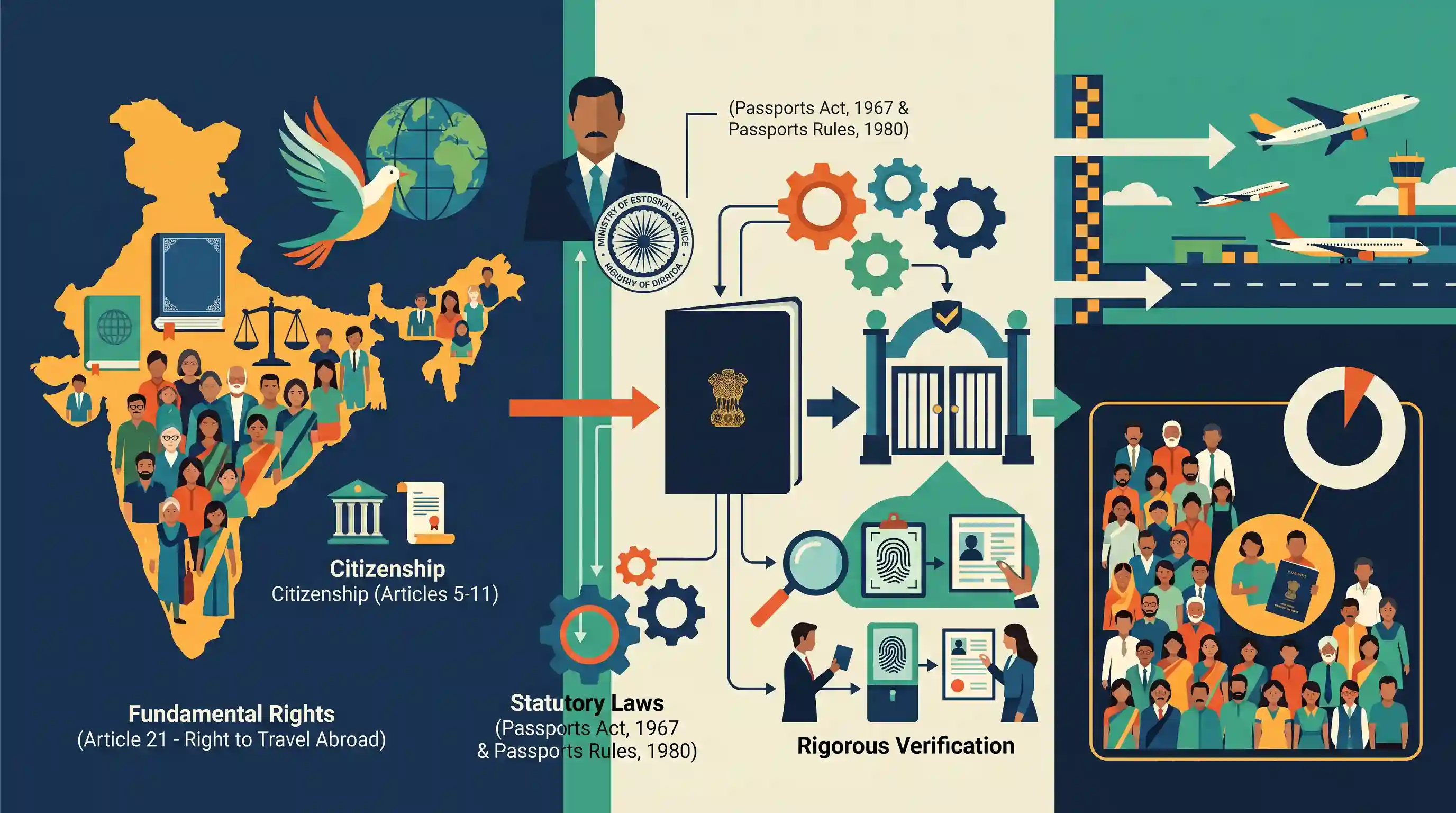
The distinction between a travel document and a primary document proving citizenship is a critical legal and constitutional question. This issue connects closely with Fundamental Rights (Article 21 and the right to go abroad as established in the Maneka Gandhi case) and the statutory machinery regulating citizenship and national documentation in India.
Summary
The Ministry of External Affairs (MEA) clarified that an Indian passport is legally a regulatory document meant to 'regulate the departure from India of citizens of India' under the Passports Act, 1967. This response addresses public debates over whether a passport represents absolute proof of citizenship, which started after a senior official referred to it as a travel document rather than a citizenship document. The MEA emphasized that passport issuance involves rigorous verification governed by the Passports Act, 1967 and Passports Rules, 1980, and noted that less than 8% of Indian citizens currently hold a passport.
Key Points
- Definition and Purpose: As per the MEA, the primary legal function of an Indian passport under the Passports Act, 1967, is to regulate the departure of Indian citizens from India.
- Debate on Citizenship Proof: The clarification follows public debate and discussion triggered by a government official referring to the passport as a 'travel document' rather than a 'citizenship document'.
- Statutory Framework: Passport issuance is governed strictly by the Passports Act, 1967 and Passports Rules, 1980, requiring administrative and police verification.
- Low Passport Penetration: Only less than 8% of the Indian population currently holds an Indian passport, making it an impractical universal document for establishing national identity or citizenship.
- Judicial & Fundamental Rights Link: While passports are issued only to citizens, the Right to Travel Abroad is recognized as a fundamental right under Article 21 (Maneka Gandhi case, 1978), which the Passports Act seeks to regulate within reasonable procedures.
Important Terms
Passports Act, 1967

An Act of Parliament that governs the issuance of passports and travel documents to Indian citizens, regulates their departure from India, and defines the procedures, grounds for refusal, and impounding of passports.
UPSC context
GS Paper II (Polity & Governance). Tests understanding of statutory frameworks regulating fundamental rights, administrative powers, and international travel.
Citizenship Act, 1955
The principal legislation governing the acquisition, determination, and termination of Indian citizenship after the commencement of the Constitution on January 26, 1950, through modes like birth, descent, registration, and naturalization.
UPSC context
GS Paper II (Polity). Tests constitutional and statutory provisions on citizenship, its acquisition, loss, and recent legislative amendments.
Constitution of India
The supreme law of India, establishing the country's political framework, fundamental rights, directive principles, and duties of citizens, while allocating powers across executive, legislative, and judicial organs.
UPSC context
GS Paper II (Polity). Formulates the foundational core of civil services exams, testing constitutional principles, fundamental rights, and governance structures.
Ministry of External Affairs
The government ministry responsible for conducting foreign relations, managing passport services through the Central Passport Organization, and administering consular affairs and international travel regulations.
UPSC context
GS Paper II (International Relations). Tests foreign policy, consular governance, international treaties, and executive administration of travel regulations.
Supreme Court of India
The highest judicial court in India, acting as the ultimate interpreter of the Constitution and guardian of fundamental rights, with landmark rulings expanding individual liberties.
UPSC context
GS Paper II (Judiciary). Tests judicial review, constitutional interpretation, landmark judgments, and the protection of fundamental rights.
Prelims Trap
An Indian passport is conclusive legal proof of citizenship and can only be issued to citizens of India.
Under Section 20 of the Passports Act, 1967, passports can be issued to non-citizens in the public interest, and courts do not treat it as definitive citizenship proof.
Static Concepts Connected
What are the key judicial milestones defining the Right to Travel Abroad?
- Satwant Singh (1967): Ruled that the right to travel abroad is an integral part of personal liberty under Article 21.
- Maneka Gandhi (1978): Established that executive actions restricting foreign travel must pass the "just, fair, and reasonable" procedural standard.
- Golden Triangle: Linked Articles 14, 19, and 21, making them mutually inclusive rather than separate watertight compartments.
Is an Indian passport conclusive legal proof of citizenship?
- Statutory scope: Under the Passports Act, 1967, it is primarily a travel document regulating departure, not a declaration of citizenship.
- Section 20 exception: The Central Government can issue passports to non-citizens under special public interest exceptions.
- Burden of proof: The onus of proving citizenship under the Citizenship Act, 1955, remains entirely on the individual asserting it.
Cross-Topic Patterns
Fundamental Rights vs Passport Impoundment
Explores the tension between Article 21's right to travel and the state's power to impound passports for national security or pending criminal proceedings.
Constitutional Citizenship vs Identity Documents
Compares legal limitations of functional state IDs (Aadhaar, Passport) with constitutional citizenship criteria under Articles 5-11 and the Citizenship Act, 1955.

Prelims may test Section 20 of Passports Act (issuance to non-citizens) alongside Article 21 evolution via Maneka Gandhi case.
Linked PYQs · 2
Linked PYQs · 2
- 2021PrelimsGS1
With reference to India, consider the following statements : 1. There is only one citizenship and one domicile. 2. A citizen by birth only can become the Head of State. 3. A foreigner once granted the citizenship cannot be deprived of it under any circumstances. Which of the statements given above is/are correct?
- 2019PrelimsGS1
Which Article of the Constitution of India safeguards one's right to marry the person of one's choice?
